The rapid expansion of the built environment in the United Arab Emirates (UAE) has made highly efficient, intelligent thermal management a core focus of modern urban design. Across residential, commercial, and industrial developments, building mechanical systems specifically HVAC infrastructure account for up to half of total municipal energy consumption. This high energy footprint highlights the critical need for advanced HVAC optimization to support regional sustainability goals, such as the UAE Net Zero 2050 and the Dubai Clean Energy Strategy 2050.
At the same time, the Gulf region’s extreme ambient conditions characterized by high temperatures and coastal humidity require cooling systems that can deliver reliable performance without consuming excessive power. In this context, the integration of artificial intelligence and advanced inverter control represents a significant technological shift, offering proactive climate management that meets both performance and conservation goals.
For developers, engineers, and property managers seeking compliant thermal solutions via specialized platforms like air-con.ae, evaluating the gree ai cooling system uae is essential to transition projects from legacy power-intensive systems to green, automated operations.
Thermodynamic Realities of T3 Environments and Inverter Engineering
To evaluate climate control performance in the UAE, systems must be certified against T3 environmental conditions, as defined by ISO 5151:2017 standards. Under these baselines, HVAC systems must operate continuously and efficiently at an outdoor dry-bulb temperature of 46°C and a wet-bulb temperature of 24°C, with structural tolerances designed to withstand peak ambient temperatures of up to 52°C. Under these conditions, legacy fixed-speed compressors experience significant performance losses, high starting current spikes, and frequent thermal overload cycles.
                       +-----------------------------------+
                       |   Ambient Air Temperature (T3)    |
                       |  (Exceeds 46°C DB / 24°C WB)      |
                       +-----------------------------------+
                                         |
                                         v
  +------------------------+   +-------------------+   +------------------------+
  | Legacy Fixed-Speed AC  |   |  Inverter AC      |   |  Gree iAiry32/Clivia   |
  | (Cyclic start/stop,    |   | (Modulated scroll |   | (Predictive G-AI loop, |
  |  high starting spike)  |   |  frequency drive) |   |  dynamic load-match)   |
  +------------------------+   +-------------------+   +------------------------+
              |                          |                          |
              v                          v                          v
  +------------------------+   +-------------------+   +------------------------+
  | 30-50% higher energy   |   | Balanced thermal  |   | Optimal comfort curve, |
  | use; rapid component   |   | load; consistent  |   | certified 10% annual   |
  | thermal degradation    |   | power draws       |   | auxiliary savings      |
  +------------------------+   +-------------------+   +------------------------+
To address these challenges, the gree smart ac dubai replaces traditional single-speed compressors with variable-speed rotary compressor drives managed by the G10 inverter module. By modulating cooling output rather than cycling on and off, the gree ai inverter ac dubai reduces energy consumption by 30% to 50% compared to conventional fixed-speed systems operating in the same climate. This performance is supported by the transition to R32 refrigerant, which has a 68% lower Global Warming Potential (GWP) and higher heat transfer capacity than traditional R410A refrigerant.
For residential and light commercial projects, the gree smart air conditioner sharjah must manage high sensible heat loads as well as significant latent heat loads caused by coastal humidity. Systems like the Gree Clivia series use advanced variable-displacement compressors to balance temperature and humidity levels. This localized climate adjustment is supported by durable physical components, including outdoor coils treated with Gold Fin anti-corrosion coatings. Gold Fin coatings provide up to twenty times the corrosion resistance of standard blue fin coatings under salt spray testing, protecting system components from saline air in coastal areas.
Engineering Specifications of Clivia R32 Inverter Split-Type Systems
For coastal properties, selecting the gree inverter ac sharjah allows the variable displacement compressor to modulate output in response to real-time environmental factors. This continuous balance of temperature and relative humidity helps prevent common indoor issues like short-cycling and excess moisture, ensuring reliable comfort in challenging coastal conditions.
Algorithmic Optimization and Deep Q-Learning
To maximize energy efficiency, modern HVAC systems are shifting from simple reactive controls to predictive, artificial intelligence-driven platforms. This is demonstrated by the gree smart inverter ac sharjah, which uses the G-AI algorithm to replace standard proportional-integral-derivative (PID) control loops with proactive climate strategies.
This control system combines Deep Q-Learning with Expert System Theory. While traditional systems only respond to a set temperature target, the gree smart cooling technology uae continuously adapts to changes in occupancy, indoor heat loads, and ambient weather.
The G-AI system operates via a continuous feedforward and feedback loop that runs on a high-speed G-AI Digital Signal Processing (DSP) computer chip. Working alongside the G10 inverter module, this chip enables the system to learn the thermal characteristics of individual rooms, such as insulation performance, solar heat gain, and peak occupancy patterns.
Instead of waiting for a room to overheat, the system calculates the cooling capacity demand ahead of time and adjusts the compressor frequency with high flexibility. This continuous tuning allows the system to deliver a certified 10% reduction in annual energy consumption compared to standard non-AI inverter units, as verified by independent Intertek testing.
IoT Connectivity and Smart Ecosystem Integration
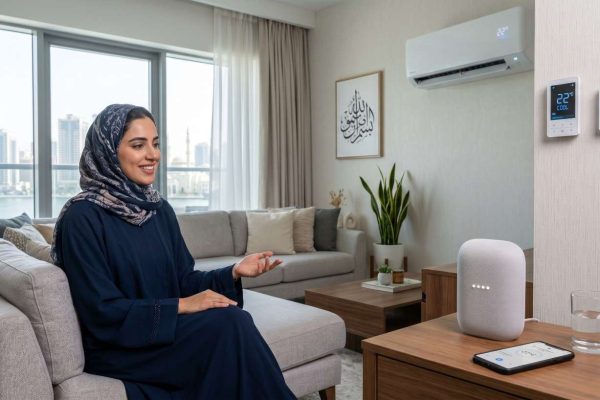
The gree wifi ac dubai integrates directly into modern smart home networks, supporting unified home automation. Using dual-band Wi-Fi and Bluetooth-assisted pairing, the system connects directly to the GREE+ application, which serves as a central platform for IoT management.
+-----------------------------------------------------------------+
|                        GREE+ IoT Cloud                          |
| (Handles geofencing, custom scheduling, and firmware updates)   |
+-----------------------------------------------------------------+
                                |
       +------------------------+------------------------+
       |                                                 |
       v                                                 v
+-------------------------------+               +-------------------------------+
|     Google Home Ecosystem     |               |    Amazon Alexa Integration   |
| (Executes vocal commands and  |               | (Controls thermal scheduling  |
|  coordinated scenes)          |               |  and automated scenes)        |
+-------------------------------+               +-------------------------------+
                                |
                                v
+-----------------------------------------------------------------+
|                    Gree Smart Home AC UAE                       |
|   (Adjusts settings based on occupancy and ambient weather)     |
+-----------------------------------------------------------------+
The GREE+ IoT application provides a range of smart control features :
- Automated Logic Scenes: Users can set up automated routines, such as “When device status changes, send email notification” or “Delay action for 2 hours”.
- Central Energy Monitoring: Provides real-time and historical energy usage data, helping building managers monitor power consumption patterns.
- Central Scheduling: Enables precise scheduling with target temperatures adjustable down to 0.1°C increments using the iChoose LED interface.
- Dynamic Geofencing: Automatically adjusts system settings based on the physical location of the user’s smartphone, pre-cooling spaces as residents return home or shutting down when the property is empty.
For refined temperature control, the gree smart thermostat ac sharjah uses the “I-Feel” feature integrated into the handheld remote control. While standard air conditioners measure return air temperatures at the wall-mounted indoor unit, the “I-Feel” system reads temperature data directly from the remote control.
The remote transmits this temperature data to the main indoor controller every few minutes, shifting the thermal feedback loop to the occupant’s actual location. This prevents temperature stratification and short-cycling, helping the gree energy saving ac dubai maintain a stable indoor climate while reducing unnecessary power draw.
These connected features allow the gree smart home ac uae to coordinate with other smart home systems, keeping indoor temperatures at the government-recommended 24°C for an optimal balance of comfort and energy efficiency.
Indoor Air Quality and Advanced Sterilization
In the UAE, sandstorms and high coastal humidity present ongoing challenges for indoor air quality (IAQ) and system cleanliness. Dust buildup on internal components can degrade heat transfer, while condensation on the evaporator coil can lead to microbial growth. The gree ai air conditioner dubai addresses these issues with a multi-stage air purification and sterilization system.
                     +-----------------------------------+
                     |      Raw Recirculated Air         |
                     +-----------------------------------+
                                       |
                                       v
                     +-----------------------------------+
                     |      High-Density Filtration      |
                     |  (Captures larger dust particles) |
                     +-----------------------------------+
                                       |
                                       v
                     +-----------------------------------+
                     |       Cold Plasma Generator       |
                     |  (Decomposes organic pollutants)  |
                     +-----------------------------------+
                                       |
                                       v
                     +-----------------------------------+
                     |     UVC Germicidal Irradiation    |
                     |  (Neutralizes viruses/bacteria)   |
                     +-----------------------------------+
                                       |
                                       v
                     +-----------------------------------+
                     |     Purified, Dehumidified Air    |
                     +-----------------------------------+
The system uses an active ionizer called Cold Plasma Plus, which releases hydrogen and oxygen ions into the air stream. These ions attach to airborne particles, bacteria, and odor molecules, breaking down their cellular structures to neutralize them. This is supported by continuous UVC sterilization, which uses ultraviolet-C lamps to irradiate the indoor evaporator coil and incoming air. This constant exposure destroys the DNA and RNA of viruses and bacteria, maintaining a clean system interior.
Additionally, the gree intelligent cooling system sharjah features a continuous dehumidification and clothes-drying cycle. This function maintains indoor relative humidity between 40% and 60%—the optimal range for human health and comfort which helps prevent mold growth in humid coastal areas. When the system is turned off, its AutoClean function continues to run the indoor fan to dry any remaining condensation on the evaporator, then heats the indoor coil to 55°C, sterilizing internal components.
Commercial Automation and Smart HVAC Systems
Large commercial buildings, hotels, and multi-residential complexes in the UAE require centralized climate control that can adapt to changing building loads. The gree ac automation dubai system meets this need by integrating Variable Refrigerant Flow (VRF) technology with centralized building management platforms.
                  +---------------------------------------+
                  |  Taishan Building Digitalization      |
                  | (Centralized enterprise coordination) |
                  +---------------------------------------+
                                      |
                                      v
                  +---------------------------------------+
                  |   G-IEMS Intelligent Energy Manager   |
                  |  (Dynamic load-balancing/monitoring)  |
                  +---------------------------------------+
                                      |
                                      v
                  +---------------------------------------+
                  |     GMV9 / GMV9 FLEX Outdoor Units    |
                  | (Modular side-discharge scroll system)|
                  +---------------------------------------+
The GMV9 and GMV9 FLEX modular units are designed specifically to handle high cooling loads in Middle Eastern climates. The side-discharge GMV9 FLEX features a compact envelope, with an ultra-thin 460 mm profile that occupies only 0.58\text{ m}^2 of floor space. This compact design is ideal for high-density balcony installations in modern high-rises. The system can scale up to an 88HP modular capacity, allowing a single outdoor unit array to manage up to 100 indoor evaporators.
The gree smart hvac system uae is built to operate reliably in extreme ambient temperatures up to 55°C. This performance is enabled by the G-Boost single-stage Enhanced Vapor Injection (EVI) compressor. Under peak cooling conditions, EVI technology injects medium-pressure refrigerant vapor directly into the compressor dome:
                                +-----------------------------+
                                |  Main Evaporator Air Stream |
                                +-----------------------------+
                                               |
                                               v
+-----------------------------+ T3 Conditions +-----------------------------+
|    Primary Suction Port     |-------------->|  G-Boost Single-Stage Scroll |
| (Draws vaporized cooling gas)               |  (Refrigerant mass pressure) |
+-----------------------------+                +-----------------------------+
                                                       ^
                                                       |
                                        +-----------------------------+
                                        |  Vapor Injection Port (EVI) |
                                        | (Injects cooled vapor gas)  |
                                        +-----------------------------+
This vapor injection process lowers the compressor discharge temperature, preventing thermal degradation of the lubricant oil and keeping the compressor within safe operating limits during extreme heat up to 68°C. Even at a low-frequency speed under T3 conditions, systems with G-Boost compressors can deliver an outlet air temperature of 8°C, providing the rapid cooling performance needed to handle intense solar heat loads.
Solar-Powered Air Conditioning
Integrating solar power with HVAC systems is a key strategy for reducing commercial building carbon emissions in the UAE. Traditional solar installations convert DC power from solar panels to AC power via an inverter, step it up or down, and then convert it back to DC inside the variable-speed compressor drive. This multi-stage conversion process can result in energy losses of 6% to 8%.
The gree solar powered ac dubai solves this problem by connecting the solar array’s direct-current (DC) output directly to the compressor’s internal DC bus. This design eliminates the traditional inverter stage, increasing the system’s solar utilization rate to 99%.
+-----------------------------+                 +-----------------------------+
| Photovoltaic Array (Solar)  |                 | Public Utility Grid (AC)    |
| (Direct-current power gen)  |                 | (Alternative external draw) |
+-----------------------------+                 +-----------------------------+
               |                                               |
               +-----------------------+-----------------------+
                                       |
                                       v
                        +-----------------------------+
                        | Ternary Commutation Module  |
                        | (Bilateral DC-to-DC routing)|
                        +-----------------------------+
                                       |
                                       v
                        +-----------------------------+
                        |   Variable Inverter Scroll  |
                        | (Powers motor compressor)   |
                        +-----------------------------+
The system uses a ternary commutation module that balances power distribution across five modes, switching between sources in under 10 milliseconds to prevent voltage drops. This fast switching allows the system to prioritize solar power, drawing supplemental electricity from the public grid only when solar output is insufficient.
Five Working Modes of Gree Solar VRF Systems:
- Solar VRF Mode: Operated as a direct DC-to-DC VRF system powered entirely by solar PV arrays.
- Solar VRF & Power Generation Mode: Runs on DC-to-DC solar power, with any surplus solar electricity converted to AC and fed back to the public utility grid.
- Solar Power Only Mode: When indoor space conditioning is turned off, 100% of the solar generation is converted to AC and exported to the grid.
- Solar VRF & Grid Consumption Mode: Active during cloudy periods; the system operates on solar DC but draws supplemental AC power from the grid to maintain cooling capacity.
- No Solar VRF Mode: Active during completely overcast or nighttime conditions; the system operates as a standard high-efficiency AC drawing 100% of its power from the grid.
These units connect to the Gree Intelligent Energy Management System (G-IEMS). This platform monitors real-time solar generation, building consumption, and local utility rates. It can also connect to external electrical energy storage units (like GreePower) to save power for nighttime use.
Technical Maintenance, Diagnostics, and Repair
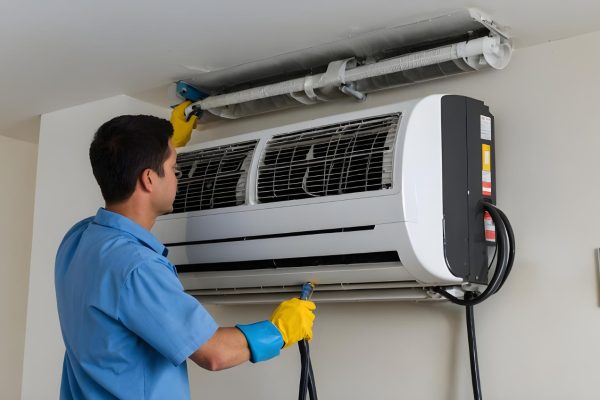
Continuous operation in the hot, dusty environment of the UAE can degrade HVAC performance if systems are not properly maintained. Dust accumulation on condenser coils and minor refrigerant leaks can reduce system efficiency by 20% to 30%, increasing energy bills and risking compressor failure. Implementing a professional program of gree ac maintenance dubai is essential to protect equipment investments and ensure long-term cooling performance.
To maintain optimal system performance, technical diagnostic procedures should follow a structured sequence :
- Inspection and Cleaning: Evaporator and condenser coils are treated with specialized cleaning solutions and washed to remove packed dust. Technicians clear drain lines and check ductwork for leaks.
- Calibration: Sensor readings are checked against actual room conditions to ensure accurate control inputs. Electrical terminals are tightened, and contactors are checked for wear.
- Refrigerant Pressure Diagnostics: Operating pressures are measured to confirm correct refrigerant charge, and connections are checked for minor leaks.
- Testing and Verification: The system is run through its full operating range to confirm proper inverter modulation and verify overall cooling performance.
In Sharjah, where coastal humidity can accelerate electrical wear, specialized gree ac repair sharjah services focus on correcting electrical issues, repairing PCB controller boards, and fixing minor refrigerant leaks.
Technical Troubleshooting Matrix and Standard Cost Profiles
This table outlines common HVAC failure modes, technical causes, and estimated repair costs in the region.
| Identified System Fault | Operational Symptom | Primary Root Cause | Remediation Procedure | Cost Range (AED) |
| Capacitor Failure | Compressor fails to start; outdoor unit hums. | Thermal stress from high ambient heat. | Replace with heavy-duty OEM run capacitor. | 150 – 250 |
| Fan Motor Burnout | Weak indoor airflow; high-pressure trips. | High dust resistance; bearing wear. | Replace condenser or evaporator fan motor. | 300 -550 |
| PCB Control Failure | Unresponsive unit; communication faults. | Voltage fluctuations in the grid. | Repair or replace main microprocessor PCB. | 350 – 650 |
| Refrigerant Leakage | Poor cooling; ice buildup on evaporator. | Joint stress or corrosion on copper tubes. | Pressure test with Nitrogen, seal leak, recharge R32. | 400- 900 |
| Compressor Failure | No cooling; active system short-circuits. | Acidic oil contamination; severe overload. | Flush system, replace compressor, pull deep vacuum. | 800 -1,400 |
Specifying certified gree cooling solutions dubai ensures that installations are matched with appropriate maintenance programs, which helps preserve the long-term energy savings of inverter systems. This is especially important for the gree smart inverter ac sharjah, where maintaining proper lubrication and coil cleanliness is essential to support the unit’s variable cooling cycles.
Regulatory Compliance and Environmental Alignment
The UAE has established strict regulatory frameworks to drive energy efficiency in the building sector and reduce national carbon emissions. The federal strategy is guided by the UAE Energy Strategy 2050, which targets a 50% clean energy contribution by 2050 while reducing overall building energy consumption by 40%.
In Dubai, the Green Building Regulations and Specifications mandate strict efficiency baselines for all new developments, requiring a minimum “Al Sa’fat” Silver rating. The Al Sa’fat rating system assesses buildings across key performance areas, from envelope thermal performance to mechanical system efficiency standards :
                  +-----------------------------------+
                  |      Al Sa'fat Silver Rating      |
                  +-----------------------------------+
                                    |
     +------------------------------+------------------------------+
     |                              |                              |
     v                              v                              v
+------------------------+     +------------------------+     +------------------------+
|   Energy Efficiency    |     |  Resource Conservation |     | Indoor Air Quality     |
| (Low U-value envelopes,|     |  (Low-flow plumbing,   |     | (Proper ventilation,   |
|  high-COP HVAC tech)   |     |  greywater reuse)      |     |  UVC air filtration)   |
+------------------------+     +------------------------+     +------------------------+
To support these goals, the Ministry of Climate Change and Environment (MOCCAE) enforces mandatory emissions reporting and energy disclosures. Under Federal Decree-Law No. 11 of 2024, large commercial facilities with an annual energy consumption exceeding $50,000\text{ MWh}$ must submit detailed carbon footprints and energy efficiency improvement plans. Non-compliance can result in significant financial penalties, ranging from AED 50,000 to AED 2,000,000, underscoring the importance of energy-efficient building operations.
At the equipment level, compliance is managed by the Ministry of Industry and Advanced Technology (MoIAT/ESMA). ESMA enforces minimum energy performance standards (MEPS) for all ductless split and window-type air conditioners sold in the country.
UAE ESMA Star Rating Brackets for Non-Ducted Split AC Systems
Under the updated UAE.S 5010-1:2019 standard, air conditioners are labeled with an Energy Guide sticker showing their efficiency class. The star rating is determined by the system’s measured Energy Efficiency Ratio (EER) at T3 testing conditions.
These strict standards make the selection of high-efficiency equipment essential. Installing advanced options like the gree smart inverter ac sharjah or other certified gree cooling solutions dubai helps properties meet municipal building codes, reduce energy footprints, and lower monthly utility expenses.
Actionable Industry Synthesis and Recommendations
The transition toward intelligent climate management in the UAE is shaped by strict building energy codes, high cooling demands, and advanced digital control systems. To help building operators, consulting engineers, and real estate developers implement efficient cooling solutions, this report outlines several technical recommendations based on current HVAC trends.
Direct-DC Solar Multi-VRF Integration
For new commercial properties and premium residential villa projects, developers should prioritize direct-DC solar-assisted variable refrigerant flow systems over traditional split AC units. Connecting solar PV arrays directly to the internal DC bus of the compressor drive eliminates the conversion losses associated with traditional solar setups.
This direct integration supports zero-energy building goals and matches daytime solar generation with peak cooling loads. The system’s ternary commutation module allows for seamless switching between solar and grid power in under 10 milliseconds, ensuring stable operation under changing weather conditions.
Algorithmic Machine Learning over Fixed Controls
When selecting air conditioning equipment, specify models that feature adaptive control algorithms, such as those combining Deep Q-Learning and Expert System Theory. By continuously analyzing variables like outdoor ambient temperatures, occupant schedules, and thermal load patterns, these systems optimize operation in real time. This smart modulation reduces the high starting currents and cyclic wear of standard systems, delivering up to 10% lower annual energy consumption compared to standard inverter units.
Dual-Loop Comfort Sensing
To prevent uneven cooling and temperature stratification, implement remote sensing systems like the “I-Feel” feature. Shifting the system’s primary feedback sensor from the wall-mounted chassis to the occupant’s location ensures more accurate temperature control and avoids the energy waste of overcooling.
                     +---------------------------------------+
                     |        Outdoor Ambient Sensors        |
                     | (Provides primary feedforward data)   |
                     +---------------------------------------+
                                         |
                                         v
                     +---------------------------------------+
                     |    Deep Q-Learning Neural Network     |
                     |  (Optimizes compressor/fan speeds)    |
                     +---------------------------------------+
                                         |
                                         v
                     +---------------------------------------+
                     |      Occupant Location (I-Feel)       |
                     |  (Provides localized feedback data)   |
                     +---------------------------------------+
Proactive Preventive Maintenance
To protect equipment and maintain efficiency, property managers should implement structured maintenance contracts. These programs should include semi-annual chemical coil cleanings, regular air filter replacements, and real-time refrigerant pressure monitoring. Keeping coils clean and ensuring correct refrigerant levels helps prevent high-pressure compressor faults and avoids the 20% to 30% drop in energy efficiency caused by dust buildup on heat transfer surfaces.
Implementing these integrated hardware and software solutions will allow the HVAC sector to play a key role in supporting the future of smart air conditioning uae. These technologies help reduce municipal carbon emissions, ensure compliance with national sustainability laws, and provide reliable comfort in challenging tropical climates.