Air-Con.ae refills AC refrigerant in Sharjah only after a leak check. Low gas is a symptom, not a service item by itself. R410A, R32, and remaining R22 systems are charged by weight or by superheat, not by guesswork. A top-up on a leaking flare is declined until the joint is repaired. Air-Con.ae is the marketing name of Burj Al Qasimiah AC units fix cont.
-
01
Inspect
Airflow, power, and the part that is actually failing.
-
02
Quote
One written price before any part is fitted.
-
03
Finish
The unit is run until the supply air and the drain are right.
Low refrigerant is a result, not a service you book every summer. A split that needs gas has a leak, a joint that was never tight, or a valve core that is seeping. Air-Con.ae, the marketing name of Burj Al Qasimiah AC units fix cont., refills R410A, R32, and remaining R22 systems in Sharjah only after a leak check. We do not top up a leaking flare and leave. The charge is weighed or set by superheat after the joint is repaired and the lines are vacuumed. A refill after the leak is fixed is typically AED 180 to AED 450 depending on the gas and the charge size. The leak check is part of that visit.
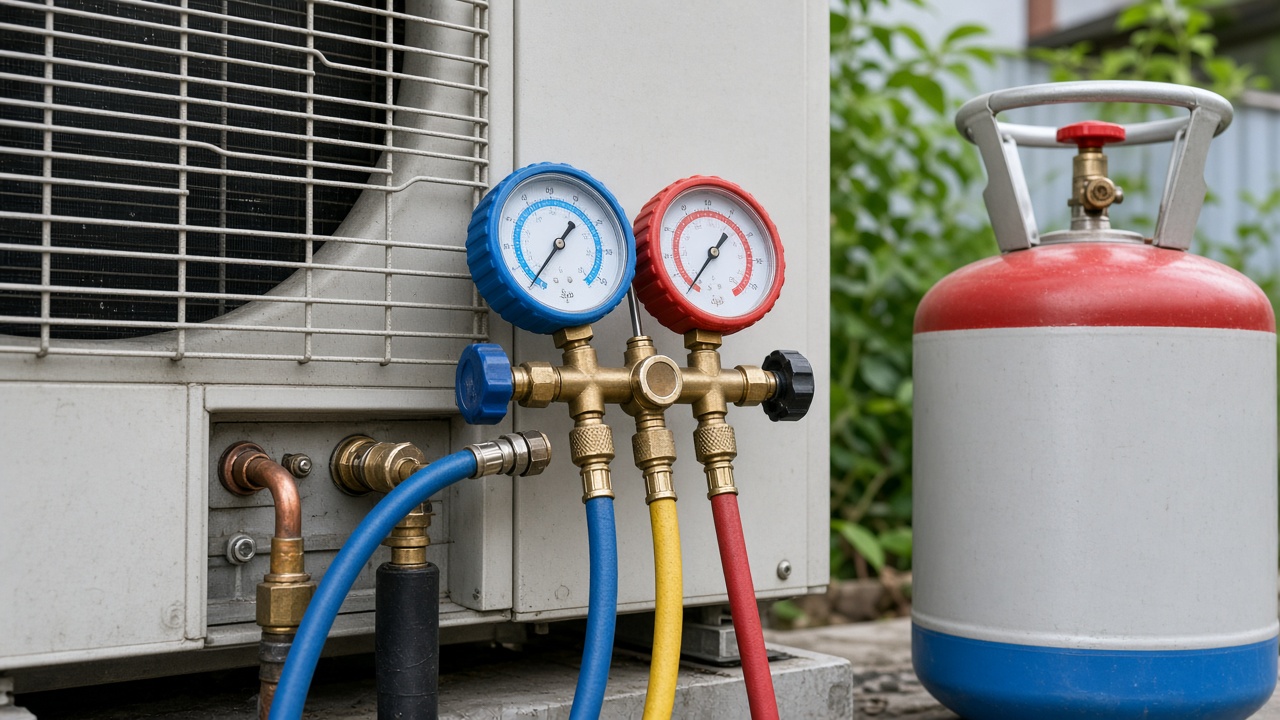
Common gas and leak problems in Sharjah
Ice on the thin copper line
The small insulated pipe should be cool and sweaty, not a block of ice. Ice means the coil is starving of heat. A choked filter does this without any leak. We prove airflow first. If the filter and blower are clear and the line still ices, the charge is low and we look for the leak. Chipping the ice off and switching the unit back on does not add refrigerant. It sends liquid back toward the compressor.
The compressor runs and the air stays warm
A compressor that runs, with a hot outdoor coil that is clean, and warm supply air, can be low on charge. It can also be a reversing valve or a failed indoor coil. The gauges tell the difference. A system that equalises too fast or will not pull down is not “a bit low”. It is empty or it is mechanically failed. We say which before any cylinder is opened.
A hiss at the flare nut
Roof flares on Muwaileh and Al Taawun villas crack after years of heat cycling. The leak is at the nut, not inside the compressor. Apartments in Al Nahda lose gas at the indoor flare behind the casing. Soap or an electronic detector finds it. The nut is remade or the flare is recut, then the system is vacuumed and charged. Tightening a nut on a split flare without repairing it is how the gas leaves again.
Repeated top-ups
A unit that “needs gas” every year has a leak that nobody repaired. Each top-up is money and a compressor that has been running with poor oil return. We will not join that pattern. If you have invoices for gas from other visits, bring them. They tell us how fast the charge is leaving and where to spend the detector time.
The wrong refrigerant
R32 and R410A are not interchangeable, and neither replaces R22 in an old system. The nameplate decides. We carry R32 and R410A because those are the charges on current Gree and O General units in Sharjah. R22 is used only where the machine was built for it. Mixing gases or “substituting” a cylinder because it was on the van damages the oil and the compressor. The cylinder is the one the plate calls for.
Overcharge
More gas is not more cooling. An overcharged system runs high head pressure, especially on a Sharjah roof in the afternoon, and trips or cooks the compressor. We weigh the charge to the nameplate after a vacuum, or set superheat on a fixed-orifice system, instead of adding gas until the pipe “feels cold”. Feeling the pipe is not a measurement.
A leak in the evaporator
Some indoor coils leak at the header after corrosion. The detector or the oil dye shows it. A coil replacement is a different price from a flare repair and is quoted before we recover the remaining gas. We do not keep topping a coil that will empty again next month.
Gas added to a dirty system
A black outdoor coil and a blocked filter make the pressures look wrong. Adding gas on top of that makes the next technician’s job harder. If the last visit was a top-up without a coil wash, say so. We clean first when dirt is the obvious restriction, then decide if a leak remains. Cleaning is priced on the cleaning page when that is the whole job.
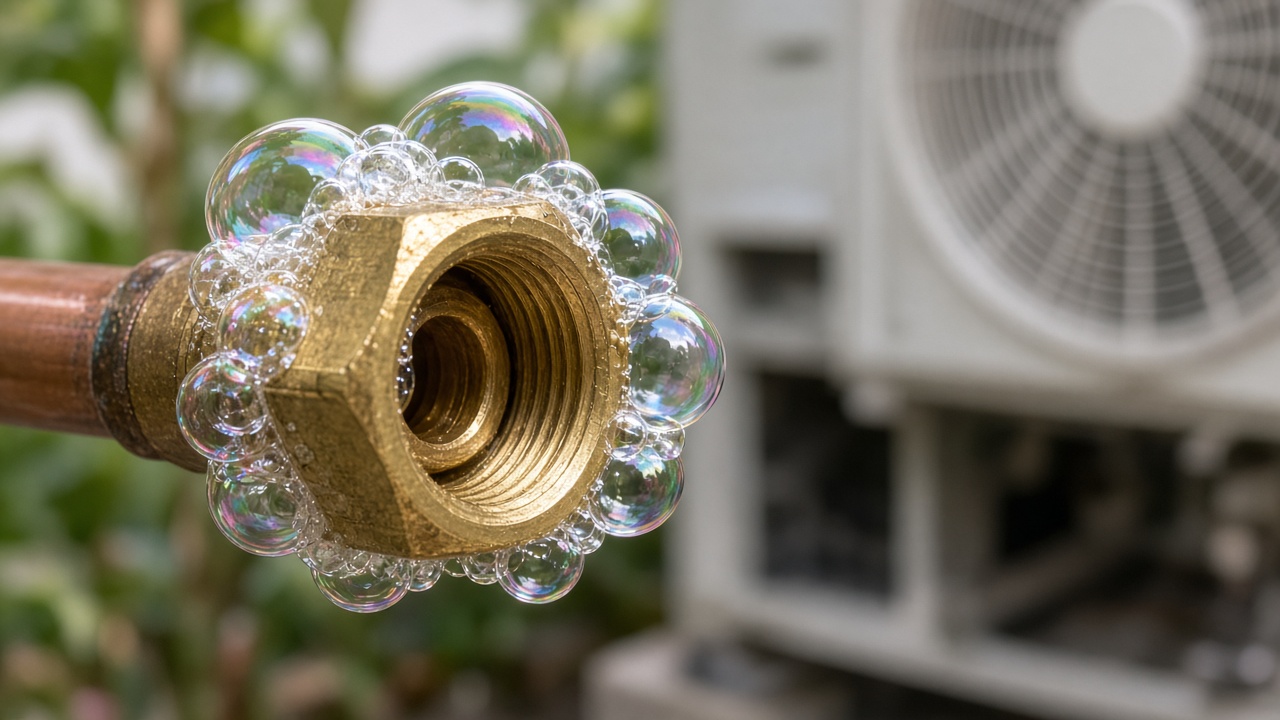
How the refill is done
The order is fixed. Airflow first. Then a leak test at flares, service valves, and the indoor header. Then a written price for the repair and the gas together. Then vacuum, charge, and a run until supply air is stable. Pressures go on the invoice. We do not open a cylinder on a system that is still leaking.
If the compressor does not start, this is not a gas job. Start with AC repair. A capacitor fault mimics “needs gas” because the indoor fan runs and the room never cools.
Where Sharjah systems leak
Villas with roof condensers leak at flares that see full sun. Apartments leak at the indoor flare or a valve core that was depressed and left slightly open. Package units and long ducted lines are a larger charge than a 1.5-ton split, so the price is not the bedroom price and is written before gas is added. Industrial Area units near chemical or oily air corrode fins and, less often, pipework. We look there when the flares are dry and the charge is still gone.
What a top-up cycle costs
Three cheap top-ups cost more than one flare repair and a correct charge, and the compressor has been run poorly the whole time. Oil leaves with the refrigerant. A compressor replaced because it was starved is the expensive end of a leak that was visible at a nut. The written quote is there so you can choose the repair once, not fund the leak.
What to tell us
Brand, roughly how old the unit is, whether ice is visible, and whether anyone has added gas before. The area in Sharjah matters for access to the outdoor unit. Call +971 50 257 5128. If you only need the machine cleaned and it still cools, book cleaning. If it cools and you want that to continue, book maintenance.
How to read the result
A repaired flare and a weighed charge should hold. If ice returns within days, either the leak was not the only one or airflow is still poor. Call us back with the invoice pressures rather than buying another top-up elsewhere. We compare the new reading with the one we wrote down. A system that lost half its charge in a week has a second leak, often at the service valve core or the indoor header, and we look there next. A system that holds and still feels weak has a coil or a fan problem, and the gas is no longer the subject.
Do not open the valves yourself to “let some gas in”. The cylinder pressure is not the system charge, and air goes in with a careless connection. On a roof in Al Taawun the copper is hot enough that a bad connection hisses and loses what was just added. Leave the gauges to the visit. If the nameplate is missing, photograph the outdoor model sticker. Without it we will not guess the gas. Guessing is how R32 ends up in an R410A unit, and that repair is a compressor, not a top-up.
Typical price guide
| Work | Guide price |
|---|---|
| Leak check and pressure test | Included in the refill visit |
| Gas refill after the leak is fixed | AED 180–450 by gas type and charge |
| Flare or valve repair | Quoted before the recharge |
These are guide prices for Sharjah. The technician confirms the exact cost in writing after inspecting the unit. No parts are fitted before you approve the quote.
Areas we cover in Sharjah
This service is listed for every Sharjah area. The full district list is on the Sharjah areas page.