If you have lived through a single summer in the United Arab Emirates, you know that the air conditioner is not a luxury it is a lifeline. With outdoor temperatures routinely shattering the 50°C mark and humidity levels that feel like walking through a warm wet blanket, AC units work overtime for nearly eight months of the year. This relentless operation leads to a terrifying moment for every resident: the arrival of the DEWA bill.
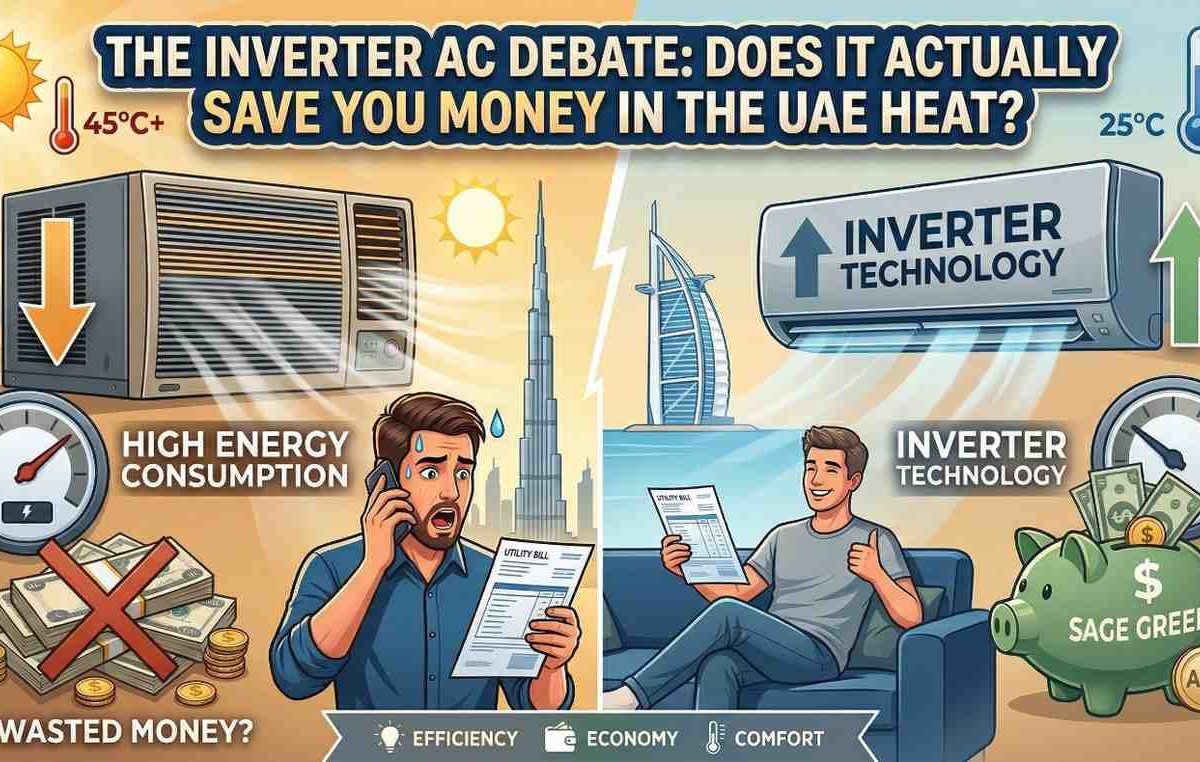
In an effort to tame these skyrocketing costs, the market has shifted heavily toward “Inverter ACs.” Promising energy savings of 30% to 50%, these technologically advanced units have become the standard in most villas, apartments, and offices across Dubai, Abu Dhabi, and Sharjah. But here lies the controversy: Do inverter ACs actually save you money in the specific, brutal climate of the UAE, or is it just clever marketing?
The physics of cooling a concrete and glass structure in the Arabian Desert is different from cooling a home in Europe or North America. We are dealing with extreme thermal gain, high humidity, and often, substandard building insulation. Let’s break down the science, the lies, the maintenance realities, and the hidden costs to finally settle the inverter debate for good.
The Science: How Inverter Technology Differs from Traditional Units
To understand the debate, you must first understand the machinery. A traditional (non-inverter or fixed-speed) AC compressor operates like a light switch: it is either 100% on or completely off. When your room reaches the desired temperature, the compressor shuts down. When the temperature rises again, it starts up with a massive jolt of electricity.
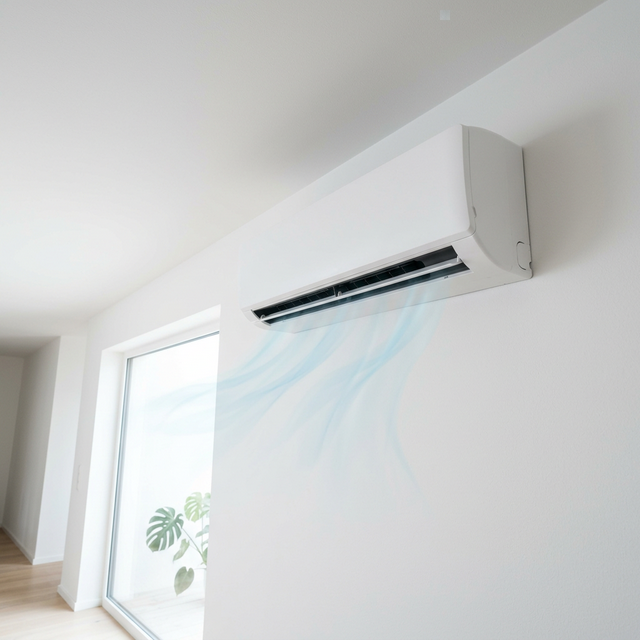
An inverter AC, however, works like an accelerator pedal. When you turn it on, it runs at full blast to cool the room quickly. But once the desired temperature is achieved, it doesn’t shut off. Instead, it slows down. It runs continuously at a low speed, maintaining the temperature without the energy-guzzling “start-stop” cycle.
In theory, this is brilliant. Starting an AC motor consumes the most electricity similar to how a car uses more fuel during acceleration than cruising on the highway. By avoiding these constant restarts, inverter ACs save energy. However, the “UAE Heat” variable changes this equation entirely.
The Hidden Variable Everyone Forgets: Deep AC Cleaning UAE
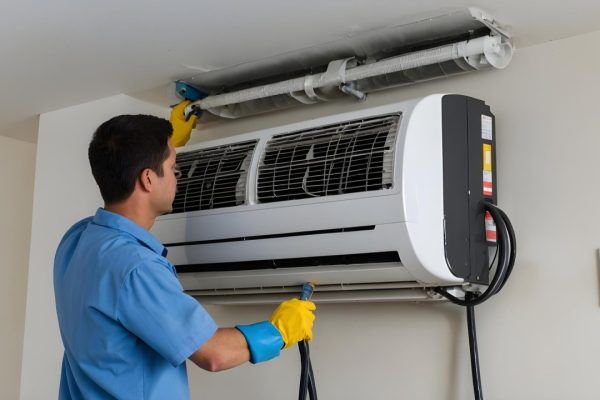
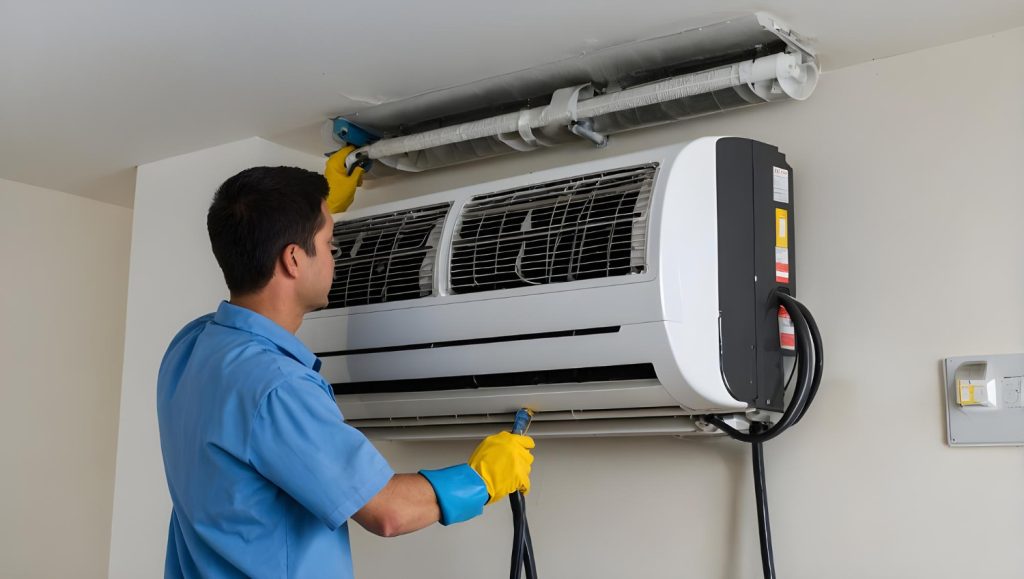
Before we dive deeper into the savings math, we must address the elephant in the room that kills every inverter AC’s efficiency: dirt. You can buy the most expensive, 5-star rated inverter unit on the market, but if you neglect the physical upkeep, you will actually pay more than someone using an old window unit. This brings us to a non-negotiable service: Deep AC Cleaning UAE. In this region, the fine desert dust, sand, and construction debris combine with humidity to create a thick mud-like sludge inside your AC’s evaporator coils and blower fans. When these components are caked in dirt, the inverter technology panics. The sensors detect that the room isn’t cooling, so the inverter keeps the compressor running at high speeds (instead of low speeds) indefinitely. You lose the “maintenance” savings entirely. A professional deep cleaning strips away this insulating layer of grime, restoring the machine’s ability to ramp down to low power modes. Without this biannual service, an inverter AC performs worse than a dirty fixed-speed unit. So, before you calculate your ROI, factor in the cost and necessity of Deep AC Cleaning UAE to ensure the inverter actually gets to use its low-power mode.
The “Run-Time” Trap: Why 24/7 Operation is Required for Savings
Here is the most common complaint in the UAE: “My new inverter AC bill is the same as my old one!”
The likely reason is usage behavior. Inverter ACs are designed for prolonged run times. They hate being turned off. Many expats maintain a habit from colder climates of turning the AC off when they leave for work at 8:00 AM and blasting it when they return at 6:00 PM.
In a standard AC, this is fine. In an inverter, this is catastrophic for savings. When you come home to a villa that has been baking at 40°C all day, your inverter AC has to run at maximum capacity (100% power) for hours just to bring the temperature down from 35°C to 23°C. During that “pull-down” period, it is using just as much electricity as a cheap fixed-speed unit. The savings only kick in during the “maintenance” period—when the room is already cool, and the inverter drops to 30% or 40% power.
The Verdict for UAE Living: Inverter ACs only save you money if you leave them on. Yes, you read that correctly. To maximize savings, set the unit to a moderate temperature (24°C to 25°C) and leave it running 24/7. The unit will maintain that temperature using very little energy. If you turn it on and off, you force it to play “catch up” in the peak heat, which is a losing battle.
The Heat Load Reality: Glass, Concrete, and Insulation
The UAE construction boom prioritized skyline aesthetics over thermodynamics. Many apartments feature floor-to-ceiling glass windows. While beautiful, glass has a very low R-value (resistance to heat flow). Your inverter AC isn’t just cooling the air; it is fighting against the infrared radiation blasting through your windows and the heat soaking through the concrete walls.
In a well-insulated European home, an inverter AC might cycle down to 10% capacity. In a standard Dubai Marina apartment or a villa in Arabian Ranches, the heat load is so immense that the AC may never drop below 60% or 70% capacity, even when maintaining temperature.
If the unit never ramps down, it never enters that “super saver” zone. In this scenario, you are paying for the expensive inverter circuit board and compressor but still using 80% of the energy of a standard unit. The savings, in this case, might be only 10-15% not the 50% advertised.
Cost Breakdown: Does the Math Work for the UAE Wallet?
Let’s look at the hard numbers. An inverter AC in the UAE costs approximately 30-40% more upfront than a standard unit. For a 24,000 BTU split unit, you might pay AED 3,500 for standard versus AED 5,500 for a high-end inverter.
Scenario A (Efficient User): You live in a well-insulated villa. You leave the inverter AC on 24/7 at 24°C. You schedule your Deep AC Cleaning UAE every six months to keep coils pristine. Your electricity bill drops from AED 1,200/month to AED 700/month. You save AED 500 monthly. Payback time: 4 months. Massive win.
Scenario B (Standard User): You live in a studio with large windows facing south. You turn the AC off at 8 AM and on at 6 PM. You rarely clean the filters. The unit struggles every evening to pull the heat out. Your bill drops from AED 800 to AED 720. You save AED 80 a month. The price premium of AED 2,000 will take 25 months to recoup. Plus, because the unit runs hard every evening, the wear and tear are high.
The Bottom Line: Inverter ACs can save you money, but only if you adapt your lifestyle to them. They reward the “set it and forget it” user. They punish the “intermittent user.”
The Humidity Factor: Dehumidification vs. Cooling
This is a technical nuance most people miss. The UAE isn’t just hot; it is humid (especially near the coast in Dubai and Abu Dhabi). Air conditioners cool by removing humidity. When a standard AC runs at full blast and shuts off, it pulls a lot of water out of the air quickly.
An inverter AC, running at low speeds for long periods, is less aggressive at dehumidifying. You might find that the temperature reads 23°C, but the room feels “clammy” or sticky because the humidity is still at 70%. To combat this, many users lower the temperature further (to 20°C) to force the inverter to work harder to remove moisture. This increases energy consumption and erases your savings.
Innovative Solution: Look for inverter ACs with a “Dry Mode” or “High Sensible Heat Ratio.” Alternatively, running a separate, low-energy dehumidifier alongside your inverter AC allows the AC to focus purely on temperature, maintaining that low-power sweet spot without the clammy feeling.
Debunking the “Junk” Myth: Quality Matters Immensely
Not all inverters are created equal. In the rush to capitalize on the “green” trend, many cheap Chinese inverters have flooded the UAE market. These units use inferior compressors that cannot handle the wide voltage fluctuations common in the UAE grid during summer peaks.
Furthermore, the inverter’s Printed Circuit Board (PCB) is sensitive to heat and dust. If the unit is not designed for tropical/desert climates, the PCB will fail within two years. A PCB replacement can cost AED 1,500 to AED 2,500 instantly wiping out five years of energy savings.
The Expert Advice: Stick to brands with proven regional track records (LG, Daikin, Gree, or Mitsubishi). Ensure the unit has a “Gold Fin” or anti-corrosion coating on the condenser coil. The salt spray from the Gulf (if you live near the coast) will eat through cheap aluminum coils in a single season.
Practical Tips to Force Your Inverter to Save Money
If you already own an inverter AC or plan to buy one, here is your playbook for beating the UAE heat without going broke.
1. Seal the Envelope
Before you touch the thermostat, check your door seals and window film. If cold air is leaking out under the door, your inverter will run at high speed forever. Buy weatherstripping tape from Ace Hardware or Amazon.ae. It costs AED 50 and improves inverter efficiency by 20%.
2. The “Golden Zone” Temperature
Never set your inverter AC below 22°C in the summer. The system is fighting a 30-degree delta (52°C outside vs. 22°C inside). Setting it to 24°C reduces the thermal load by 40% and allows the inverter to drop to its lowest power setting.
3. Mandatory Bi-Annual Deep Cleaning
As mentioned earlier, dust is the enemy. Filters need cleaning monthly, but the internal drum fan and deep coils need professional attention. Invest in a service contract that includes Deep AC Cleaning UAE before summer (April/May) and after summer (October). This ensures the unit isn’t working against a blanket of sand.
4. Use Ceiling Fans
If you have ceiling fans, use them. A ceiling fan creates a wind chill effect, making you feel 3-4°C cooler. This allows you to raise your inverter AC setpoint from 22°C to 25°C without noticing a difference in comfort. For every degree you raise the thermostat, you save roughly 5-7% on your cooling bill. For an inverter, this allows it to run at 30% capacity instead of 60%.
The Final Verdict: Yes, but with Caveats
So, will the Inverter AC actually save you money in the UAE Heat?
Yes, absolutely. But only for the disciplined homeowner.
If you are the type of person who “forgets” to clean the filters, turns the AC off every morning, sets it to “Arctic Blast” (18°C) when you get home, and lives in a glass box, an inverter AC will not save you a single fils. You will pay a premium for the technology and get zero return.
However, if you treat your home like a thermodynamic system leaving the AC on continuously at a moderate temperature (24°C), sealing your windows, running ceiling fans, and paying for Deep AC Cleaning UAE twice a year the inverter AC is the single best investment you can make. In the former scenario, you lose. In the latter, you can easily cut your summer DEWA bill by 30-40%, recouping the higher upfront cost within one brutal summer.