Thermodynamics and Smart Control in the Gulf Climate
The extreme geoclimatic conditions of the Arabian Peninsula demand robust cooling solutions capable of operating reliably under prolonged thermal stress. In urban centers like Dubai and Sharjah, where summer ambient temperatures routinely exceed 45°C and can spike to 52°C, the thermodynamic load placed on residential and commercial air conditioning systems is extraordinary. Managing these conditions requires advanced hardware engineering, but achieving optimal energy efficiency and personalized comfort also relies on intelligent control systems.
For modern residential properties in areas like Dubai Marina, Downtown, or Palm Jumeirah, implementing mitsubishi ac wifi control dubai enables residents to monitor and adjust temperatures remotely, ensuring they always return to a pre-cooled home. Similarly, establishing mitsubishi ac smart control sharjah offers local villa owners an intuitive way to manage cooling dynamically, preventing energy waste during unoccupied hours.
To withstand these harsh regional conditions while maintaining indoor comfort, the air conditioning system must be capable of precise output modulation. The purchase of a mitsubishi electric smart ac uae ensures that the selected unit has the computational power to handle localized temperature profiling. The physics of continuous heat extraction relies on maintaining a stable temperature differential between the indoor air and the supply air, while managing the mass flow rate and specific heat capacity of the air volume. In the extreme climate of the United Arab Emirates, managing this sensible cooling load without overloading the electrical grid requires advanced control mechanisms. By installing a mitsubishi wifi air conditioner dubai, residents can easily connect their indoor environment to their smartphones, enabling them to monitor real-time temperature fluctuations.
In the UAE, United Electronics Company L.L.C. (UNITCO) has served as the sole distributor of Mitsubishi Electric air conditioning systems and home appliances since 1983. Through their network of showrooms and service centers across Abu Dhabi, Dubai, Sharjah, and Al Ain, UNITCO ensures that these advanced systems are backed by localized technical expertise and certified support. Installing a smart climate system allows residents to command their indoor environment remotely, preparing their living spaces before arrival and monitoring energy consumption in real time.
Hardware Architecture of Tropical Inverter Systems
At the heart of Mitsubishi Electric’s high-performance residential lineup is the MSY-GT series, which features premium wall-mounted split systems designed specifically for high-ambient tropical environments. These systems utilize advanced inverter compressors that adjust their operating frequency dynamically, rather than cycling on and off.
For properties in Sharjah’s residential districts, a mitsubishi smart inverter ac sharjah modulates the speed of the compressor to prevent power spikes during the hottest hours of the day. The thermodynamic efficiency of these inverter systems is reflected in their high Energy Efficiency Ratio (EER), which measures the cooling capacity against the electrical power input to optimize seasonal power consumption.
In the tropical configurations designed for the UAE, the MSY-GT series maintains up to 95% of its cooling capacity at an ambient outdoor temperature of 46°C, and is guaranteed to continue operating for at least two hours even when temperatures reach a punishing 52°C. With mitsubishi ac remote app control dubai, users can adjust temperature, change fan speeds, and set weekly schedules from anywhere in the world, mitigating the risk of system strain while away.
An analysis of the mitsubishi electric ac smart features uae reveals how advanced algorithms optimize both airflow and comfort. These units utilize R32 refrigerant, which is highly efficient and has a Global Warming Potential (GWP) that is approximately one-third of the older R410A refrigerant. For smaller residential spaces or multi-room configurations, a mitsubishi wifi enabled ac dubai streamlines climate management, allowing individual control over multiple split indoor units.
| Technical Parameter | MSY-GT18 (1.5 Ton) | MSY-GT24 (2.0 Ton) | MSY-GT36 (3.0 Ton) |
| Cooling Capacity (kW) | 5.28 | 7.05 | 10.03 |
| Cooling Capacity (BTU/hr) | 18,015 | 24,055 | 34,222 |
| Air Flow Rate (CFM) | 545 | 620 | 788 |
| Refrigerant Type | R32 | R32 | R32 |
| Indoor Unit Dimensions (H x W x D mm) | 325 x 1100 x 238 | 325 x 1100 x 238 | 365 x 1170 x 295 |
| Outdoor Unit Dimensions (H x W x D mm) | 714 x 800 x 285 | 714 x 800 x 285 | 880 x 840 x 330 |
| Indoor Noise Level (Quiet/Low/High dB(A)) | 38 | 39 | 43 |
Comparative Analysis of Software Interfaces: MELCloud vs. Comfort App
Mitsubishi Electric utilizes different software applications depending on the region and the specific hardware generation. In the UAE and wider Middle East and Indian markets, the primary control platform is MELCloud (and the next-generation MELCloud Home app). In contrast, the North American market primarily uses the Comfort app (formerly known as kumo cloud) , while Oceania relies on the Melview/Wi-Fi Control application. To complete the mitsubishi ac wifi app setup dubai, users must establish a local connection on the 2.4 GHz frequency band.
The inclusion of mitsubishi ac iot features dubai provides the foundation for real-time energy tracking and performance analytics, which is essential for managing high Sewa and Dewa bills. Deploying a mitsubishi smart cooling system uae ensures the absolute optimization of sensible heat extraction in extreme ambient conditions, balancing indoor comfort with systemic health. Integrating advanced motion detection algorithms into the system provides a seamless experience of mitsubishi ac automation dubai.
The development updates as of May 2026 for these platforms demonstrate significant progress in usability and stability. The Comfort app has progressed to version 3.4.0, which features unified zone equipment cards, MHK2 low-battery notifications, and an entirely redesigned scheduling experience that enables users to configure events across multiple zones within a single intuitive workflow. Meanwhile, MELCloud Home has evolved to version 2.3.7, introducing the Air to Water Comfort Graph to visualize temperature time-series data and standardizing QR-code onboarding to drastically reduce manual entry errors.
| Feature Parameter | MELCloud Home (Europe, Middle East, India) | Comfort App (North America) |
| Primary Region | UAE, Middle East, India, Europe | United States, Canada |
| Hardware Compatibility | MAC-567IF-E, MAC-577IF-E, MAC-587IF-E, MAC-597IF-E | PAC-USWHS002-WF-2 Wireless Interface |
| Legacy Interface Support | PAC-WF010-E, MAC-557IF-E | Older kumo cloud integration accessories |
| Smart Scheduling | Weekly programs, customized Scenes | Multi-zone unified workflow scheduling |
| Temporary Override | Manual temperature and mode changes | “Hold Until” (Temporary, Holiday, Permanent) |
| Energy Optimization | Time-series graphs and historical energy tracking | Away Mode (paused schedules, energy-saving targets) |
| Diagnostics | Real-time error logging and instant email alerts | Dirty filter, low battery, and extreme temperature alerts |
These applications provide the necessary interface to manage complex, multi-zone residential properties. For instance, the scheduling engine in MELCloud Home allows users to configure up to seven weekly events per zone, ensuring that unoccupied zones are kept at moderate temperatures during peak sunlight hours to minimize thermodynamic strain when the spaces are re-occupied.
Sensor-Driven Spatial Intelligence: The 3D i-See Sensor
Standard air conditioners measure room temperature using a return-air thermistor, which only reads the temperature of the air entering the unit near the ceiling. Because cool air naturally settles, this often leads to uneven cooling and warm pockets at floor level. To address this issue, Mitsubishi Electric developed the 3D i-See Sensor, which is built into premium high-wall and ceiling-cassette units.
Industrial and commercial properties benefit greatly from mitsubishi electric hvac smart control sharjah, allowing centralized oversight of multiple cassettes. During unoccupied hours, the system activates the mitsubishi ac energy saving smart mode uae to reduce compressor workload. Homeowners can fine-tune air distribution using the mitsubishi ac smart thermostat features dubai to eliminate warm zones entirely. Selecting a mitsubishi smart split ac dubai allows for zone-by-zone cooling without wasting energy on unoccupied rooms.
The physical mechanism of the 3D i-See Sensor is exceptionally sophisticated. In commercial PLFY and PLA ceiling cassettes, the sensor continuously sweeps the space in a circular motion, performing 232 circular scans with eight points per scan to measure 1,856 individual zones within a given space. For standard residential wall-mounted units, the sensor scans a thermal grid of 752 three-dimensional zones. This detailed thermographic sweep identifies heat signatures based on size, movement, and temperature, allowing the system to distinguish between human occupants and inanimate thermal sources like computers or sunlight streaming through windows.
The integration of dual split vanes enables the unit to direct airflow independently. When the sensor identifies a human occupant, the control board can execute “Direct Airflow” to focus the cooling jet directly on the individual, or “Indirect Airflow” to sweep the air around the occupant to prevent the discomfort of drafty, chilled air. Furthermore, if the sensor detects that a room has been empty for a predetermined period, it instructs the inverter compressor to scale down its frequency, temporarily raising the setpoint to conserve energy. The moment an occupant re-enters, the sensor detects the thermal signature and immediately restores the user’s preferred cooling profile.
Mechanical Self-Preservation and Indoor Air Quality
Managing air quality in the Gulf is a continuous battle against fine desert sand, airborne dust, and elevated relative humidity. Dust accumulation on heat exchangers and fan blades reduces airflow and acts as an insulating barrier, forcing the system to consume more energy to achieve the same cooling effect. Managing indoor climate parameters directly from a tablet or phone is simplified through mitsubishi ac mobile app control sharjah. This continuous calibration is a direct result of mitsubishi ac smart technology uae, designed to withstand coastal salinity and intense heat waves. Ultimately, leveraging mitsubishi electric air conditioner wifi features dubai helps users maintain a healthy, highly efficient, and perfectly cooled indoor environment.
To ensure mechanical self-preservation, Mitsubishi Electric incorporates its patented Dual Barrier Coating (DBC) into select wall-mounted units. This state-of-the-art protection is applied to the heat exchanger, fan blower wheel, and internal air ducts during manufacturing. The coating is applied in a two-stage process :
- Fluorine Particle Fusion: The first layer is blended with fluorine particles that prevent water-soluble (hydrophilic) contaminants, such as fine sand, fiber dust, and pollen, from sticking to internal surfaces.
- Hydrophilic Particle Fusion: The second layer is blended with hydrophilic particles to repel oil-soluble (hydrophobic) contaminants, such as cooking grease, aerosols, and cigarette smoke.
By preventing these particles from sticking to internal surfaces, Dual Barrier Coating keeps the indoor unit clean all year round, minimizing odors and reducing maintenance needs. Over a ten-year operating cycle under typical regional conditions, units protected with Dual Barrier Coating are projected to reduce energy efficiency degradation by up to 18% and minimize airflow volume reduction by up to 30% compared to unprotected systems.
Additionally, the active Plasma Quad Connect filtration system (model MAC-100FT-E) provides an extra layer of indoor air purification. This secondary filter acts as an electrostatic barrier. The plasma electrode generates a high-voltage electrical field that charges microscopic airborne particles as they pass through. These charged particles are then attracted to and trapped by the filter mesh.
This electrostatic charging process removes up to 99% of airborne viruses, bacteria, and molds, and 98% of allergens. In certified laboratory tests, the Plasma Quad technology demonstrated a 99.8% neutralization rate of SARS-CoV-2 particles. The combination of Dual Barrier Coating and Plasma Quad Connect ensures that the air conditioner continues to deliver clean, purified air while maintaining optimal operating efficiency.
Technical Implementation Protocol: Wireless Interface Configuration
To enable remote app control and smart home integration, the indoor unit must be equipped with a compatible Wi-Fi interface, such as the MAC-567IF-E adapter. While some modern premium models have this interface built-in, other systems require a professional technician to install the adapter into the unit’s internal control board.
The physical installation begins by disconnecting the main power supply and opening the indoor unit’s front casing to access the primary printed circuit board (PCB). The lead wire from the Wi-Fi interface must be plugged directly into the dedicated CN105 connector on the PCB. The physical adapter must be positioned away from direct sunlight and areas where ambient temperatures fall outside the operating range of 0°C to 40°C, as extreme heat can cause the housing to deform or cause internal component failure.
Once the physical installation is complete and power is restored, the interface must be paired with the local router. The setup manual for the MAC-567-587IF-E series defines three distinct pairing methods depending on the router’s hardware capabilities.
| Pairing Mode | Access Point Mode | WPS-Push Mode | WPS-PIN Mode |
| Router Requirements | No WPS button; requires smartphone/tablet | Router must have physical WPS button | Router must support WPS-PIN entry |
| Activation Step | Press and hold MODE switch for 7 seconds | Press and hold MODE switch for 2 seconds | Press and hold MODE switch for 14 seconds |
| LED Indication | Orange MODE LED flashes slowly (every 5 seconds) | Orange MODE LED flashes quickly (every second) | Orange MODE LED flashes rapidly (every 0.5 seconds) |
| Handshake Process | Connect phone to “ME-XXXX” network, select local router | Press router WPS button within 2 minutes | Enter interface PIN into router administration portal |
| Reset Action | Hold MODE for 7 seconds to exit | Hold RESET for 2 seconds to cancel | Hold RESET for 2 seconds to cancel |
To complete the setup using Access Point Mode:
- Verify that the local router is broadcasting on the 2.4 GHz frequency band with WPA2-AES encryption active.
- Press and hold the MODE switch on the interface for 7 seconds. The orange MODE LED will begin flashing once every 5 seconds, confirming the interface is broadcasting its own localized Wi-Fi network.
- On a smartphone or tablet, navigate to the wireless network settings menu and connect to the network SSID beginning with ME-. Enter the unique security KEY printed on the label on the back of the interface.
- Launch a web browser and enter the configuration address or scan the setup QR code. In the configuration portal, select the local home or office Wi-Fi network and enter the password.
- Once the interface establishes a link to the router, the green NET LED and the green UNIT LED will light up, indicating a stable link to the cloud servers.
- Open the MELCloud app, select Add New Unit, and enter the unit’s MAC Address and ID Number from the label on the interface to complete registration.
Interoperability and Smart Home Integration
Integrating the air conditioning system with Google Assistant or Amazon Alexa allows users to manage their home climate with simple voice commands, enhancing convenience and efficiency. Setting up mitsubishi smart home ac integration sharjah allows homeowners to coordinate their cooling with other smart devices, creating automated routines that adapt to their daily schedules.
  [User Voice Command] ---> [Amazon Alexa / Google Home App]
                                         | (Cloud-to-Cloud API)
                                         v

                                         | (Secure Web API)
                                         v
                                 [MAC-567IF-E Interface]
                                         | (CN105 Serial Bus)
                                         v

                                         |
                                         v
                                [Cooling Commenced]
Google Assistant Configuration Protocol
To link the air conditioning system with Google Home, first verify that the AC unit is successfully configured and controllable within the MELCloud (or Melview/Wi-Fi Control) application. Open the Google Home app on a smartphone, tap the Add (+) icon, select Set up device, and then select Works with Google (or “Have something already set up?”).
Search for Mitsubishi Electric – Wi-Fi Control (or search internationally for Melview Wi-Fi Control if required by the regional account structure) and enter the login credentials for the MELCloud account to link the services. Once linked, Google Home will automatically discover the connected AC zones. Users can then assign each indoor unit to its respective room for convenient voice control, allowing commands like, “Hey Google, set the Living Room AC to 22 degrees”.
Amazon Alexa Configuration Protocol
To integrate the system with Amazon Alexa, launch the Alexa app, navigate to the main menu, and select Skills & Games. Search for Mitsubishi Electric – Wi-Fi Control (or Melview Wi-Fi Control for older international profiles) and tap Enable to Use. Enter the MELCloud account credentials to link the systems securely.
Once linked, prompt Alexa to discover new smart home devices by saying, “Alexa, discover my devices,” or by selecting the discovery option within the app. After discovery is complete, the AC units can be controlled using standard voice commands, such as “Alexa, set the Living Room to 22 degrees” or “Alexa, turn off the Master Bedroom”.
Advanced Local Control: KNX and Modbus B2B Integration
While consumer smart home assistants rely on cloud-to-cloud connections, high-end residential villas and commercial offices in Dubai and Sharjah utilize local, hardwired integration via open protocols like KNX or Modbus. Because cloud APIs introduce latency and depend entirely on active internet connections, local integration is preferred for mission-critical automation.
To achieve this, system integrators bypass standard Wi-Fi adapters and install professional HVAC translation gateways, such as the CoolAutomation CoolMaster or CoolLink Hub. These gateways connect directly to the Mitsubishi communication bus (M-Net line).
The gateway translates the proprietary Mitsubishi Electric protocols to open KNX group addresses or Modbus TCP registers, allowing third-party control systems (like Crestron, Control4, or Savant) to command the HVAC units with zero latency. This hardware-level integration allows the smart home system to directly read indoor temperature thermistors, set fan speeds, adjust vanes, and receive immediate diagnostic error codes locally.
Regional Micro-Climates and Professional Lifecycle Maintenance
The geographic diversity of the UAE ranging from the dense, high-rise, and humid coastal communities of Al Khan and Al Majaz in Sharjah to the drier, hotter inland villa communities of Al Khawaneej in Dubai—presents distinct environmental challenges for HVAC systems. Each micro-climate places unique operational stresses on air conditioning units, requiring targeted maintenance to prevent premature wear and maintain peak efficiency.
In highly populated coastal high-rise buildings, persistent winds can subject outdoor units to significant aerodynamic drag. This high pressure can cause the condenser fans to spin backward or experience resistance, increasing current draw and leading to vibration-induced leaks in the copper refrigerant lines.
In contrast, systems installed in inland villa communities are exposed to extreme ambient temperatures and fine, highly abrasive desert sand. Over time, this fine dust can build up inside the outdoor unit, clogging the condenser fins and causing the compressor to overheat.
| Neighborhood / Micro-Climate | Primary Environmental Stressor | Direct Mechanical Impact | Recommended Preventive Intervention |
| Al Majaz & Al Khan (Sharjah) | High relative humidity, salt-laden sea air | Galvanic corrosion of copper-aluminum fins; refrigerant leaks | Bi-annual chemical wash with specialized anti-corrosive coil coatings |
| Jumeirah & Dubai Marina (Dubai) | Saline coastal breeze, persistent high winds | Vibration-induced line stress; fan-motor resistance | Mechanical vibration-damper installation; fan assembly re-balancing |
| Muwaileh & Industrial Areas (Sharjah) | High ambient particulate load (concrete dust, soot) | Fast filter clogging; reduced airflow volume | Quarterly deep coil cleaning and air duct sanitation |
| Al Khawaneej & Inland Districts (Dubai) | Extreme dry heat (up to 52°C), abrasive desert sand | High head pressure; thermal degradation of run-capacitors | Installation of protective condenser shades; electrical audit of start/run capacitors |
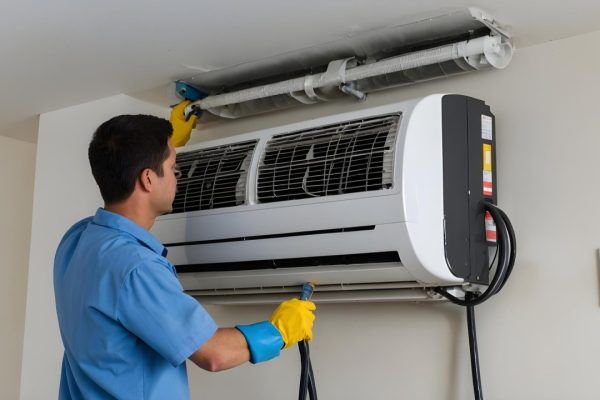
To maintain the efficiency and longevity of these advanced climate systems, property owners should establish a bi-annual professional preventive maintenance contract with certified HVAC specialists, such as Air-Con.ae. Professional maintenance ensures that the system is thoroughly inspected and calibrated to handle the extreme regional conditions.
A comprehensive professional service must include:
- Precision Refrigerant Calibration: Technicians use digital scales to measure and adjust the refrigerant charge precisely, avoiding the risks of under-charging or over-charging. Over-charging is particularly dangerous, as it can cause liquid refrigerant to enter the compressor, leading to permanent mechanical failure.
- Chemical Coil Decontamination: Coils are treated with specialized, non-acidic chemical washes to dissolve salt crusts and fine sand, restoring proper heat exchange without damaging the sensitive fins.
- Drainage Flush and Sanitation: Technicians clear the condensate lines and verify that the drain system is sloped correctly to prevent water back-flow and blockages.
- Electrical Audit: Technicians inspect all electrical connections, contactors, and capacitors. In high ambient temperatures, capacitors are under constant thermal stress and can degrade, leading to sudden compressor failures.
Engineering Syntheses and Best Practices
Deploying a smart, connected climate control system is one of the most effective ways for homeowners and commercial operators in the UAE to balance premium indoor comfort with responsible energy use. Mitsubishi Electric’s advanced inverter technology, combined with the spatial intelligence of the 3D i-See Sensor, provides precise cooling that adapts dynamically to real-time demands.
Furthermore, physical self-preservation features like Dual Barrier Coating and active Plasma Quad Connect filtration help protect the equipment from the region’s harsh dust and high humidity, preserving both energy efficiency and indoor air quality over the long term.
To maximize the performance and lifespan of a Mitsubishi Electric system, property owners should implement the following engineering recommendations:
- Establish a Dedicated IoT Network: Connect all Wi-Fi interfaces to a dedicated, stable 2.4 GHz IoT network with adequate coverage of at least -60 dBm across all indoor units. This prevents IP conflicts and connectivity dropouts caused by high network traffic on standard dual-band routers.
- Activate Energy-Saving Automation: Use the MELCloud scheduling and 3D i-See Sensor occupancy settings to automatically adjust temperatures in unoccupied rooms, reducing unnecessary cooling and lowering utility costs.
- Professional Installation for Upgrades: When adding optional accessories, such as the MAC-567IF-E Wi-Fi adapter or the Plasma Quad Connect filter, always employ licensed technicians to handle the internal PCB wiring and secure physical mounting.
- Schedule Bi-Annual Maintenance: Protect your investment by arranging professional, bi-annual maintenance with certified technicians to clean the coils, clear the condensate lines, and inspect the electrical components, ensuring the system operates reliably through the hottest summer months.