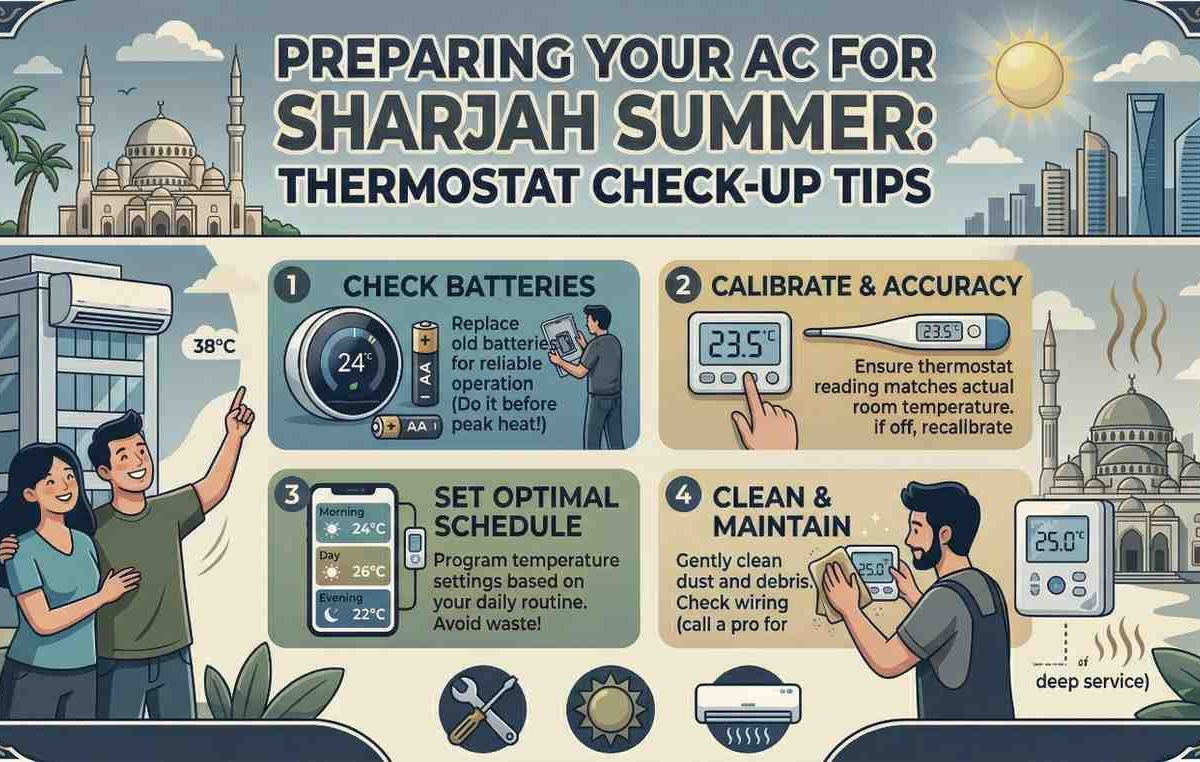
The environmental conditions characteristic of the Sharjah summer represent a significant challenge for residential and commercial cooling infrastructure. With ambient temperatures frequently surpassing 45°C and coastal humidity levels reaching saturation points of 80% to 100%, the air conditioning system transitions from a supplemental luxury to a critical life-support mechanism. During these months, the mechanical load on cooling units is relentless, requiring systems to operate almost 24/7 to maintain habitable indoor environments. While common maintenance often focuses on physical filtration or refrigerant levels, the thermostat serves as the primary intelligence of the entire HVAC apparatus. Neglecting the control interface during pre-summer preparations can lead to catastrophic system failure, excessive energy consumption, and a degradation of indoor air quality that impacts the health of occupants. This report provides an exhaustive technical analysis of why the thermostat is the linchpin of summer readiness in Sharjah, detailing the thermodynamic, economic, and technological factors that necessitate a professional evaluation of this component. Detailed service offerings for these essential procedures are available via the specialized portal at Air Con.
The thermodynamic role of the thermostat in extreme heat
The thermostat functions as the central regulatory hub of the air conditioning system, modulating the cycle of the compressor based on high-precision temperature readings from internal sensors. In the extreme thermal environment of Sharjah, the temperature differential between the exterior ambient air and the interior setpoint is often greater than 20°C. This requires the thermostat to maintain precise calibration to prevent the compressor from overworking, which can lead to thermal runaway or mechanical burnout. The precision of a thermostat’s thermistor the component responsible for detecting temperature changes is vital; even a minor discrepancy of 1°C to 2°C can result in the system running significantly longer than required, exponentially increasing wear on the start-run capacitors and the motor windings.
In addition to temperature regulation, the thermostat manages the Sensible Heat Ratio (SHR). Sensible heat is the energy associated with the temperature of the air that can be measured by a thermometer, while latent heat is the energy required to remove moisture from the air through the process of condensation. In Sharjah’s coastal climate, the latent heat load can be immense. A properly calibrated thermostat ensures that the cooling cycles are long enough to facilitate effective dehumidification without overcooling the space. If a thermostat is faulty, it may prematurely terminate the cooling cycle, leaving the indoor environment feeling “clammy” despite reaching the target temperature.
| Thermodynamic Component | Functional Impact | Maintenance Priority |
| Thermistor Calibration | Ensuresaccurate T{indoor} detection | High |
| Signal Relay | Communicates setpoint to the compressor | Essential |
| Humidistat Integration | Manages latent heat (moisture) removal | Critical in Coastal Areas |
| Anticipator Settings | Prevents temperature overshoot | Standard |
| Differential Control | Manages the “deadband” between cycles | Periodic |
The technical necessity of precision control hubs
The process of ensuring a control system’s integrity often necessitates professional ac thermostat repair to address the intricate wiring and sensor degradation that occurs in high-heat environments. Over time, the internal components of a thermostat can experience electrical drift, where the relationship between the measured resistance and the actual temperature becomes non-linear. This is particularly prevalent in Sharjah, where sand and fine dust particles can infiltrate the thermostat casing, coating the sensitive electronic contacts and acting as an unintended thermal insulator. When the sensor is insulated by dust, its response time increases, causing the AC system to lag and leading to significant temperature fluctuations that diminish occupant comfort and increase energy spikes.
Furthermore, the electrical connections within the thermostat are subject to thermal expansion and contraction cycles. As the device switches high-voltage signals to the AC contactor, the points of connection can develop oxidization or become loose. Loose connections create resistive heating, which can further distort the thermostat’s internal temperature readings or even lead to a complete loss of signal to the HVAC unit. Professional technicians utilize digital multimeters and thermal imaging to identify these high-resistance points, ensuring that the signal path from the wall unit to the compressor is optimized for the heavy duty-cycles required in July and August.
Economic implications of thermostat accuracy in Sharjah
The financial burden of air conditioning in Sharjah is dictated by the slab-based tariff structure implemented by the Sharjah Electricity, Water and Gas Authority (SEWA). For residential consumers, electricity consumption is categorized into color-coded bands, where the price per kilowatt-hour ($kWh$) increases as consumption rises. A thermostat that is out of calibration by even a small margin can force a household from the relatively affordable “Green” or “Yellow” slabs into the “Orange” or “Red” slabs, resulting in a dramatic increase in the monthly utility bill.
| SEWA Consumption Slab | Usage Range (kWh/Month) | Tariff Rate (Fils/kWh) |
| Green | 0 – 2,000 | 23 |
| Yellow | 2,001 – 4,000 | 28 |
| Orange | 4,001 – 6,000 | 32 |
| Red | 6,001+ | 38 |
Diagnostic indicators of control system failure
Property owners should be vigilant for the early warning signs of thermostat malfunction before the ambient temperatures peak. One of the most prevalent symptoms is “short cycling,” a condition where the AC unit turns on and off in rapid, frequent intervals. This behavior is often triggered by a faulty thermostat sensor that misreads the cooling effect, or by improper placement of the thermostat near a heat source or air draft. Short cycling is particularly destructive to the compressor, as the highest electrical and mechanical stress occurs during the startup phase. Repeatedly forcing the compressor to start against high head pressure can lead to premature failure of the motor windings and the mechanical seals.
Inconsistent temperature readings across different rooms can also indicate that the thermostat is failing to accurately gauge the whole-home environment. While this can sometimes be attributed to ductwork issues, the thermostat’s inability to maintain a stable “deadband” the range between the temperature that triggers cooling and the temperature that stops it is a common culprit. Additionally, an unresponsive display or a screen that periodically loses power may indicate failing internal circuitry or compromised $24\text{V}$ power delivery from the air handler’s transformer, both of which require professional intervention to resolve.
| Symptom | Probable Technical Cause | Long-term Risk |
| Frequent Starts/Stops | Thermistor drift or poor placement | Compressor motor burnout |
| Display Failure | Battery death or transformer fault | Complete system outage |
| Constant Running | Fused relay contacts or sensor failure | Excessive utility bills/Ice buildup |
| Erratic Setpoints | Software glitch or electrical noise | Inconsistent comfort levels |
| High Humidity | Short cooling cycles (Short cycling) | Mold and IAQ degradation |
Integrating thermostat health with holistic system integrity
A comprehensive approach to summer readiness must involve a thorough home ac repair and maintenance protocol that addresses the synergy between the digital controls and the mechanical hardware. The thermostat can only function effectively if the physical system is capable of executing its commands. For instance, if the evaporator coils are clogged with dust or the refrigerant levels are low, the thermostat will continue to call for cooling indefinitely, as the system struggles to reach the setpoint. This creates a feedback loop of inefficiency where the thermostat registers a constant T_{indoor} > T_{setpoint}, forcing the mechanical components to run at 100% duty cycle, which significantly accelerates the wear of the compressor’s mechanical components.
Furthermore, the maintenance of air filters is inextricably linked to thermostat performance. A clogged filter reduces the volume of air passing over the cooling coils, leading to a drop in the coil temperature below the freezing point of water. This results in ice formation on the coils, which acts as an insulator and further restricts airflow. The thermostat, sensing that the room is not cooling, continues to signal for more power, potentially leading to liquid refrigerant “slugging” back into the compressor, which is a leading cause of catastrophic mechanical failure. A professional pre-summer service ensures that the airflow dynamics, refrigerant pressures, and control signals are all balanced to handle the extreme Sharjah heat.
| Maintenance Task | Impact on Control System | Efficiency Benefit |
| Coil Cleaning | Reduces compressor run-time | Up to 20% Energy Saving |
| Refrigerant Balancing | Prevents “always-on” signals | Extends system lifespan |
| Filter Replacement | Normalizes cycle lengths | 10-15% Airflow Improvement |
| Contactor Inspection | Ensures reliable signal execution | Prevents electrical arcing |
| Drain Line Flushing | Prevents humidity-related sensor errors | Protects against water damage |
The transition to AI-driven diagnostics in 2026
The year 2026 has seen a paradigm shift in the Middle Eastern HVAC industry with the widespread adoption of AI-driven predictive maintenance and smart thermostat integration. Modern systems in Sharjah are now being equipped with IoT-enabled sensors that track not only temperature but also the “vital signs” of the mechanical hardware, such as motor vibration frequencies and current draw signatures. By analyzing this data against historical performance models, AI algorithms can identify subtle deviations from normal operation such as a 3% increase in amperage which often signals the onset of a bearing failure or a refrigerant leak weeks before a breakdown occurs.
These advanced control systems, such as the Google Nest Learning Thermostat (4th Gen) and the Ecobee Smart Thermostat Premium, use machine learning to adapt to the specific thermal properties of a Sharjah villa. For instance, the AI learns the “thermal lag” of the building how quickly the interior warms up once the AC is turned off and optimizes the startup time to ensure the home is cool exactly when the occupants return, without wasting energy on mid-day cooling when the house is empty. Furthermore, these systems can integrate with the SEWA grid to participate in demand-response programs, automatically adjusting the setpoint by 1°C or 2°C during peak grid load periods to help stabilize the utility infrastructure while reducing the homeowner’s costs.
| AI Diagnostic Feature | Mechanism | 2026 Performance Metric |
| Vibration Analysis | Detects bearing/fan imbalance | 72% reduction in downtime |
| Amperage Monitoring | Identifies electrical/mechanical friction | 30% reduction in energy waste |
| Pressure Sensing | Catches “pinhole” refrigerant leaks | Prevents 90% of system freezes |
| Adaptive Learning | Models the home’s thermal envelope | 15-25% utility bill reduction |
| Remote Triage | Technicians diagnose via the cloud | 84% faster repair resolution |
Environmental challenges: Coastal salinity and desert dust
Sharjah’s unique geography presents environmental stressors that are rare in other parts of the world. For properties located in coastal districts like Al Khan or Al Mamzar, the air is highly saturated with salt particles, which are aggressively corrosive to the metallic components of the AC unit. Salt-air corrosion leads to “pitting” of the aluminum fins on the condenser coil, which reduces the surface area available for heat exchange and significantly degrades the system’s efficiency. The thermostat, once again, becomes the victim of this inefficiency, as it is forced to maintain the compressor in an active state for longer durations to compensate for the diminished heat rejection capability of the corroded coils.
Inland areas of Sharjah face the challenge of fine desert dust, which is chemically distinct from typical urban dust and possesses a high abrasive quality. This dust can accumulate on the fan blades of the outdoor unit, leading to imbalance and excessive vibration that can eventually sever electrical connections or damage the compressor mounting. Maintenance for Sharjah AC systems must therefore include specific anti-corrosion treatments for coastal units and high-pressure cleaning for inland units to ensure that the mechanical system can keep pace with the thermostat’s demands.
| Environment Type | Primary Threat | Mitigation Strategy |
| Coastal (Al Khan/Mamzar) | Salt-air corrosion/Fin pitting | Rinsing and Anti-corrosion coatings |
| Inland (Muwaileh/Sajaa) | Fine sand/Dust accumulation | High-pressure cleaning/Frequent filter changes |
| High Humidity | Mold/Latent heat load | Humidistat calibration/UV air sanitizers |
| High Ambient (>45°C) | Thermal stress/Capacitor failure | Heat shielding/Regular electrical testing |
| Urban Sharjah | Industrial pollutants/VOCs | Carbon filtration/HEPA upgrades |
Managing indoor air quality through control optimization
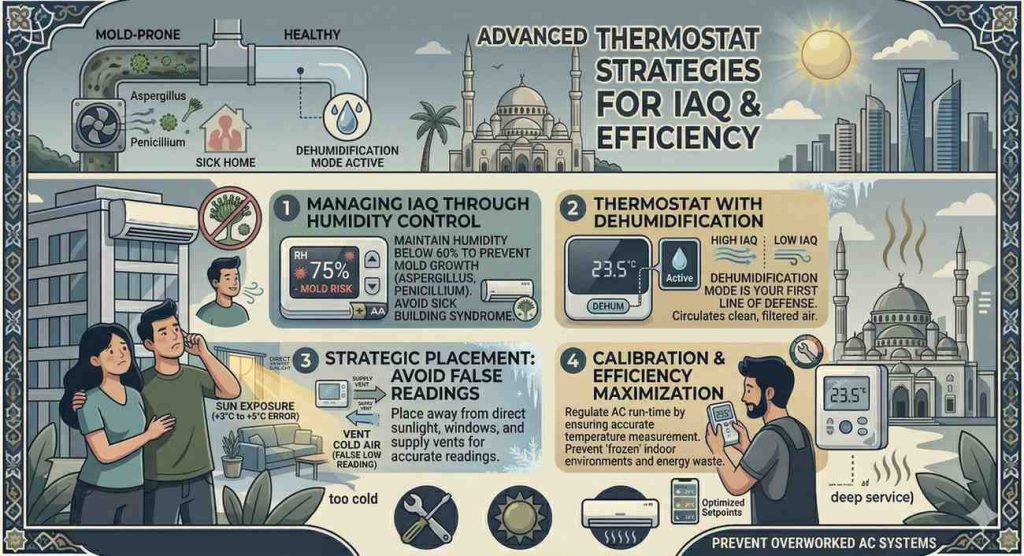
The thermostat’s role in managing indoor air quality (IAQ) is often overlooked but is vital for the health of Sharjah residents. High humidity levels in the summer, if not properly managed, can lead to the growth of mold (such as Aspergillus or Penicillium) within the dark, damp environments of the AC ducts and evaporator coils. Once mold becomes established, the AC system acts as a delivery mechanism, circulating spores throughout the home every time the unit engages. A properly functioning thermostat with a dehumidification mode is the first line of defense against this “sick building syndrome.” By maintaining indoor relative humidity below 60%, the thermostat prevents the conditions necessary for mold to flourish.
Strategic placement and calibration for maximum efficiency
The physical location of a thermostat within a Sharjah villa is as critical as its internal calibration. A thermostat placed in direct sunlight, near a window, or in the direct path of a supply vent will provide a “false” reading that does not reflect the actual temperature of the living space. For example, a unit exposed to the afternoon sun hitting a west-facing wall may register a temperature $3^\circ\text{C}$ to $5^\circ\text{C}$ higher than the rest of the room, forcing the AC to run unnecessarily and leading to a “frozen” indoor environment that wastes significant energy.
Technicians recommend installing thermostats on an interior wall, away from drafts and heat-producing appliances, at approximately eye level ($1.5$ meters from the floor) to ensure an accurate sample of the room’s air. In multi-story villas, the use of remote sensors is highly recommended. These small, wireless devices can be placed in bedrooms or living areas, allowing the smart thermostat to average the temperature across multiple rooms or prioritize the cooling of occupied spaces during the night. This “zoning” approach ensures that energy is directed only where it is needed, which is essential for managing the high SEWA bills associated with large properties in Sharjah.
| Placement Factor | Recommendation | Consequence of Neglect |
| Height | (Eye level) | Reading stratified (hot) air |
| Solar Exposure | Avoid direct sunlight | Continuous “false” cooling demand |
| Airflow | Away from supply vents | Short cycling from rapid cooling |
| Wall Type | Interior walls only | External heat ghost-loading |
| Connectivity | Check Wi-Fi signal (3-4 bars) | Loss of smart features/remote control |
The relationship between smart controls and SEWA’s sustainability goals
The adoption of smart thermostat technology in Sharjah aligns with the broader sustainability initiatives of the UAE government and SEWA’s “Home Rationalisation Initiative.” SEWA has historically implemented programs to install water- and energy-saving devices in thousands of homes, achieving reductions in consumption of up to $55\%$ for lighting and significant savings for water. By integrating a smart thermostat into this ecosystem, residents can further contribute to the emirate’s goal of reducing carbon emissions and managing peak electrical load.
The use of “Eco” modes on modern thermostats which allow for a slightly wider temperature range during hours when the home is unoccupied helps to prevent the “peak hour” spikes that strain Sharjah’s electrical grid. SEWA encourages these behaviors through its “Peak Hour” corporate social responsibility initiative, which aims to educate the public on reducing consumption during the hottest parts of the day when the grid is most vulnerable. For a property owner, the smart thermostat is the most effective tool for adhering to these guidelines while maintaining a high standard of comfort.
| Sustainability Initiative | Thermostat Role | Environmental Impact |
| Peak Hour Shaving | Automatically raises setpoint during peaks | Reduced grid strain/carbon footprint |
| Home Rationalisation | Optimizes system efficiency | Significant utility bill reduction |
| Green Building Standards | Mandatory high-efficiency controls | Long-term emirate sustainability |
| Smart Metering | Real-time feedback to the thermostat | Transparent energy management |
| Demand Response | Coordinated cooling with utility needs | Stabilized energy infrastructure |
Professional standards for thermostat calibration and repair
Given the technical complexity and the high stakes of Sharjah’s summer, pre-summer thermostat maintenance should not be treated as a DIY task. Professional HVAC technicians utilize specialized diagnostic equipment, such as NIST-calibrated thermometers and psychrometers, to verify that the thermostat’s readings match the actual dry-bulb and wet-bulb temperatures of the air. They also perform “amp-draw” tests on the AC components to ensure that the thermostat’s signals are resulting in the expected electrical behavior of the compressor and fan motors.
Furthermore, professional service includes a firmware audit for smart devices. Software glitches can cause thermostats to lose their programming or disconnect from the home’s Wi-Fi, leaving the homeowner unable to control their system remotely. Ensuring that the device is running the latest manufacturer software can prevent these “ghost” malfunctions that often occur during the most inconvenient times of the year.
| Professional Service Level | Tools/Methods Used | Outcome |
| Calibration Verification | NIST-calibrated reference probes | Guaranteed $\pm 0.1^\circ\text{C}$ accuracy |
| Signal Testing | Oscilloscopes/Multimeters | Clean, bounce-free relay signals |
| Firmware Management | Manufacturer-authorized updates | Stable, secure smart-home connectivity |
| Thermal Imaging | FLIR/Infrared cameras | Identification of loose/hot connections |
| Performance Mapping | Psychrometric charts | Optimized Sensible/Latent heat removal |
Strategic conclusions for summer readiness in Sharjah
The air conditioning thermostat is the single most important component for navigating the thermal extremes of the Sharjah summer. As the system’s primary control hub, it manages the delicate balance between thermal comfort, energy efficiency, and mechanical durability. A thermostat that is neglected during pre-summer maintenance is a liability that can lead to excessive utility costs under SEWA’s slab-based tariffs, premature failure of expensive AC components, and health risks associated with poor indoor air quality.
The technical analysis presented in this report underscores the necessity of a professional thermostat check-up as part of a holistic pre-summer AC strategy. From the calibration of sensitive thermistors to the integration of AI-driven predictive diagnostics, the technology of climate control has evolved to meet the challenges of the UAE environment. For the Sharjah resident, ensuring that the thermostat is accurate, well-placed, and mechanically synchronized with the rest of the HVAC system is the only reliable way to ensure a cool, healthy, and cost-effective summer. Investing in professional calibration and repair today is the most effective insurance against the inevitable breakdown and economic loss that comes with the arrival of the desert heat.