If you live in the UAE, you already know that summer isn’t just a season it’s a lifestyle adjustment. From June to September, temperatures routinely soar past 40°C, and even the “cooler” months hover well above what most Europeans or Americans would consider comfortable. In this climate, air conditioning isn’t a luxury; it’s a necessity for survival. But here’s the paradox that millions of UAE residents face every night: you crank up the AC, sleep through the night, yet wake up feeling groggy, dehydrated, congested, and far from refreshed.
You blame your mattress, your late-night screen time, or your stressful job. But what if the real culprit is hanging on your wall, humming quietly as you drift off? What if your AC the very machine designed to make you comfortable is secretly sabotaging your sleep quality?
The answer lies not in turning your AC off, but in understanding how to use it smarter. Welcome to the science of sleep-optimized air conditioning. In this comprehensive guide, we will explore how small, intentional adjustments to your AC settings can transform your nightly rest, boost your daytime energy, and protect your long-term health. And yes, we will address the elephant in the room: when your system itself is the problem.
Heading 1: Why UAE Residents Are Sleeping Poorly (And Don’t Know Why)
Before we fix the problem, we must diagnose it. The UAE has one of the highest per capita rates of air conditioner usage in the world. In many villas and apartment buildings, AC units run 24/7, 365 days a year. Yet, according to sleep studies conducted in hot climates, residents of the Gulf Cooperation Council (GCC) countries report significantly higher rates of sleep disturbances than those in temperate regions.
Why? Because most people treat their AC as a binary device either “on” or “off” without understanding the nuanced relationship between temperature, humidity, airflow, and human sleep cycles.
Your body’s core temperature naturally drops by 0.5 to 1 degree Celsius as you fall asleep, reaching its lowest point in the early morning hours. This drop is essential for initiating and maintaining deep sleep stages. When your bedroom is too warm, your body cannot shed heat effectively, leading to restless tossing and turning. When it’s too cold, your body burns energy trying to stay warm, fragmenting your sleep architecture.
But here’s where the UAE adds a unique twist: the extreme outdoor heat means your AC works harder than anywhere else on earth. This constant battle creates wild temperature swings, humidity imbalances, and noise pollution that your conscious mind ignores but your nervous system registers all night long.
Most UAE residents set their bedroom AC to 18–20°C, believing “colder equals better sleep.” This is scientifically incorrect. The optimal sleep temperature for adults is between 18°C and 22°C, but with a crucial caveat: stability matters more than the number. A room that fluctuates between 19°C and 24°C throughout the night is far worse than a stable 22°C.
Furthermore, the humidity factor cannot be overstated. The UAE’s ambient humidity often exceeds 70%, even indoors. When your AC runs constantly, it strips moisture from the air, turning your bedroom into a dry desert environment. This dehydrates your nasal passages, throat, and skin, leading to snoring, morning headaches, and that awful “sandpaper throat” sensation. You wake up feeling like you haven’t slept at all because, in many ways, you haven’t.
Heading 2: The Critical Link Between System Health and Sleep Quality
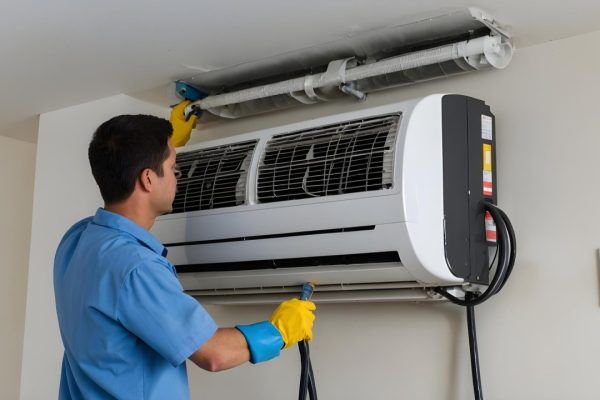
Here is where most homeowners make a catastrophic mistake: they obsess over thermostat settings while ignoring the mechanical health of their system. If your AC unit is malfunctioning, no amount of temperature tweaking will save your sleep. This brings us to the non-negotiable importance of Central AC Repairing. A poorly maintained central AC system creates a cascade of sleep-disrupting problems: uneven cooling that leaves one side of the room frozen and the other sweltering, mysterious clicking or banging sounds that jolt you from deep sleep cycles, refrigerant leaks that produce strange odors and trigger respiratory irritation, and compromised airflow that forces the system to run longer and louder than necessary. In the UAE, where central AC units often serve entire villas or multi-story apartments, a single fault in the ductwork, compressor, or thermostat sensor can sabotage the climate of every bedroom simultaneously. Many residents spend months blaming their insomnia on stress or diet, only to discover that their AC’s evaporator coil was frozen solid or their air handler was cycling on and off every seven minutes due to a faulty control board. The lesson is simple: before you adjust a single degree on your thermostat, schedule a professional inspection. A certified technician can measure airflow velocity, check refrigerant levels, clean clogged evaporator coils, and ensure your thermostat is calibrated accurately. In the UAE’s punishing climate, central AC units degrade twice as fast as they would in moderate regions. Ignoring this reality is the fastest route to chronic sleep deprivation.
Heading 3: The Goldilocks Temperature Zone for UAE Bedrooms
Now that we have established the importance of a properly functioning system, let’s talk numbers. What is the perfect temperature for sleep in the UAE?
Research from the National Sleep Foundation, combined with climate-specific studies from the University of Sharjah, points to a sweet spot of 20.5°C to 21.5°C for UAE residents. This range is slightly higher than the 18–19°C recommended for temperate climates because of two factors: humidity adaptation and energy efficiency.
When you set your AC below 20°C in the UAE, two negative things happen. First, your system must work exponentially harder to achieve and maintain that temperature, leading to shorter compressor life and higher electricity bills. Second, the rapid temperature differential between your bedroom (19°C) and the outdoor air (40°C+) creates thermal shock every time you leave the room or even open a door. This confuses your body’s thermoregulation system and can actually make you feel warmer when you return, prompting you to lower the temperature further in a vicious cycle.
Instead, set your thermostat to 21°C exactly one hour before bedtime. This gives the room time to stabilize without shocking the system. Then, program your AC to increase to 22.5°C after you have fallen asleep—specifically, 90 minutes after your typical sleep onset time. This slight increase aligns beautifully with your body’s natural temperature minimum, preventing the “middle of the night freeze” that causes you to wake up shivering and pulling blankets.
For families with young children or elderly members, adjust these numbers upward by 1°C. Infants and seniors have less efficient thermoregulation and are more susceptible to hypothermia from overcooling.
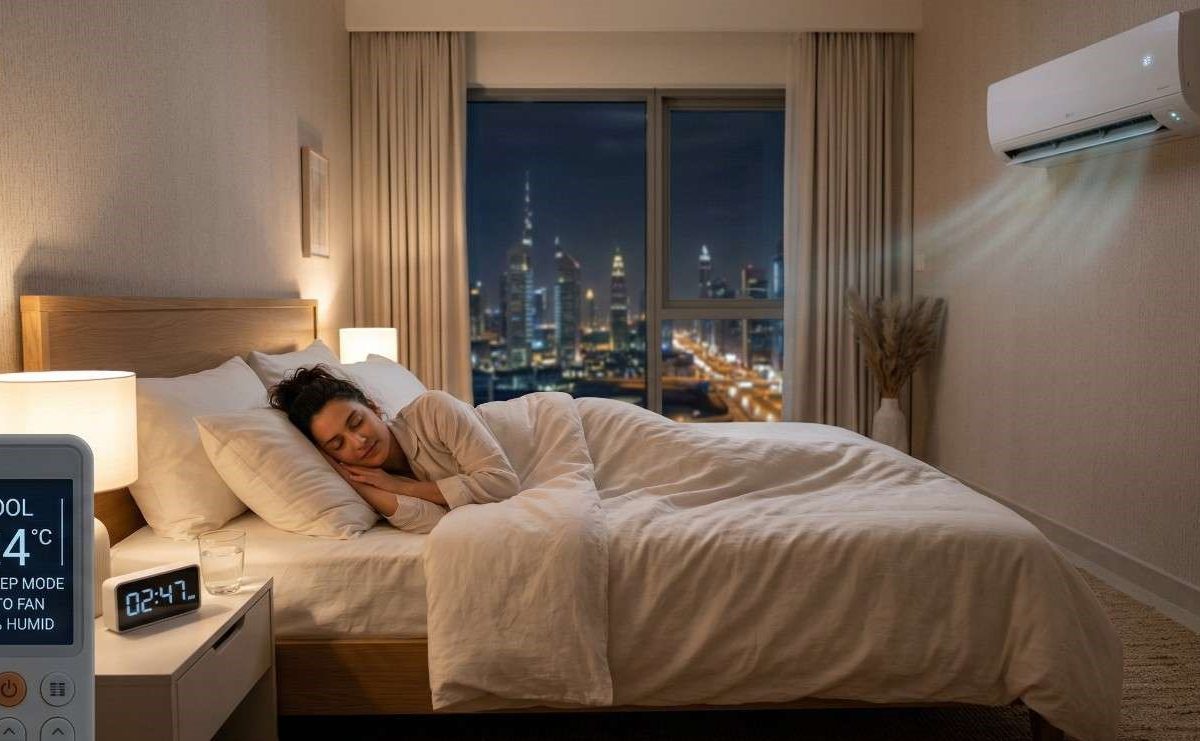
Here is an innovative trick that UAE residents swear by: use your AC’s “sleep mode” not as a crutch, but as a strategic tool. Sleep mode typically increases the temperature by 0.5°C per hour over 6–8 hours. Start at 20°C at bedtime, and let sleep mode take you to 23°C by morning. This mimics the natural rise in body temperature as you approach wakefulness, making it easier to open your eyes when the alarm rings.
Heading 4: Fan Speed and Air Velocity—The Silent Disruptor
Temperature gets all the attention, but fan speed is the unsung hero of sleep quality. Most UAE residents set their AC fan to “Auto” or “High” and never think about it again. This is a mistake with significant consequences.
When your AC fan runs at high speed, it creates air velocities of 0.5 to 1 meter per second across your body. Even at the perfect temperature, this constant breeze triggers a physiological response called “evaporative cooling,” where your skin loses heat faster than your internal thermostat expects. The result? You feel colder than the actual room temperature, leading to shivering, muscle tension, and disrupted sleep architecture. Some people even develop “air conditioning sickness” characterized by stiff neck, sore joints, and sinus congestion all from excessive airflow.
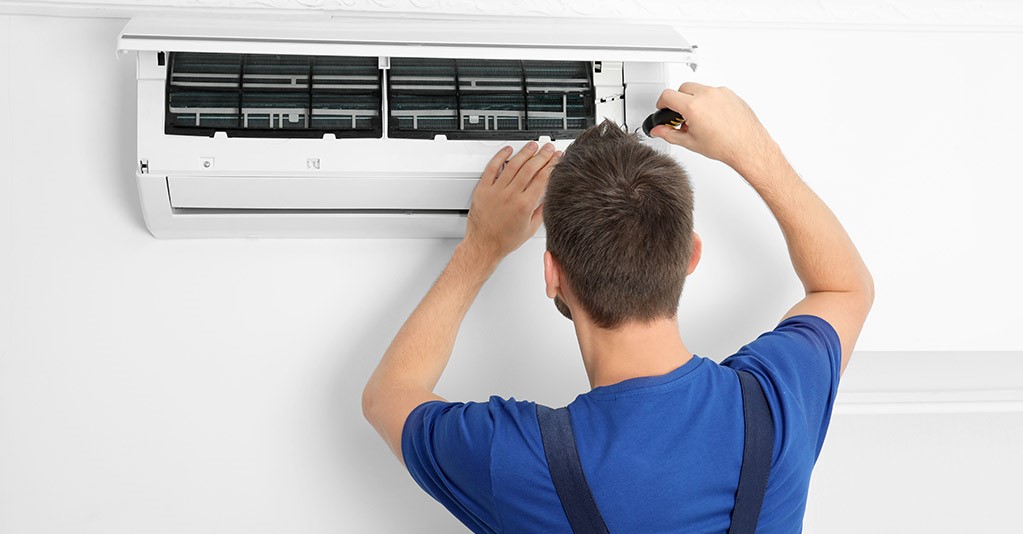
The optimal fan speed for sleep is low, or in some systems, “silent mode.” Low fan speed achieves three critical things: it maintains gentle air circulation without drafts, it reduces noise pollution significantly (important for light sleepers), and it allows your body’s natural heat exchange to occur without forced convection.
But there is an exception. In the UAE’s most humid months (July and August), low fan speed may not provide enough air movement to prevent condensation on your windows and walls. In this case, use medium fan speed but position your bed so that no vent blows directly onto your head or torso. Angle adjustable louvers toward the ceiling or an empty corner of the room. Air should circulate around you, not through you.
Another pro tip: if your AC unit has a “constant fan” or “circulate” mode that runs the fan continuously even when cooling is off, use it. This prevents stagnant air pockets and maintains even temperature distribution, which is especially valuable in larger UAE master bedrooms that often have vaulted ceilings and multiple AC vents.
Heading 5: Dry Mode vs. Cool Mode The Humidity Hack You Need
Here is the single most innovative sleep strategy for UAE residents: stop using Cool Mode at night and switch to Dry Mode.
Every modern AC unit in the UAE has at least two operating modes: Cool (which lowers temperature aggressively while removing some humidity) and Dry (which prioritizes humidity removal with minimal temperature change). In Cool Mode, your compressor runs at full capacity, dropping temperature rapidly while dehumidifying as a secondary function. In Dry Mode, the compressor runs intermittently, focusing on extracting moisture from the air while maintaining a stable temperature.
Why does this matter for sleep? Because human sleep quality is more sensitive to humidity than to temperature. The ideal indoor relative humidity for sleep is between 40% and 60%. Below 40%, you experience dry eyes, cracked lips, nasal bleeding, and respiratory irritation. Above 60%, you feel sticky, clammy, and suffocated, and you become vulnerable to dust mites and mold growth.
Here is the reality check: a typical UAE AC running in Cool Mode at 21°C will produce relative humidity of 30–35%—too dry for optimal sleep. That same AC running in Dry Mode at 22°C will produce 45–50% humidity—the perfect range.
The energy savings are substantial, too. Dry Mode consumes 30–40% less electricity than Cool Mode because the compressor cycles off more frequently. In the UAE, where cooling can account for 70% of summer electricity bills, this translates to hundreds of dirhams saved per month.
To implement this strategy, set your AC to Dry Mode, temperature at 22°C, fan speed low, one hour before bed. If you wake up feeling cold, increase to 23°C. If you wake up stuffy or with a dry throat, place a shallow bowl of water near the AC return vent this adds passive humidity back into the room without using an expensive humidifier. Some UAE homeowners even install dedicated humidifiers on their central AC systems, but for most bedrooms, the bowl method works surprisingly well.
One warning: Dry Mode works best in the UAE’s shoulder seasons (October–November and March–April) and during humid summer nights. During extreme heat waves when temperatures exceed 45°C during the day and remain above 32°C at night, you may need to use Cool Mode for the first few hours of sleep before switching to Dry Mode after midnight.
Heading 6: Advanced AC Features for Circadian Health
If your AC unit was manufactured in the last five years, it likely contains features you have never used. These are not gimmicks—they are powerful tools for aligning your bedroom climate with your body’s natural circadian rhythms.
Programmable Thermostats: Set different temperatures for different sleep phases. Example: 22°C from 10 PM to 12 AM (falling asleep), 21°C from 12 AM to 4 AM (deep sleep phase), 23°C from 4 AM to 6 AM (REM sleep and natural waking). Most smart thermostats allow seven-day programming, so you can have weekend settings that accommodate later bedtimes.
Motion Sensors: Some premium systems detect when you are in bed versus moving around the room. During sleep, the system reduces airflow and raises temperature slightly. When you get up to use the bathroom, it temporarily increases airflow to prevent you from feeling cold when you return to bed.
Air Quality Sensors: The UAE’s frequent sandstorms and high pollen counts mean indoor air quality fluctuates wildly. ACs with built-in PM2.5 sensors can automatically increase filtration when particle counts rise, preventing allergy-induced sleep disruption. If your system lacks this feature, consider a standalone HEPA filter unit positioned away from direct airflow.
Wi-Fi Connectivity: Being able to adjust your AC from your smartphone without leaving your bed is not laziness—it is sleep protection. When you wake up at 3 AM feeling too warm or too cold, you should not have to walk across a cold floor, blinding light from the thermostat, ruining your sleep continuity. A quick phone adjustment lets you fix the problem while barely opening your eyes.
Vent Positioning: This is not an electronic feature but a design consideration. In UAE bedrooms, AC vents are often poorly placed directly above the bed, above windows, or in corners that create dead zones. If your budget allows, hire an HVAC technician to relocate vents to blow along the ceiling or down exterior walls. The goal is to create a “curtain” of conditioned air that circulates around the perimeter of the room, not a jet that blasts the sleeping occupant.
Conclusion: Your Path to Refreshed Mornings Starts Tonight
The secret to better sleep in the UAE is not a new mattress, blackout curtains, or sleeping pills. It is hiding in plain sight on your wall. Your air conditioner, when understood and operated correctly, becomes not just a cooling appliance but a sophisticated sleep optimization device.
Start tonight. Check your thermostat temperature if it is below 20°C or above 23°C, adjust it immediately. Switch from Cool Mode to Dry Mode and feel the difference in your morning congestion. Lower that fan speed and let silence return to your bedroom. And if your system is more than five years old or making strange noises, call a professional for Central AC Repairing before you waste another sleepless night.
The UAE’s climate is unforgiving, but your bedroom does not have to be. With these science-backed adjustments, you can transform your AC from a sleep enemy into your greatest ally. The first night you wake up feeling truly refreshed—without headache, without dry throat, without that foggy morning stupor—you will wonder why you waited so long to learn these secrets.