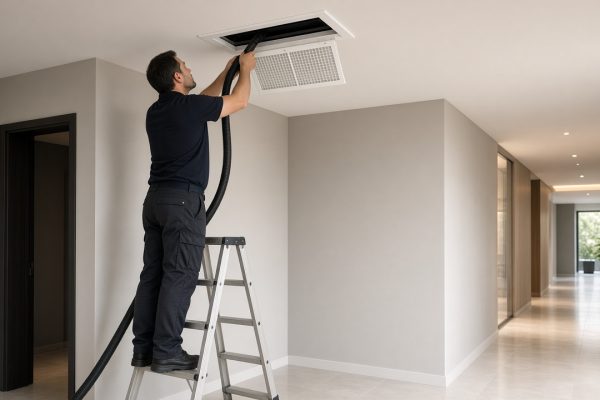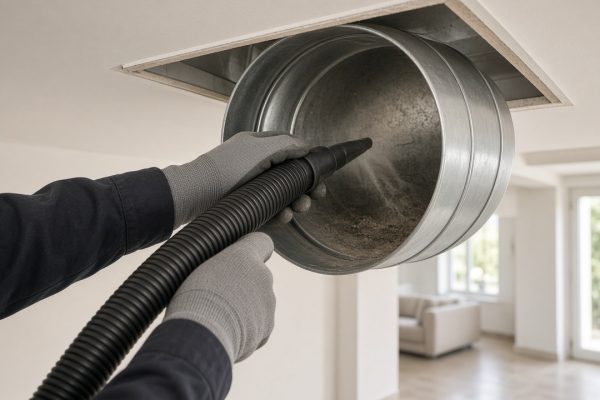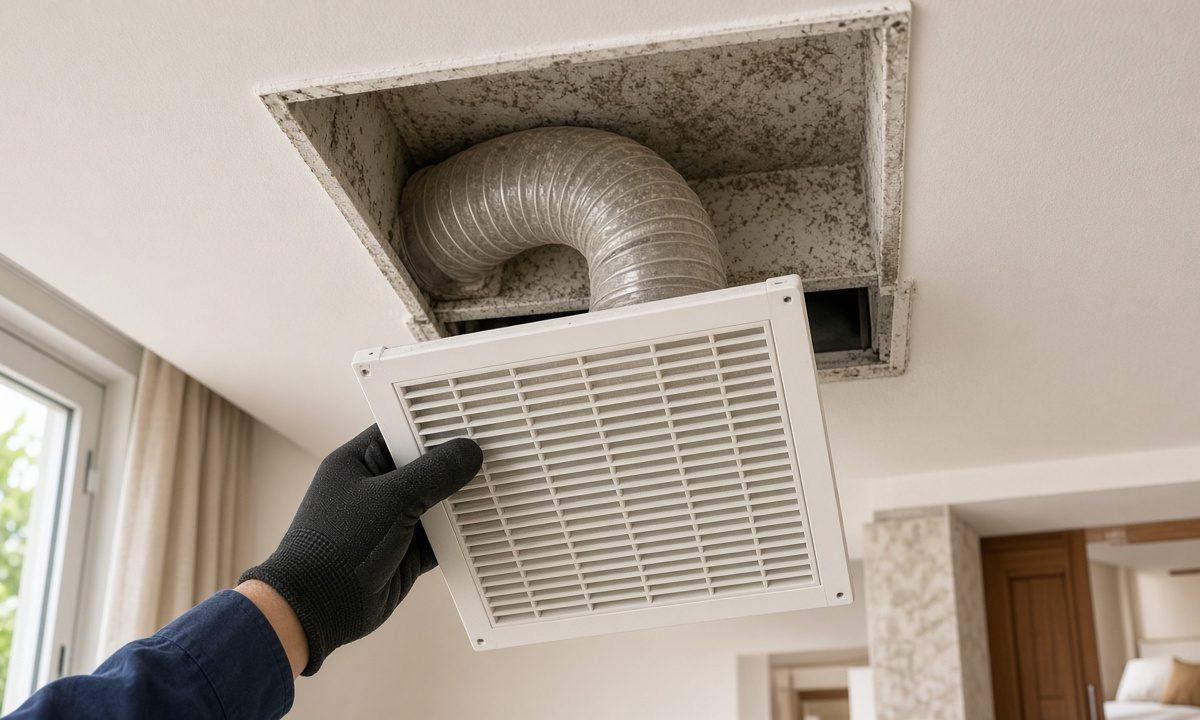
Dust that returns the day after the rooms are wiped is often coming from the return box, not from the supply grilles. The handler fan is a vacuum. Any gap around the return pulls air from the ceiling void, and that air never passes the filter. Gypsum powder and insulation fibres ride in with it, cross the coil, and leave through the supplies onto the furniture. A scented spray in the grille perfumes the dust. It does not close the gap.
Return boxes are sealed by Burj Al Qasimiah AC units fix cont., using the marketing name Air-Con.ae, and only in Sharjah. The workshop faces the cricket stadium in Industrial Area 6. The usual houses are Muwaileh villas and Al Majaz homes with a hall return in a gypsum ceiling. The usual shops are industrial units with a return open above a mezzanine. An Al Nahda apartment on wall splits rarely has this box at all. If the dust is from one split, the indoor coil and the wheel are the job, not a return plenum.
What the void is made of
Gypsum dust
Sanding a false ceiling drops a fine white powder into whatever is open above the grille. The return box on these houses is often a gypsum or sheet-metal plenum built in the same ceiling. Joints open when a downlight is cut nearby, when the ceiling is repainted, or when the access panel is only sitting in the hole. The powder is gritty between the fingers and pale. It films the majlis table and the top of a wardrobe. Wiping the table does not stop the fan. The next afternoon the film is back, heavier in the rooms closest to the return.
Insulation fibres
Fibres are a different material. Torn liner inside a metal duct, or loose roof insulation that has fallen against an open plenum, sheds short fluffy strands. Some are yellow or pink, some are grey. In afternoon light they glitter in the supply air. They snag on the coil fins and they come out of the boots with the gypsum. A filter that is the right size still does nothing for air that enters around the filter. The fibres are in the void. The void is on the wrong side of the rack.
The slot around the filter
The fan does not prefer the filter. It prefers the largest hole with the least resistance. A filter that is smaller than the frame, a gasket that has fallen off, or a rack that does not meet the box leaves a slot. House air and void air both enter, and the void air wins as soon as the slot is easier than the paper. We look at the frame with the grille off and with the fan running. A hand at the joint feels the pull. That pull is the leak. A clean filter element in a leaking frame is a decoration.
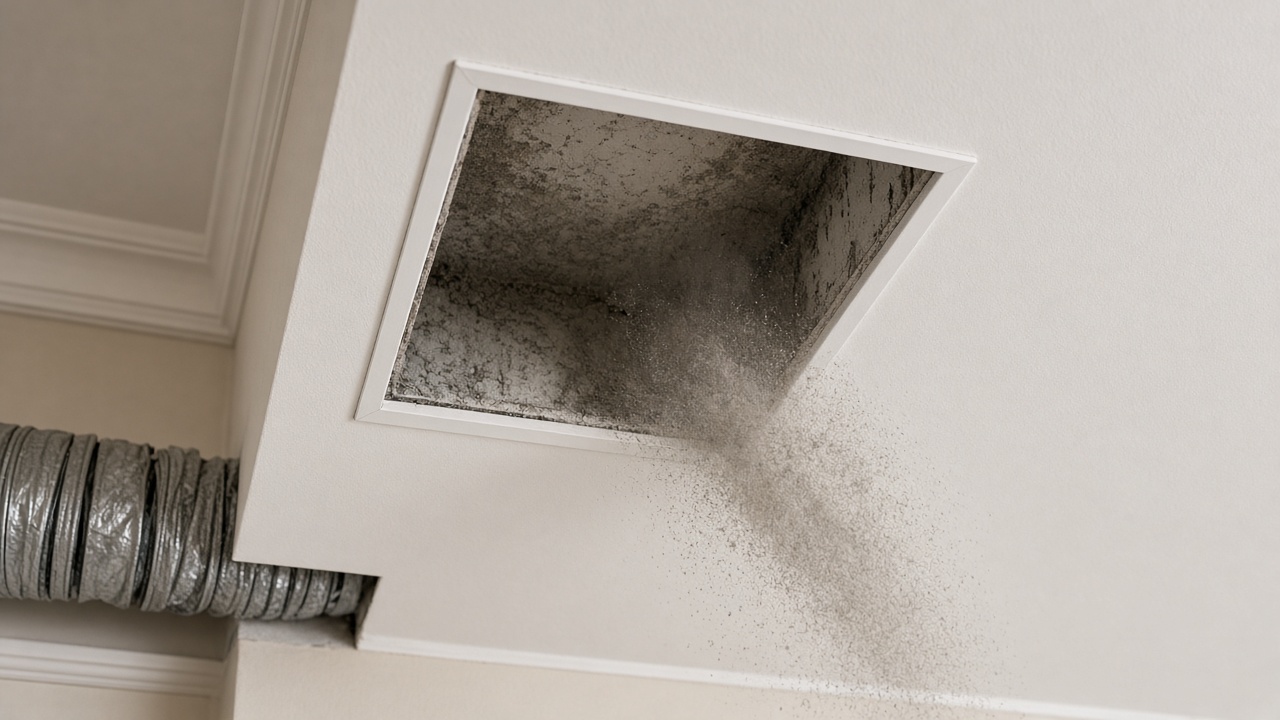
Seal the box before any wash
Washing the handler coil or vacuuming the supplies while the box is still open loads them again the first hour the fan runs. The order is fixed. Gaps are closed first. Foil tape goes on clean metal. Mastic goes on gaps the tape will not hold, including the joint between the box and the gypsum and the collar where the return duct leaves the plenum. Cloth tape softens and falls off in a Sharjah roof void, so it is not the seal we leave behind. The filter frame is made to meet the filter on all four edges. If the opening is the wrong size and a standard filter cannot seal, a new frame is quoted. The price is written on site before that frame is fitted.
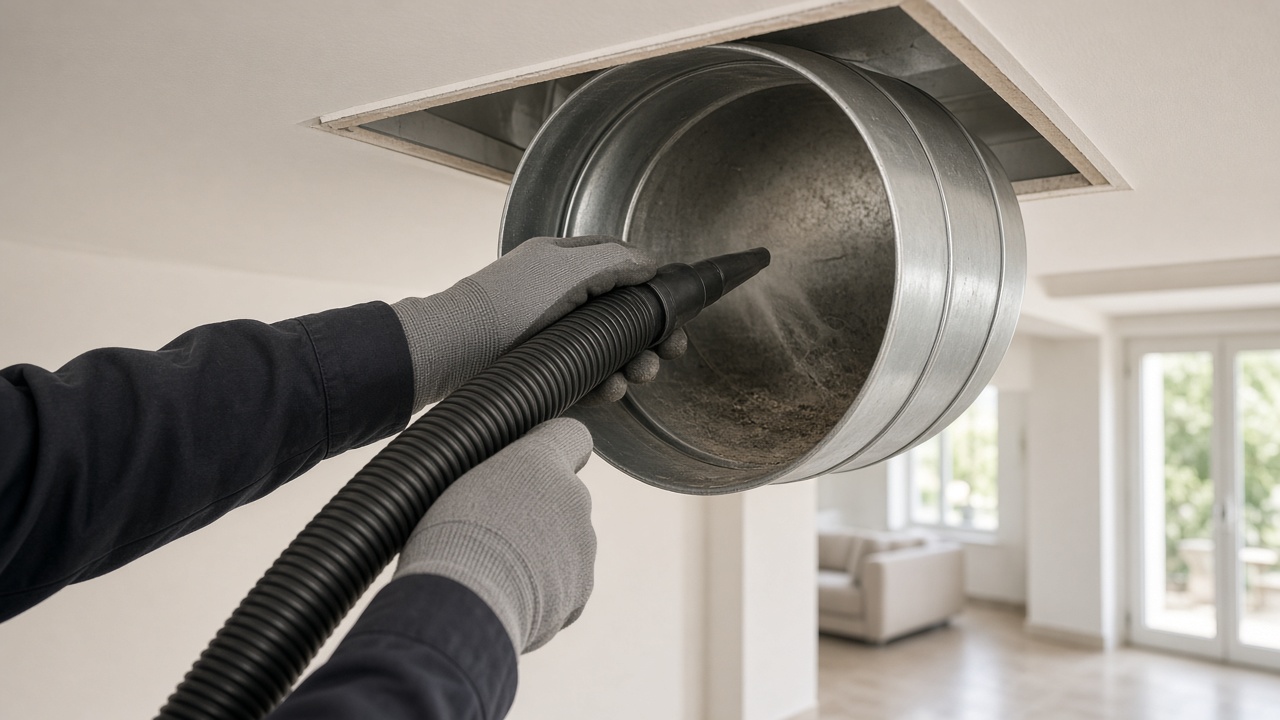
Only after the bypass is closed do we vacuum the return run and the supply boots, and only then is a dirty handler coil washed. Wash water stays in the handler drain pan with the drain open. It is not poured through the return grille. Sealing a box and leaving a coil matted with gypsum still leaves weak airflow, so the coil is part of the same visit when we are already in the cabinet. If the box itself has collapsed or the collar has dropped off the unit, rebuilding it is metalwork, not a wipe, and that figure is written before any sheet is cut.
- White grit is gypsum from the ceiling. Fluff is insulation fibre.
- Air that pulls at a joint is bypassing the filter.
- The box and the filter frame are sealed before the coil is washed.
- Foil tape and mastic stay put. Cloth tape does not.
- A new frame or a rebuilt collar is priced before it is fitted.
Which way the joint pulls
With the handler running, a strip of tissue at each joint shows the direction of the leak. A joint that sucks is return air being stolen from the void. A joint that blows is supply air wasted above the ceiling. The house then makes up the loss by pulling at the doors, which is why dust also appears at a door undercut even after the table has been wiped. Both leaks are found with the same test and closed with foil tape on clean metal or mastic where the tape will not hold. Cloth tape is left off the job. It lets go in the heat of a roof void and the gap opens again by the next summer.
How thick the filter is matters less than whether it meets the frame. A thick element that cannot slide home leaves a wider slot than a thin element that fills the hole. After painters have been through a Muwaileh hall, the return frame is often crusted with gypsum mud and the filter sits proud. We clean that frame until the filter lies flat on all four edges. The handler coil, once void air has been crossing it, carries a pale hard crust rather than the grey felt of a bedroom wall split. That crust is gypsum. It is washed only after the box is sealed, and the water stays in the handler pan with the drain open. Wash it first and the crust is back after an hour of fan run. A new filter frame, if the hole is the wrong size to seal, is written up before it is fitted.
Why a scented spray changes nothing
A spray from a can has no effect on a gap, on gypsum, or on fibres already in the trunk. The scent sticks to the dust and the dust still lands on the table. When the scent fades, the original smell of dry plaster is what is left, and people book another spray. We do not fog a return that has not been sealed. If there is a stale note as well as dust, it is usually a wet handler pan or a lined duct that has been damp, and that is cleaned as its own fault once the air path is closed. Perfume on top of a wet pan is how a sour smell becomes a sour sweet smell.
After the seal
The first start should not throw a cloud. A cloud means a branch was still full or a joint was missed. We reopen that point rather than spraying the room. Furniture under the vents is covered during the vacuum. In a Muwaileh void the return is often a grilled opening in the hall with no filter at all. Fitting a frame that can actually seal is the useful part of the visit. In an Industrial Area shop the dust is more cardboard and cement than gypsum, and the same rule holds: close the path from the dirty void, then clean what has already entered. Call +971 50 257 5128 with the area and whether the dust is white powder or fibre. The work is on the duct cleaning in Sharjah page. Sharjah only. Parts are written up before they are fitted.
Checking the supplies after the void is closed
Sealing the return stops new dust entering. It does not pull the powder already sitting in the supply branches back out. Those branches are vacuumed from the trunk toward the grilles, with the furniture covered, until a white cloth at the grille stays pale. A room that still films the table the next day is a joint we missed, usually a downlight hole or a return panel that was only pushed back into the ceiling. We mark that point and close it. We do not add another spray.
If the handler coil is matted with the same white powder, it is brushed and washed into the drain pan on the same visit, because a sealed return feeding a choked coil still blows weakly. The pan is dried so the new seal is not followed by a musty smell. Call +971 50 257 5128 and say whether the dust is pale plaster or grey fibre.