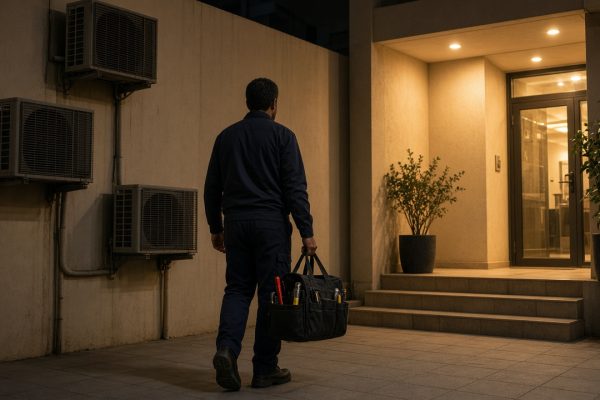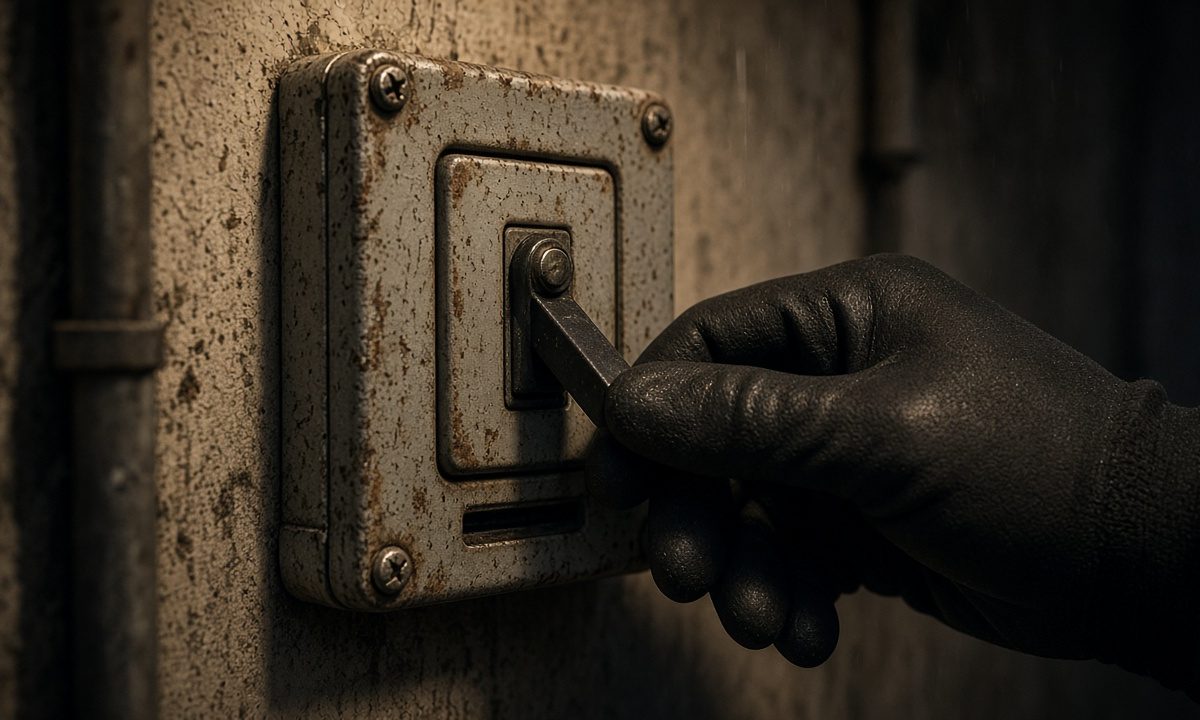
A burning smell at the outdoor isolator at night is an electrical fault, not a dirty filter and not a gas leak. The plastic of the switch, the insulation of a cable, or the bakelite around a terminal is hot because current is crossing a loose or corroded joint. Sharjah roof units and ledge units run for months without anyone opening that box. Heat, dust, and vibration loosen the screws. The joint then runs hotter than the cable was sized for. You smell it on the balcony or in the bedroom wall before you see the brown mark.
Air-Con.ae is the marketing name of Burj Al Qasimiah AC units fix cont. We treat this as a stop-and-test job across Sharjah, from Al Nahda ledges to Muwaileh roofs and shop isolators in Industrial Area. The workshop is opposite the cricket stadium in Industrial Area 6. The price of any part is written before it is fitted. Do not keep resetting the switch to get through the night.
What you should do before anyone arrives
Switch the outdoor isolator off and leave it off. If the smell is inside the flat and you cannot reach the outdoor switch, open the AC breaker in the distribution board and leave that off too. Do not stand on a wet balcony to pull a switch that is already smoking. Open the window of the room that smells, and keep people away from the outdoor unit. A photo of the isolator, taken from a step back, and a photo of the indoor unit are enough to send. Say whether the smell is plastic, hot dust, or a sharp electrical odour, and whether the breaker had already tripped.
Resetting a tripped breaker once, so you can see if it holds, is a common reaction. On a burning isolator it is the wrong one. The terminal that smelled is still loose or still carbonised. The next start pushes the same current through a worse joint. That is how a brown screw becomes a melted switch, and how a compressor winding that was still sound gets cooked because it was single-phasing or stalling against a bad connection. Leave it off.
What the burnt part usually is
A loose lug
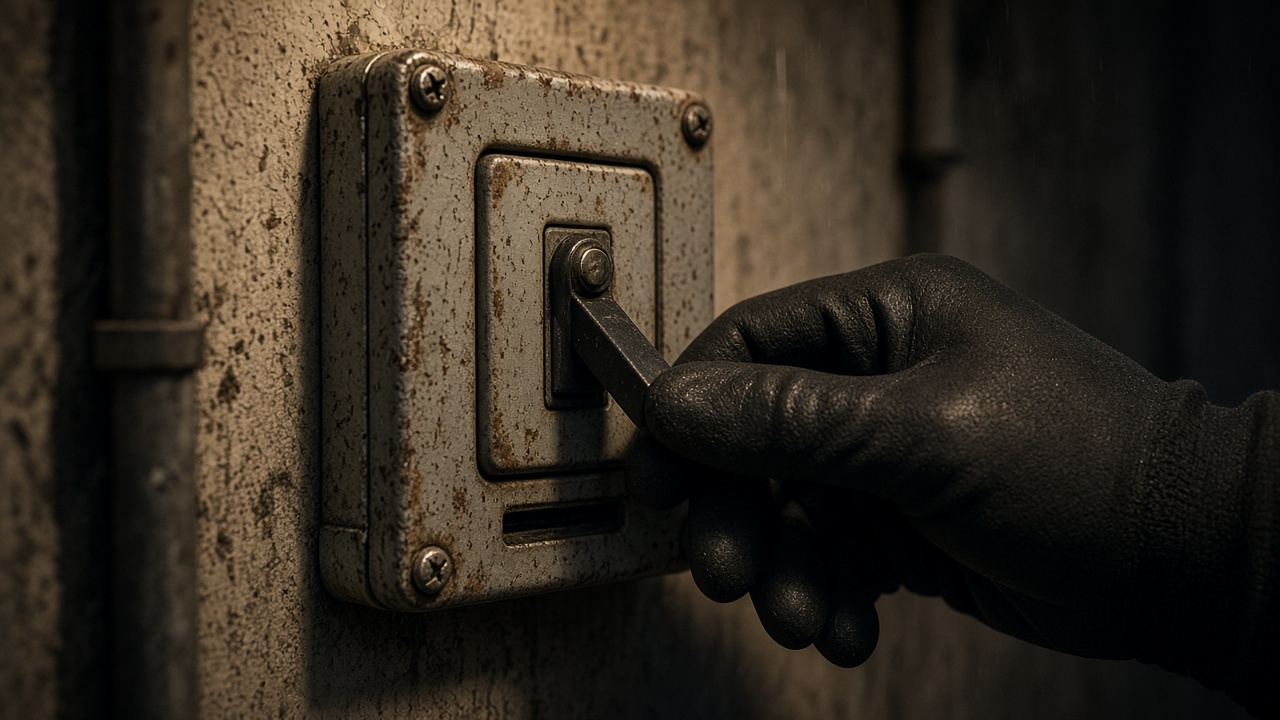
The incoming lives and the outgoing lives land on screw terminals. A screw that was tight on the day of installation works loose after a summer of compressor starts. The cable strand that is barely touching arcs. You see a black crescent on the copper and a discoloured screw head. The rest of the switch can look ordinary. We isolate, prove the conductors are dead, and only then open the cover. The damaged strand is cut back to bright copper. If the screw thread is stripped or the terminal is eaten, the isolator is replaced, not tightened and hoped over.
A heat-damaged switch body
If the plastic around one pole is swollen, brown, or cracked, that pole has been hot for a while. Tightening the screw does not restore the spring or the contact face inside. The switch is changed for one with the same marked current, and the cable is remade onto clean terminals. We do not move the wires onto a domestic socket switch or a smaller breaker because that is what is in the van. The ampere figure on the old isolator, or on the outdoor unit nameplate if the isolator plate is unreadable, decides the replacement.
The compressor is still tested
A burnt terminal is not automatically a dead compressor, and a dead compressor can be what burnt the terminal. After the supply is safe we measure the windings. An open winding, a winding shorted to earth, or a large imbalance means the motor is finished and a new connection will only trip again. Balanced windings and a running current under the nameplate, on all legs if it is three-phase, mean the connection was the fault and the machine can stay. We write both results down. Resetting first and measuring never is how a saveable compressor is lost.
How the joint is remade
Power is proved dead at the terminals, not assumed because the handle says off. A switch that has welded its contacts can still be live with the handle down. We check from a known earth or from a proved tester. The damaged copper is cut out. Strands that are black do not get reused under a new screw, because they are brittle and they will loosen again. The new termination is tight on bright metal, the earth is confirmed, and the cover goes back with its gland tight so the next dust storm does not fill the box.
Then the unit is started once, with the cover on, and the current is read at the cable, not by listening from the balcony. A current well above the nameplate means we stop again. The terminal can be perfect and the compressor still stalled. A current in range, held for a full cooling cycle, with no smell and no warmth at the isolator body beyond normal sun heat, is a finished electrical repair. Supply air is checked so we know the machine is actually cooling and not merely spinning.
- The circuit is proved dead before the cover stays off. A welded switch can be live with the handle down.
- Blackened strands are cut back to bright copper. They are not folded under a new screw.
- A distorted body is replaced with a switch of the same marked current. A dull but sound body is remade.
- Running current is compared with the nameplate after the joint is closed.
- Winding resistance and insulation decide whether the compressor stays. A brown terminal alone does not condemn it.
Smells that are not the isolator
A musty smell when the indoor unit starts is a wet drain pan or a dirty blower wheel. It is unpleasant and it is not this fault. A hot-dust smell the first time a unit runs after months off can be fluff on a heater element or on an indoor motor, and it should fade in a minute. A smell that gets stronger, that is sharp, or that you can trace to the outdoor box, does not fade. An oily chemical smell at the flares is refrigerant oil from a leak, and it belongs to a gas repair after the electrics are safe. We do not add gas to a unit whose isolator has just been on fire.
On a ledge in Al Qasimia or Al Nahda the isolator is often in a plastic box beside the condenser, painted over, with the hinges broken. On a Muwaileh roof it sits in full sun on a metal frame and the cable has chalked. In Industrial Area the same box fills with conductive dust. The failure looks different and the test is the same: dead, cut back, remake, measure. If the cable itself is heat-damaged along its length, not just at the screw, that length is replaced back to sound insulation. Tape over a cracked sheath is not a repair.
What happens if it is left until morning
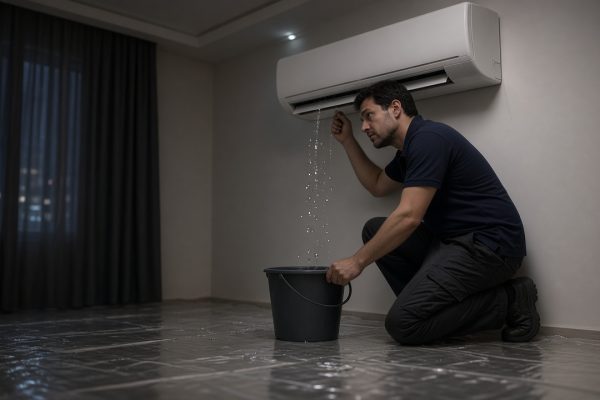
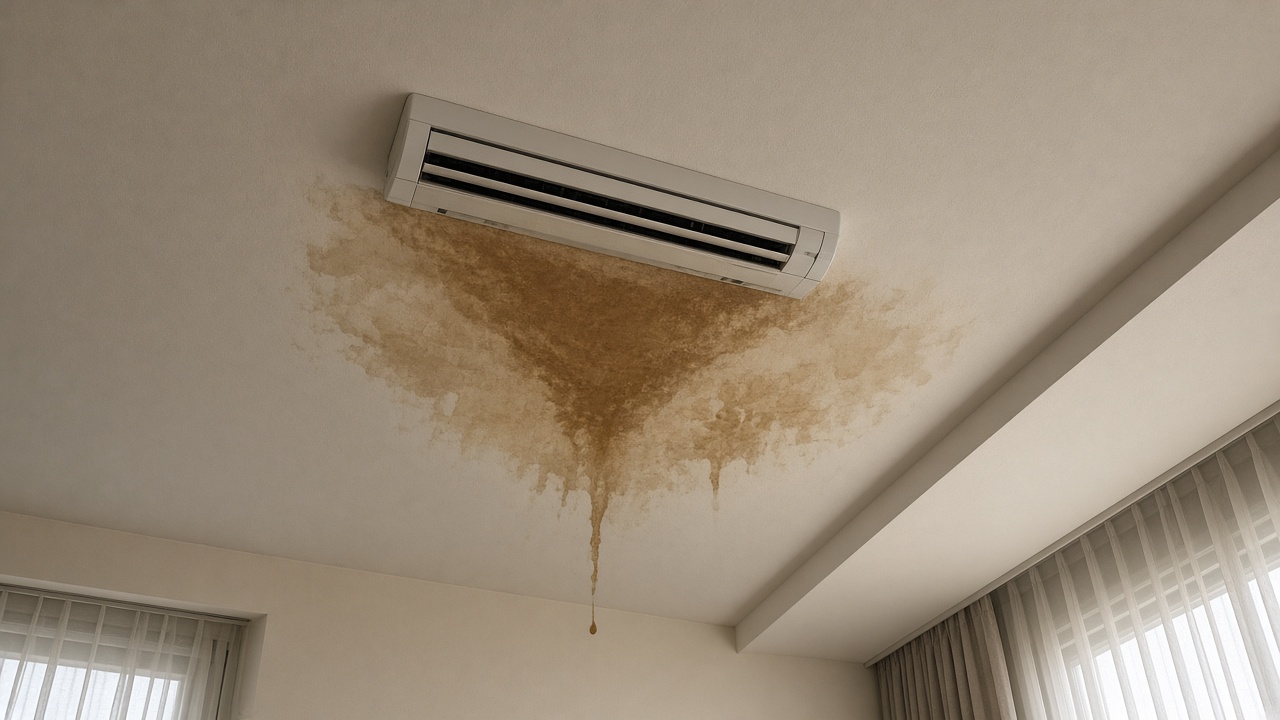
A joint that is already smelling will be hotter on the next start. The breaker may hold for a while because the fault is heat at a terminal, not yet a dead short. That delay is why people reset and go back to sleep. By morning the switch can be a solid lump, the conductor can have welded to the terminal, and the compressor may have been running on a partial connection long enough to open a winding. The repair that was a switch and a cut-back becomes a compressor quote. Water on the ceiling is a different emergency. This one is fire risk in a small plastic box, and it does not improve by waiting for a cooler hour.
What to say when you call
Say the district, that the smell is at the outdoor unit or the isolator, and whether you have already switched it off. A photo of the box, even a dark one, shows us if the cover is melted. Call +971 50 257 5128. The workshop is in Industrial Area 6, opposite the cricket stadium, and the work is Sharjah only. The electrical repair and any replacement switch are written down before they are fitted. The wider night call is described on our emergency AC repair in Sharjah page. Leave the isolator off until the current has been read on a remade joint.
If a part has actually failed, that visit is AC repair in Sharjah.
Keeping the same fault from returning is AC maintenance in Sharjah.