A car that blows cold on the move and turns warm in a Sharjah queue is telling you that ram air was doing a job the condenser fan or the refrigerant charge cannot do alone. At speed, air is forced through the condenser. At a signal in Al Nahda or a crawl on Al Wahda, only the electric fan moves that air, and a system that is a little short of gas has less margin as well. Air-Con.ae, the marketing name of Burj Al Qasimiah AC units fix cont., separates those causes in the workshop opposite the cricket stadium in Industrial Area 6. They are not separated by guessing at the kerb with traffic behind the car.
The vents can still blow hard. This complaint is temperature, not a blocked cabin filter. Weak airflow is a different visit. Here the air is there, and it is cold only while the car is moving.
Why speed hides the fault
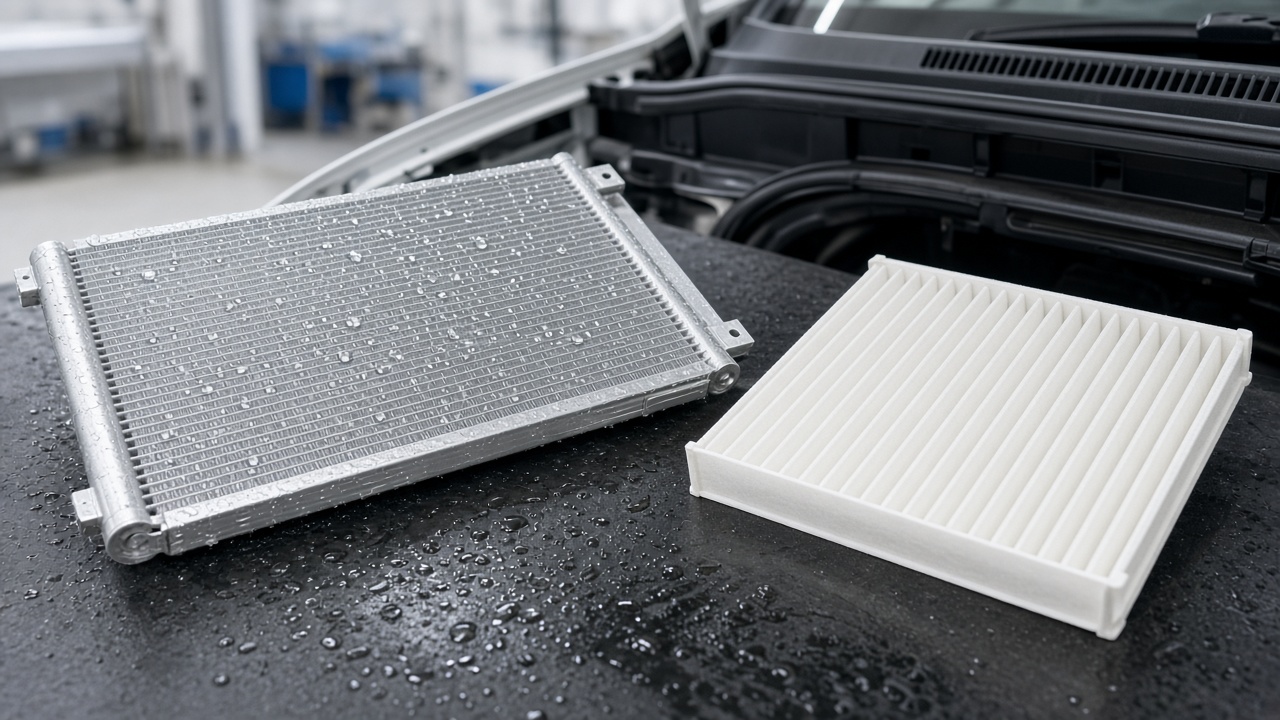
The condenser has to reject the heat the cabin and the compressor put into the refrigerant. It needs airflow to do it. On the road that airflow is free. In traffic it is the electric fan, switched by a relay, often with a pressure switch or the engine controller in the circuit. If the fan is seized, open-circuit, or never told to start, head pressure rises as soon as the car stops. The air from the centre vent climbs toward ambient. As soon as you pull away, ram air returns and the vent goes cold again. Drivers describe a car that is “fine on the ring road and useless in town”.
A low charge can imitate the same pattern. With enough refrigerant and enough air, the system still produces a cold vent at speed. At idle the condenser is less able to reject heat, pressures wander, the compressor may cycle on a pressure switch, and the vent warms. Adding gas on the roadside because the car felt cold for five minutes on a test drive does not tell you whether the fan ever started. Both faults live in the same symptom. The workshop test is how they are pulled apart.
The fan and the relay, watched at idle
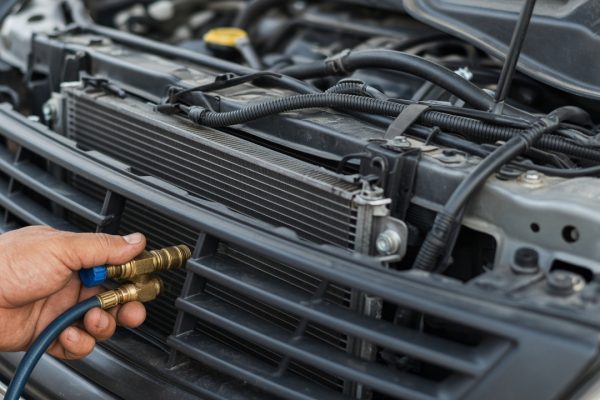
The car is brought in, the bonnet is opened, and the engine is held at idle with the air conditioning commanded on. We watch the condenser fan, not the radiator fan’s cousin if the car has two and only one serves the condenser. A fan that does not turn is not given a gas top-up. We check the fuse, the relay, and whether the fan is being commanded. A relay that has burnt its contacts is a common, small part. Substituting a known relay, or operating the fan on its own feed where the connector allows a safe test, shows whether the motor itself is alive. If the motor runs on a direct test and sits still when the system asks for it, the relay or the command is the quote. If the motor does not run on a direct test, the fan is the quote. Either figure is written before the part is fitted.
A fan that starts late, or that runs only on the high-speed setting, is written down as well. Some cars use two speeds. Low speed can fail and leave the condenser short of air at a long idle even though a blast of high speed appears when pressures are already too high. We do not call that fan “working” because it spun once when the high-pressure switch screamed.
A charge that still works with ram air
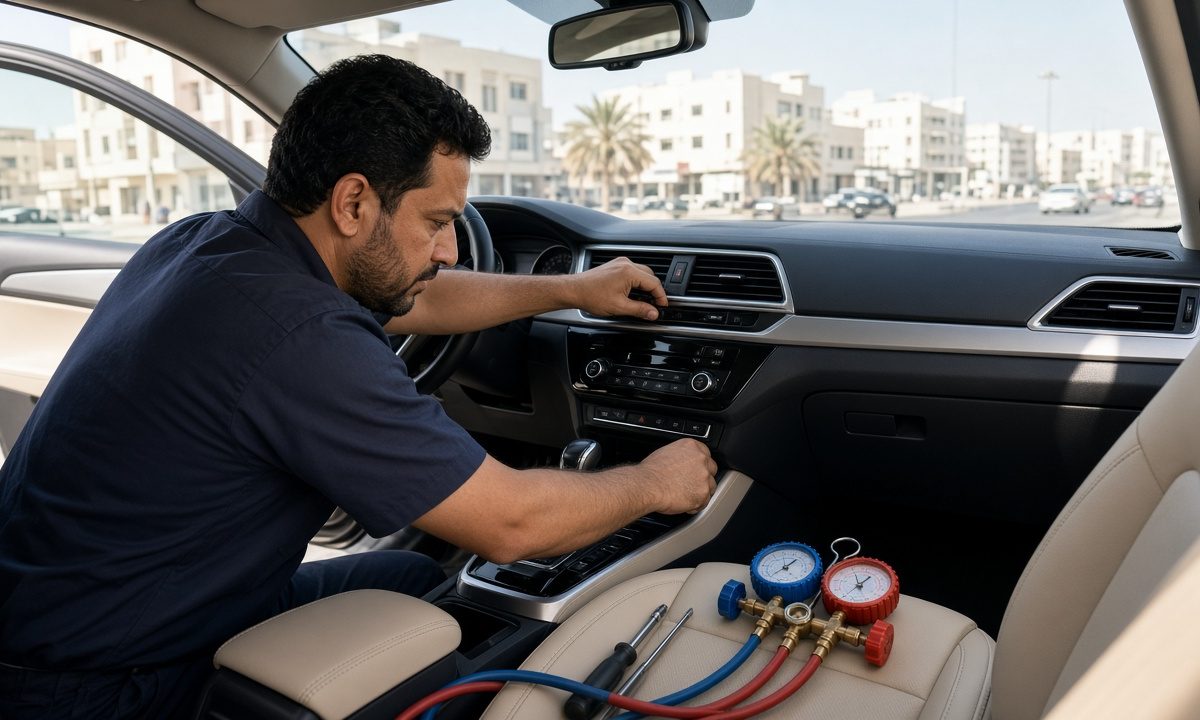
If the fan is running properly and the vent is still warm at idle, gauges go on. A system that is short of refrigerant often shows a weak low side and a high side that does not match the work the compressor is doing. We then give the condenser the airflow the road was giving it, with a workshop fan in front of the grille or by raising engine speed, and we watch the vent temperature and the pressures together. Improvement that appears only when extra air is forced through, on a system whose pressures already say the charge is low, is the low-charge pattern. Improvement that appears as soon as a dead fan is made to run, with pressures that were only high because the condenser was stalled, is the fan pattern. The two can exist together. We still do not add refrigerant until the fan is honest, because a charge weighed into a system with no idle airflow will mislead the gauges.
- Fan dead at idle, vent cold once the fan is made to run: relay, fuse, command, or fan motor. No gas yet.
- Fan running, pressures low, vent improves only with speed or a workshop fan: leak test, then a weighed charge.
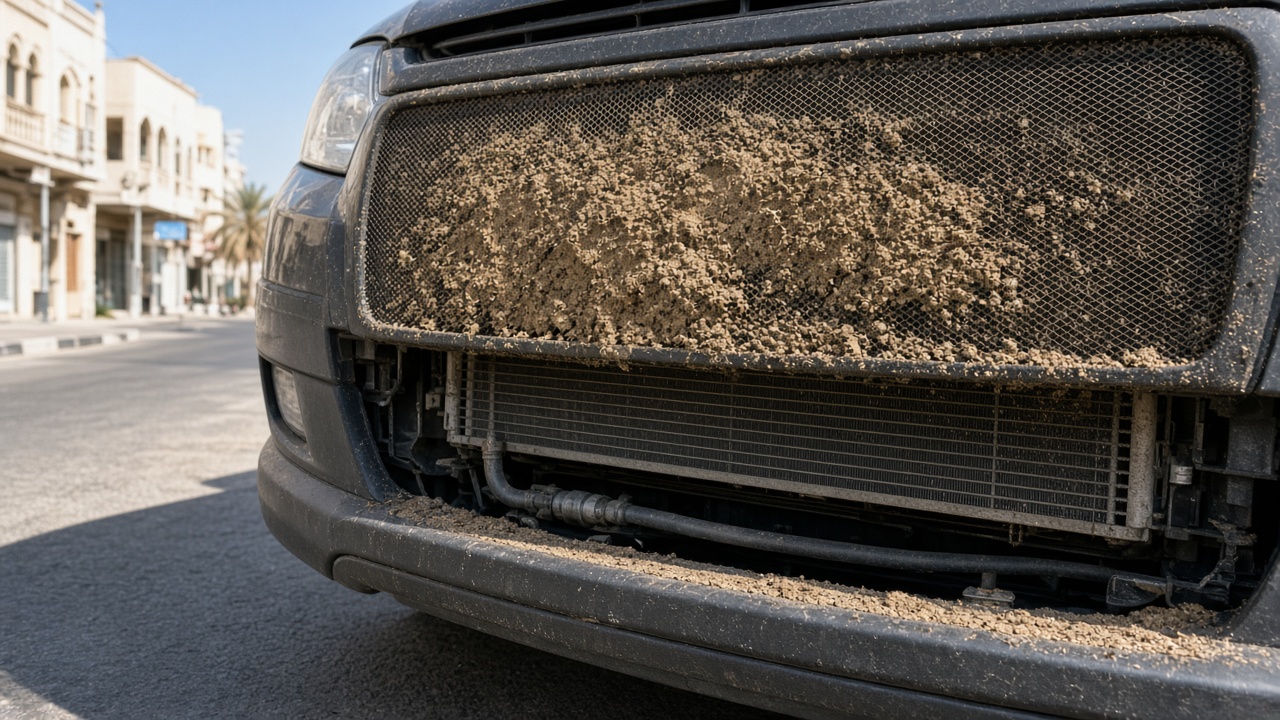
- Fan running, pressures already very high, vent stays warm: look at a blocked condenser face before a compressor is discussed.
A leak test comes before any refill. The condenser face, the service ports, and the hose joints are the usual places. A system that has been topped up in a car park every summer has been losing oil with the gas. We will not add another undocumented fill. The label under the bonnet decides the refrigerant. We do not mix types. A vacuum is held, and the charge is by weight for that vehicle, after the leak is repaired. That price is separate from the fan price, and both are approved before the work continues.
Why this is a workshop test
At the roadside you cannot hold a stable idle, watch the fan, connect gauges, and prove a leak while a queue forms. A short drive that feels cold tells you ram air still helps. It does not tell you which part to buy. In the workshop the same car can sit at idle for as long as the readings need, with a fan in front of the condenser as a stand-in for road speed, and with the relay in a hand rather than in a guess. After the repair we confirm at idle first. A road run is a check that the idle result survived, not the method that chose the part.
Compressor replacement is the expensive wrong turn on this symptom. A compressor that is noisy, that will not clutch in at all, or that has metal in the oil is a compressor job, and we will say so. A compressor that engages, and a vent that goes cold as soon as the fan runs or the charge is corrected, is not. We do not quote the compressor to cover a relay we have not tested.
What to tell us when you book
Say whether the vent is cold above a walking pace and warm in traffic, or warm all the time. Say if the fan noise behind the grille changes when you stop. A fan you can hear at idle is not proof it is the condenser fan, but it is a useful clue. Bring the car to Industrial Area 6, opposite the cricket stadium, where the idle test can be done properly. Call +971 50 257 5128 with the district you are coming from and the make of the car if you know it.
Price before parts
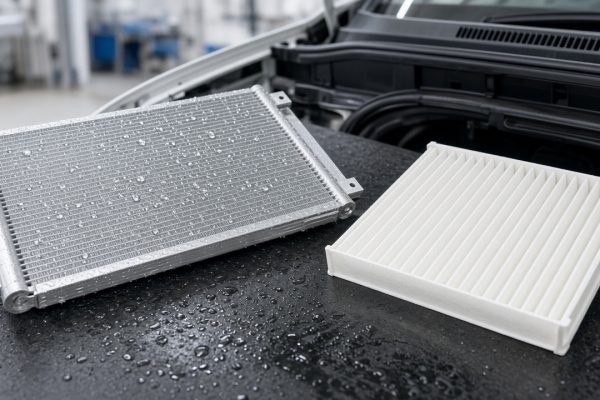
A cabin filter and a basic check are often AED 80 to AED 150, and we will still look at the filter so a second fault is not missed, but a clean filter does not fix this pattern. A relay or a fan motor is quoted after the idle test. A gas refill after a repaired leak is typically AED 150 to AED 350 depending on the charge size. Nothing is fitted before you approve the figure. Car air conditioning work is described on our car AC services in Sharjah page. If the air is weak as well as warm, say so. A blocked filter or a blend door is then part of the same visit, not a surprise at the end of a fan replacement.