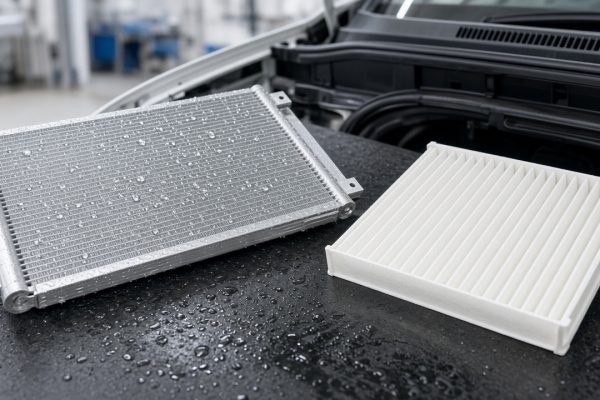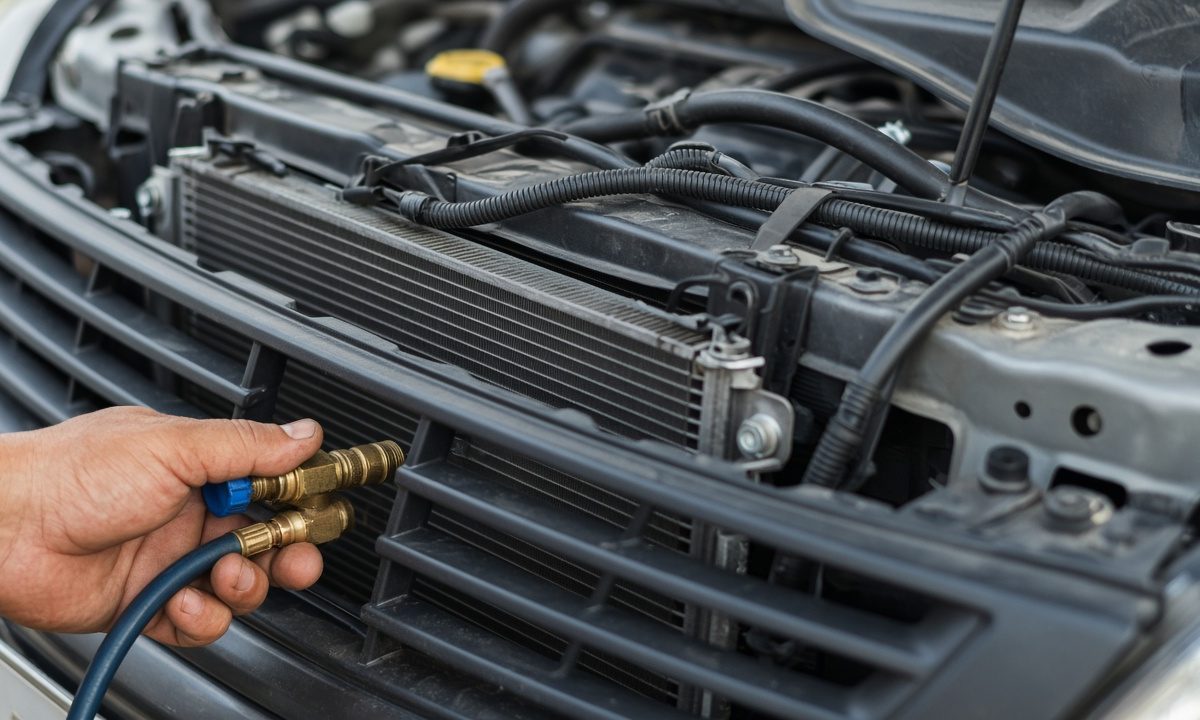
Sand in Sharjah does not stay on the road. It packs the condenser behind the grille, fills the gap between the condenser and the radiator, and turns a thin heat exchanger into a blanket. Head pressure rises, cooling at idle falls away, and the compressor is the part people are offered because the gauges look ugly. Air-Con.ae, the marketing name of Burj Al Qasimiah AC units fix cont., washes that sand out from the engine side before a compressor is discussed. The car is in the workshop opposite the cricket stadium in Industrial Area 6, where the wash and the pressures can be compared on the same afternoon.
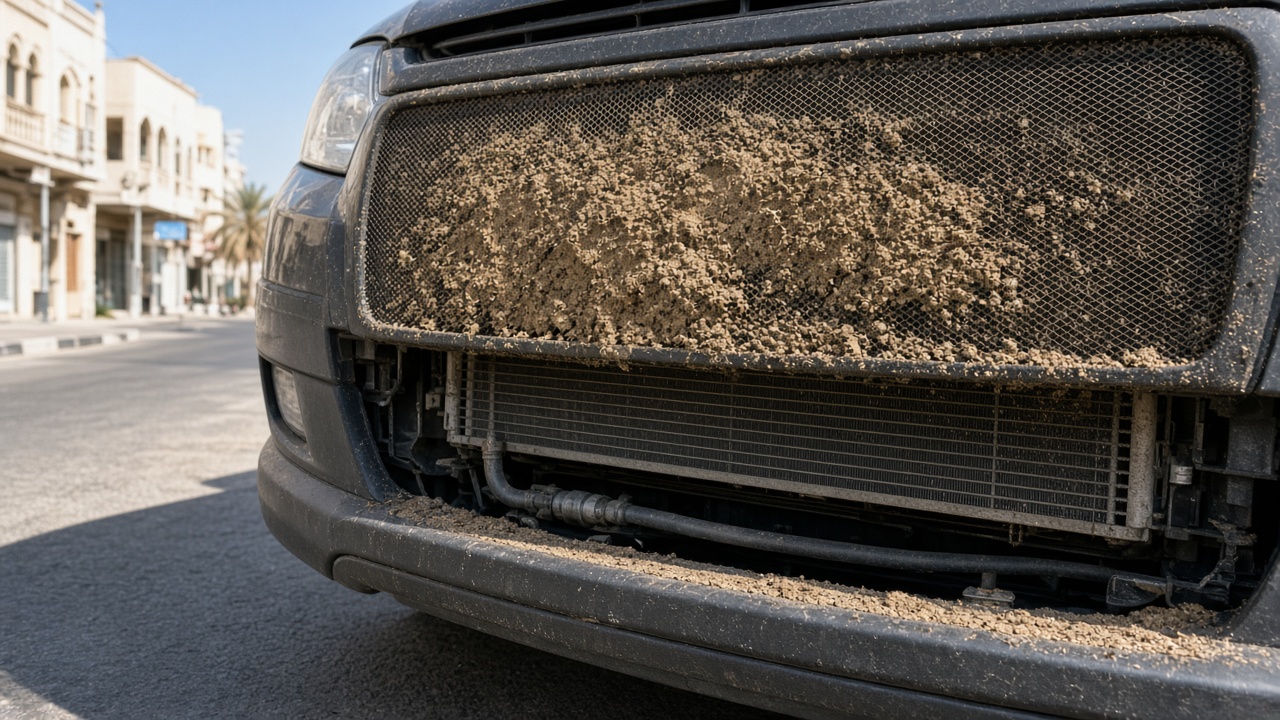
Cars that live in Industrial Area, or that spend the week on the ring roads, load this mat faster than a car that only moves between a basement and an office. The symptom is often the same one as a weak fan: cold enough on a short run, warm when the car sits still. A torch through the grille shows a brown felt that the outside of the bumper never hinted at.
What the sand does to the pressures
The condenser can only reject heat where air can pass the fins. A layer of fine sand, sometimes mixed with the fluff that sheds off the road, blocks that path. At speed a little air still forces through, so the vent may be acceptable on a moving test. At idle the electric fan cannot pull through a choked core, head pressure climbs, and the high-pressure switch may cycle the compressor. The clutch clicks in and out. From the cabin that feels like a compressor that is “weak” or a system that “needs gas”. Low gas usually pulls the low side down. A blocked condenser pushes the high side up. The gauges can tell those apart only if somebody has looked at the fins first. Adding refrigerant to a choked condenser makes the high side worse.
The mat is not always on the face you can see. Bumpers and grilles hide the front. The thicker deposit is often in the narrow gap between condenser and radiator, where sand enters from below and has nowhere to go. A quick hose from the outside drives that sand deeper into the gap. That is why the wash has a direction.
Washing from the engine side
The grille comes off when the bumper design traps the core, which is most cars we see from Industrial Area. We wash from the engine side, through the radiator toward the condenser and out through the front, so the water carries the sand out of the car rather than into the radiator. Pressure is kept low enough to avoid folding the fins flat. Fins that are already folded over a patch are opened only where they block a slab of the core. A folded fin still passes some air. A fin hammered shut by a pressure washer passes none.
Where the gap is packed solid, the cores have to be separated enough to flush the felt out, not merely wetted. We put the covers back only when light passes the fins and the fan can pull without a whistle of blocked mesh. The electric fan is checked after the wash. A fan that was struggling against a choked core can also be tired on its own, and a clean condenser with a dead fan will go warm in traffic again. That fan is quoted as its own line if the test shows it.
A new compressor is not the first part
High head pressure, a cycling clutch, and warm idle air are what a failing compressor can cause. They are also what a sandy condenser causes while the compressor is still doing its job. The order is airflow, then pressures, then a decision. After the wash we run the system at idle and read the vent and the gauges again. If head pressure has come back into a normal relationship with the fan running and the vent goes cold, the compressor stays. The quote you do not get is the expensive one.
- Sand in the fins or the gap, pressures high: wash from the engine side, then measure again.
- Core clean, fan dead: the fan or its relay, not a compressor and not a blind gas fill.
- Core clean, fan running, pressures still wrong, or metal in the oil: then the compressor is a real conversation, with the drier included if the system has to be opened.
A compressor that has been slugged or overheated by weeks of high head pressure can still be damaged after the sand is gone. We do not hide that. Noise when the clutch pulls in, a high side that will not fall even with a clean core and a working fan, or debris in the oil, are reasons to quote the compressor. The quote comes after the wash, so you are not buying a compressor to push against a blanket of sand, and the new one is not installed in front of the same blocked radiator. If the system is opened, the receiver-drier is part of that quote, not an extra discovered at payment.
What the idle test shows after the wash
The useful comparison is written down: vent temperature and a note of the pressures before the wash, at idle, and the same two after. “It feels better” is not the record. A vent that drops and stays down at idle, with the fan running and no sand left in the gap, is a finished job. A vent that only goes cold when the engine is revved still has an airflow or a charge problem, and we stay with it rather than handing the car back because the fins look wet.
Leak signs are separate from sand. Oily dust on the condenser face, as opposed to dry sand, means refrigerant oil has been carrying dirt to a pinhole. We do not wash that away and pretend it was only the ring road. The oily patch is marked, the leak is repaired, and then the core is cleaned. Dry sand with no oil film is the article you are reading. Oily sand is a leak that happens to live in a sandy city.
How often this returns
A car that parks in Industrial Area and runs the ring roads will collect another layer. We do not sell a monthly compressor. We do say that a condenser which was packed solid will pack again, and that a wash is the maintenance, not a one-time miracle. If the grille design is a scoop for sand, we show you where it gathers so a later wash is asked for before the idle cooling disappears. A fine mesh added in front of the condenser that then clogs in a week is not an improvement. The core has to breathe.
Booking the wash
Call +971 50 257 5128 and say the cooling is poor at idle and the car lives in Industrial Area or spends its time on the ring roads. The workshop is in Industrial Area 6, opposite the cricket stadium. Bring the car in. A grille-off wash is not a roadside splash. A basic check is often AED 80 to AED 150. The wash is priced before we start if the bumper has to come off, because that labour is not the same as a rinse through the slats. A compressor, if the readings after the wash still require one, is a separate written price.
Car air conditioning work sits on our car AC services in Sharjah page. If the fan behind the grille never runs, say that too. Sand and a dead fan together are common, and testing the fan after the wash is already part of the visit. We would rather know the fan is silent before the car arrives than discover it only after the fins are clean.