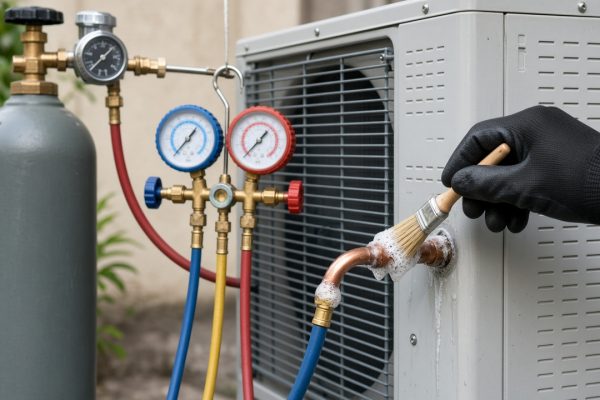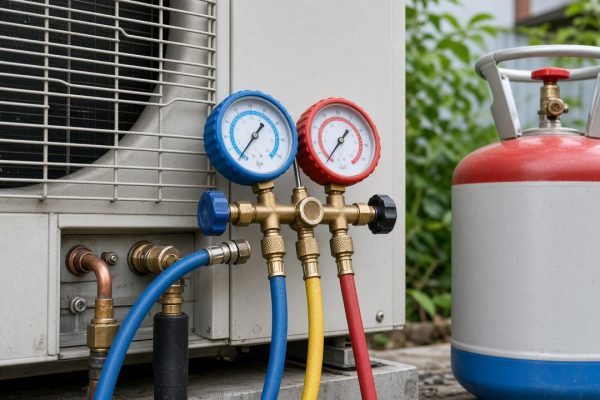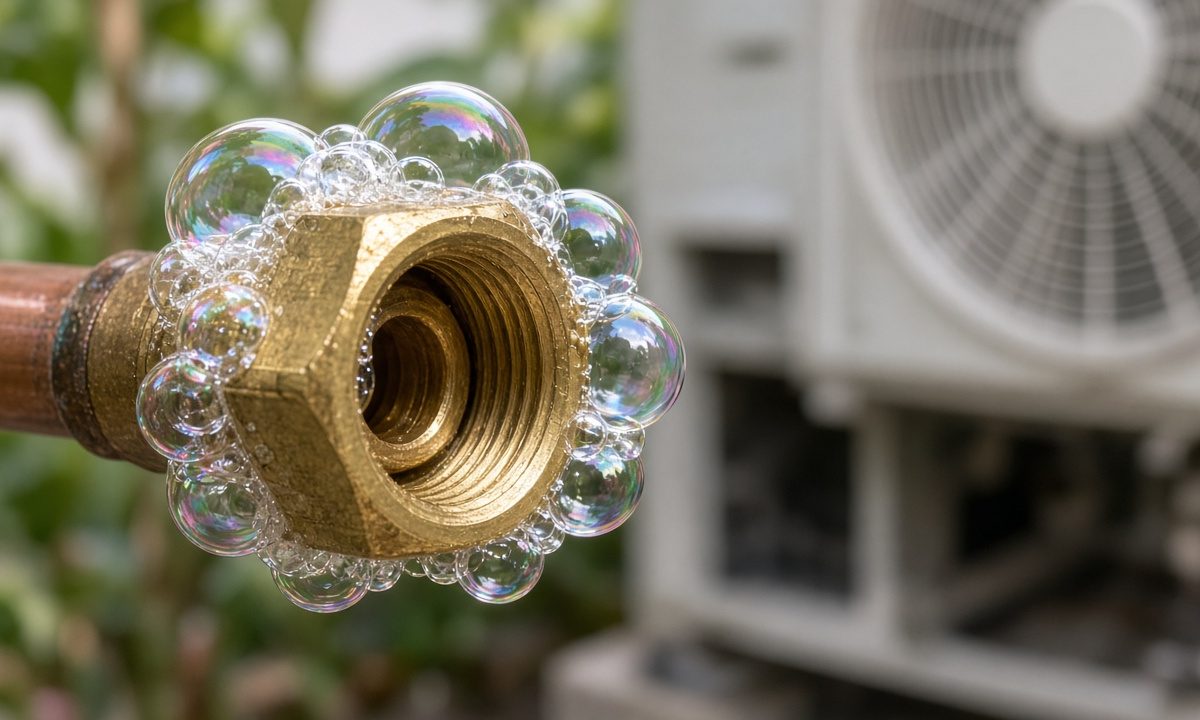
The flare nut on a split is a copper cone pulled against a brass seat. It is the joint we find leaking more often than the compressor shell. Heat on a roof, a nut that was tightened by feel, and a flare that was cut on copper that was not square all open a path. Refrigerant leaves. Oil leaves with it. Topping the system and leaving the nut as it is puts the same warm room back on the phone a few weeks later. The leak is found first. The cylinder stays shut until the joint holds.
Leak repairs are carried out by Burj Al Qasimiah AC units fix cont., the company behind the Air-Con.ae name, and only inside Sharjah. The base is the Industrial Area 6 workshop opposite the cricket stadium. Indoor flares behind the casing are common in Al Nahda apartments, where the joint is hidden by the cover and the insulation. Outdoor flares on Muwaileh villa roofs see full sun and crack at the cone. Al Majaz balconies add a third case: a nut that was disturbed when the outdoor unit was shifted to paint the wall, then snugged until it stopped turning.
Oil, then soap
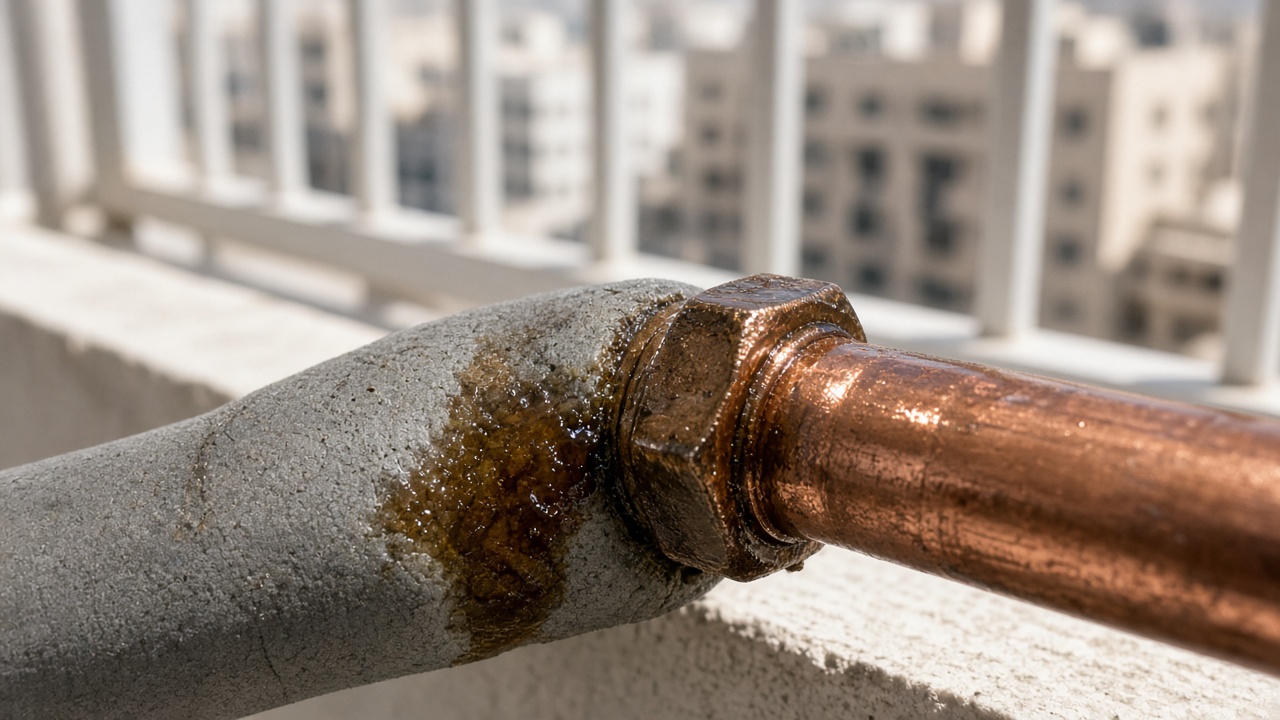
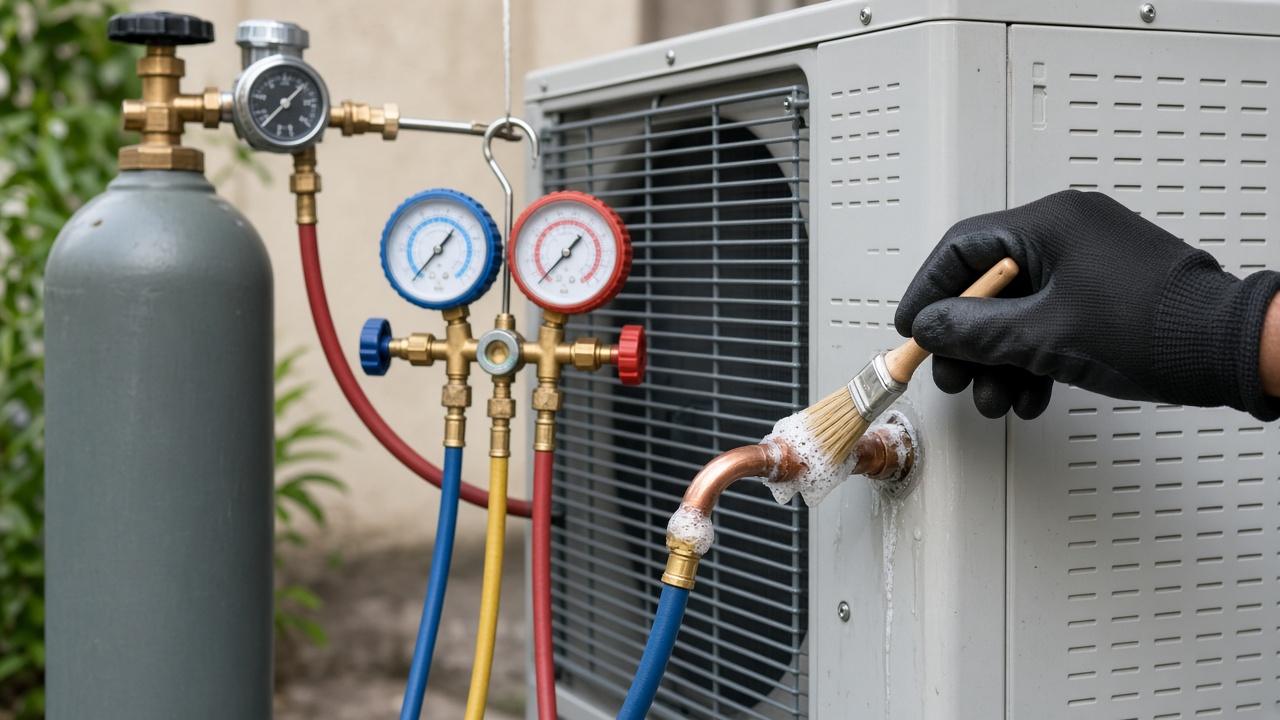
Refrigerant oil travels out of a leaking joint and leaves a wet dark mark. We pull the insulation back rather than trusting the outside of the armaflex, because the oil sits on the copper underneath. A dry, dusty flare is not given a free pass, but an oily one is the first place the soap goes. The solution is a proper leak-detection soap, brushed on the flare face, the service-valve caps, and the Schrader cores while the system still has pressure. A growing bubble is the leak. Washing-up liquid left thick on the nut only makes a mess and can hide a slow seep. The bubble test needs pressure. A system that is already empty will not bubble, no matter how carefully the soap is mixed.
Nitrogen when the charge is already gone
An empty system is tested with dry nitrogen, not with shop air and not with oxygen. Air carries moisture, and oxygen has no place in a refrigerant circuit. The nitrogen is brought up to a test pressure suited to the gas on the nameplate. An older R22 machine is not tested at the pressure used on an R410A or R32 machine, because the design pressure is lower. The gauge is watched. A steady drop is a leak somewhere in the section we have isolated. Soap goes on the joints while the nitrogen is in them, so the joint that is falling is the one that bubbles. If the whole line set drops, we split the test: indoor flare, outdoor flares, and the service valves, one at a time. A valve core that was depressed and left slightly off its seat bubbles at the port even when the flare cone is perfect.
Dye when the leak is slow
Ultraviolet dye is for a system that holds a short nitrogen test and still loses charge over weeks. The dye travels with the oil. After the unit has run, a lamp shows the joint that is weeping. Dye is not the first tool, and it is not a repair. A flare that already bubbles does not need dye, a wait, and a second visit. We also do not keep adding dye on top of old dye and calling the stain a fix. Once the joint is identified, it is remade.
Remaking the flare
The nut comes off and the cone is inspected. A crack, a flare that was over-tightened until the copper split, or a cone cut on oval pipe will not seal if it is only turned harder. Harder on a split flare opens it further. The damaged end is cut off square, the pipe is deburred so a lip of copper does not stay inside the line, and a new cone is cut with a flaring tool. The seal is the cone against the seat. Tape on the threads does not make that seal, and scraps of tape inside the pipe do not belong in the compressor. Each pipe size on a Sharjah split, from the small liquid line to the larger suction line, has its own torque. We use a torque wrench rather than stopping when the nut feels tight. Feel is how the original leak was made.
The lines are then vacuumed with a micron gauge, not with a manifold needle and a guess. The pump runs until the reading is properly down, then the pump is valved off. A needle that climbs straight back up is a leak we have not finished, or moisture still boiling out of the oil. Moisture in an R410A or R32 system, both of which use oil that absorbs water, becomes acid later. We pull the vacuum again until the reading stays down. Only then is the charge weighed in from the cylinder the nameplate names. Longer pipe than the factory precharge adds the grammes printed on the plate per extra metre. The pipe is not filled until it feels cold.
- Oil under the insulation marks the joint to test first.
- Soap needs pressure. An empty system needs nitrogen before it can bubble.
- Shop air and oxygen are not test gases.
- A split or cracked cone is recut. It is not tightened again.
- The vacuum has to stay down after the pump is isolated.
- The charge is weighed to the plate after the joint holds.
Supporting the indoor joint, and the valve core
On a wall split the indoor flare often sits above the coil, behind the casing, on soft copper. Turning the nut without holding the pipe twists the header. A twisted header leaks inside the cabinet, and soap left on the nut stays quiet because the hole has moved. We support the pipe so the coil does not take the turning force. In an Al Nahda flat that joint is reached from the front once the cover is off. On a Muwaileh roof the usual failures are the outdoor flares, hotter to the touch through the afternoon and more often split at the cone after years of expansion and cooling.
A Schrader core in the service port can seep while every flare cone is sound. Bubbles appear at the port when the cap is removed, or the cap is oily because it has been the only seal. The core is changed with a tool that keeps the remaining charge from dumping, when the system is not already being recovered. It is a small part, and the price is still written before it is fitted. Weighing in a fresh charge and leaving a tired core is how the same gas has left again by the following month. The cap is put back properly afterwards. A missing cap lets dust sit on the core and gives the next leak a place to start.
Why a top-up of R410A comes back
R410A runs at a higher pressure than the older R22 machines still sitting on some Al Nahda ledges. The same pinhole loses charge faster. A top-up leaves the pinhole exactly as it was, so the room is warm again in weeks, sometimes sooner on a roof that sees afternoon sun. R410A is also a blend. Adding it carelessly as vapour can shift the mixture that is left in the pipes, so the pressures no longer match the chart even when someone has “put enough gas in”. The sound repair is to recover what remains, remake the flare, vacuum, and weigh in virgin refrigerant as liquid so the blend stays in proportion.
R32 and R22 are not stand-ins
R32 is a single gas and it is mildly flammable. R22 uses a different oil and a lower working pressure. Neither is a substitute for R410A, and they are not substitutes for each other. Putting the wrong cylinder on a flare you have just repaired fills a tight system with the wrong fluid. The compressor is the part that pays for that. If the plate is sun-bleached we photograph the indoor data plate or the panel inside the outdoor cover before any hose is fitted. No plate, no guess. Call +971 50 257 5128 with the district and say if you can see oil on the copper. The refill, after the leak is actually repaired, is the job on the AC gas refill in Sharjah page. The price is written on site before parts, including a new nut or a valve core, are fitted.
After the joint is remade
A new flare is not trusted because it looks bright. Nitrogen is put in the repaired side and the joint is watched with soapy water for a steady stream of bubbles, not a single bubble that was already on the brush. The pressure is held long enough to see a slow leak, not just a burst.