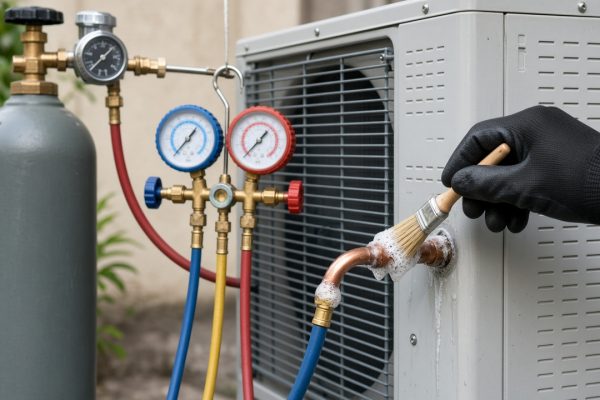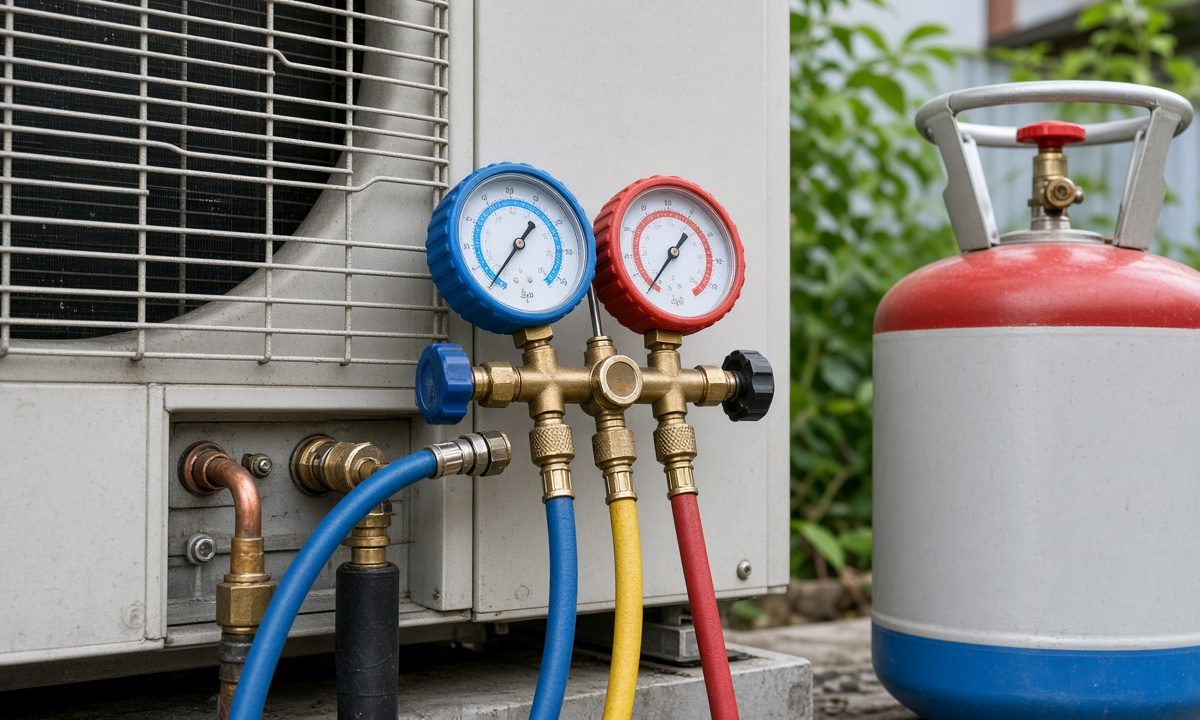
A split does not use refrigerant the way a car uses fuel. The same charge travels from the compressor to the outdoor coil, through the metering device, through the indoor coil, and back. If the pipes are tight, the amount in that loop next summer is the amount that was weighed in. When someone says the gas is finished and needs topping every June, they are describing a leak, or they are describing a dirty coil and selling a cylinder anyway. Low gas in Sharjah is real. It is also the easiest line to sell to a warm room.
On the invoice the company is Burj Al Qasimiah AC units fix cont., marketed as Air-Con.ae. Gauges stay in the van until the checks that mimic a low charge have been done. The workshop is in Industrial Area 6, opposite the cricket stadium, and we do this in Sharjah only. Al Nahda ledges, Al Majaz balconies, and roof condensers on Muwaileh villas all lose charge at joints. They also ice up from choked filters. The visit has to separate those before a cylinder is opened.
What has to pass before the gauges come out
Air across the coil
A felt-covered evaporator or a bridged blower wheel starves the coil of heat. The suction line ices and the room stays warm with a full charge still in the pipes. We look at the filter, the fin face, and the wheel, and we feel the air at the louvre, before any hose is connected. If the coil is dirty, it is cleaned and dried first. Pressures read on a choked coil point at the wrong fault. Ice is melted on fan-only. The compressor is not started against a solid block of ice.
The capacitor and the compressor, actually running
On a fixed-speed split the dual capacitor is tested against the microfarad value printed on the can. A weak capacitor lets the indoor fan blow while the compressor hums and stops, or the outdoor fan never starts. The room never cools. That is an electrical part, and the price is written on site before the capacitor is fitted. It is not a gas refill. On an inverter there may be no compressor capacitor at all. We confirm from sound and from current that the compressor and the outdoor fan are both running. Indoor air moving, and silence outside, is not a low charge.
A clean outdoor coil
Dust packed into the condenser fins keeps the heat in the refrigerant. Head pressure rises, the compressor works hot, and the indoor air is only mildly cool. Adding gas to a buried outdoor coil makes the head pressure worse once the afternoon sun is on a Muwaileh roof or an Industrial Area ledge. The outdoor coil is washed through, from the inside of the fin outward, if it is the obvious restriction. Only then do the gauges mean what they appear to mean.
The signs that justify gauges
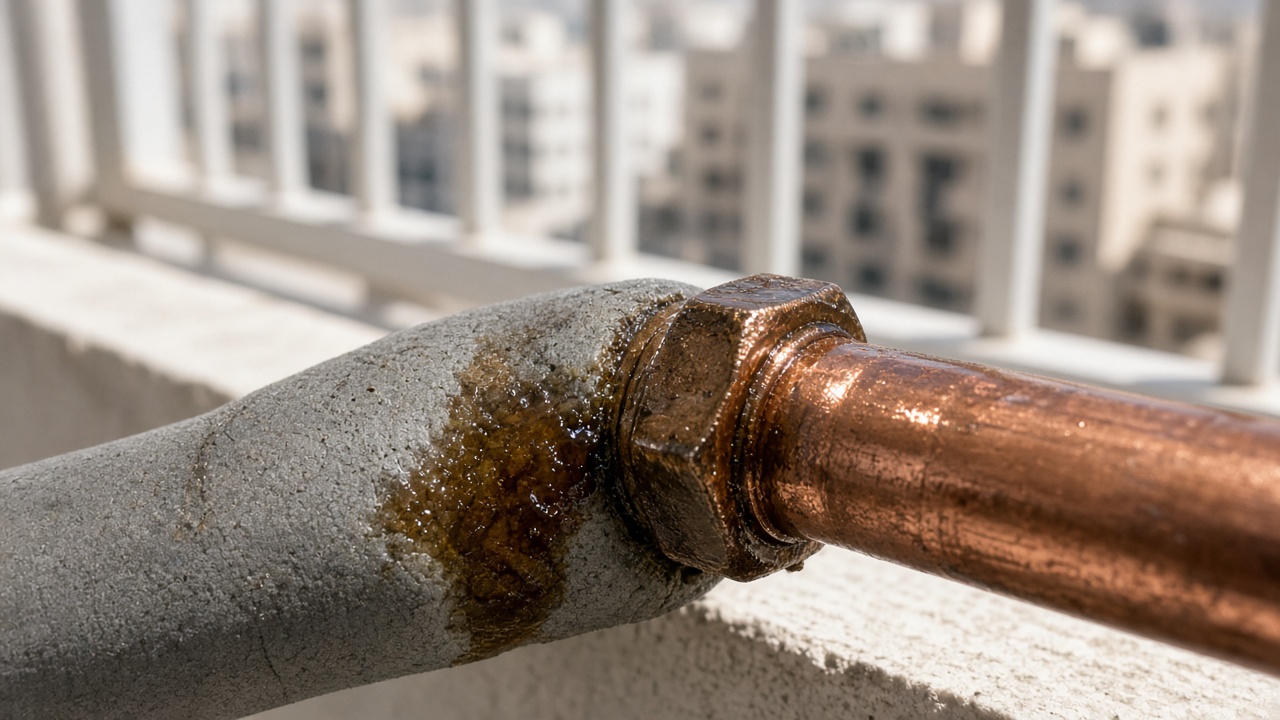
Three findings, after the checks above, are why the manifold comes out. The first is ice on the suction line or the indoor coil when the airflow is genuinely strong and the fins are bare metal. The second is oil at a flare, a service valve, or a dark wet patch under the insulation. Refrigerant oil leaves with the gas, so a wet joint is a leak you can see. The third is warm supply air after the coil is clean, the blower is clear, and the capacitor or the inverter run-test has passed, with the compressor actually pumping. Any one of those is enough to measure. A room that feels warm at 2pm, with a dirty filter and a fan that barely moves the curtain, is not enough.
- Ice plus strong air plus a clean coil: measure.
- Oil at a flare or under the insulation: find the leak, then measure.
- Warm supply after the coil, the wheel, and the run-test pass: measure.
- A silent compressor or a failed capacitor: do not open a cylinder.
- A felt-covered coil: clean it, then decide if a leak is still there.
What the readings are for
Low suction pressure together with high superheat and weak subcooling fits a system that is short of refrigerant. The coil is not being fed enough liquid, so the vapour leaving it is too warm. Low suction with low superheat fits poor airflow or a metering problem, and adding gas makes that worse. High head pressure fits a dirty condenser, a stopped outdoor fan, an overcharge, or air left in the pipes. We write the pressures down. We do not add refrigerant until the pipe “feels cold”. Feeling the insulation is not a charge.
Most inverter splits in these districts are weighed. The nameplate gives the factory charge, and extra pipe beyond the precharged length adds a stated amount per metre. Superheat is still useful as a check, but it is a poor way to invent a charge on an electronic expansion valve. Older fixed-speed machines with a capillary can be set more carefully by superheat once the leak is repaired, and even those are weighed when the plate is readable. The cylinder that matches the plate is the only cylinder opened. R410A, R32, and R22 are not topped from whichever bottle is lightest to carry.
A restriction can imitate a low charge
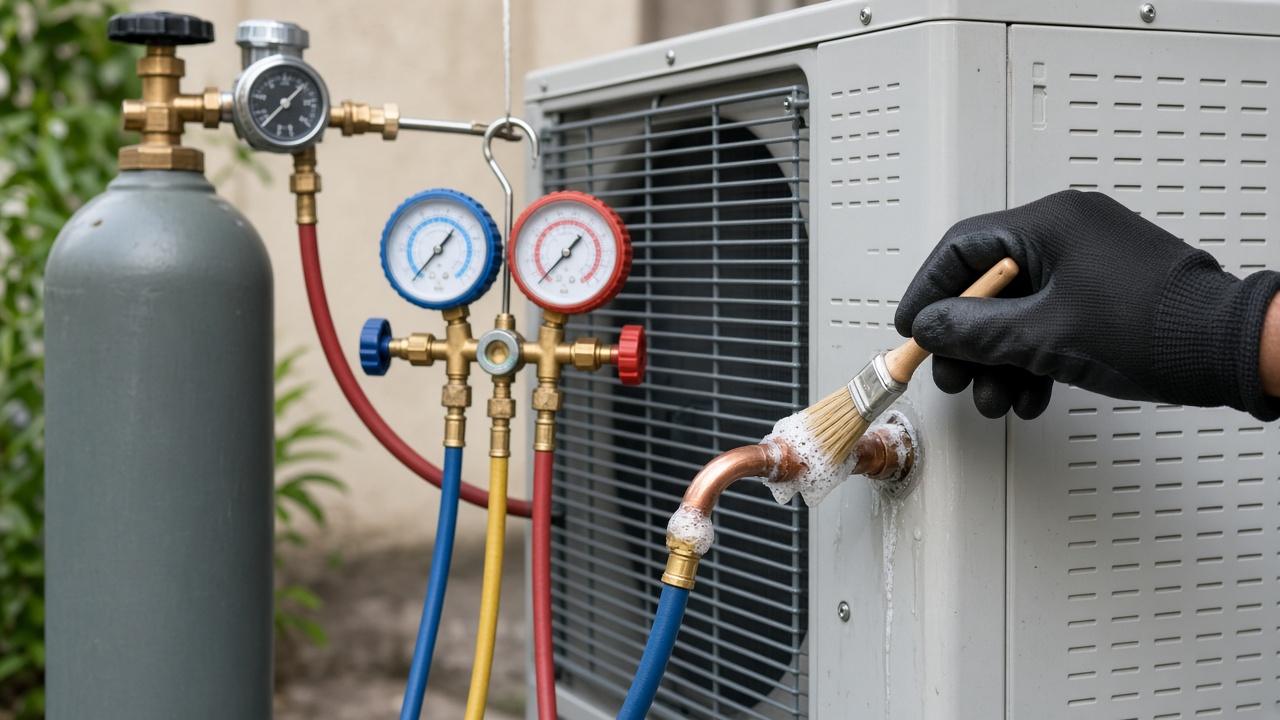
Low suction is not always an empty system. A capillary that has been pinched, or a filter-drier blocked with debris from a compressor that is starting to fail, starves the indoor coil in a similar way. Ice appears, the room stays warm, and a quick reading looks short of gas. The flares may be dry, and a nitrogen test may hold. Adding refrigerant does not open a blocked capillary. When the ice later melts, liquid that was held back can return to the compressor. A true undercharge tends to pull the high side down as well as the low side. A blocked metering device often keeps the high side up while the low side collapses. The drier or the damaged capillary is then the part to replace, and it is priced on site before it is cut in.
Afternoon air in Sharjah moves the head pressure even when the weight of refrigerant is correct. A condenser boxed into a walled niche, or a roof unit that pulls its own hot discharge straight back into the coil, runs a high head in July because the outdoor air is already hot. The repair is the air path: a cracked fan blade, a coil packed on the inner face, or a parapet that will not let discharge air escape. Another top-up makes that head pressure worse. We write down the air temperature at the coil face and whether the fan is recirculating, and those notes sit beside the pressures so the next visit does not start from a blank page.
The sales line, and the real leak
A sealed system that needs gas every summer has a hole. Each top-up without a repair leaves the hole the same size. Oil leaves with the refrigerant, and the compressor runs with poor oil return until it fails. Three cheap top-ups cost more than one flare repair and a weighed charge, and the compressor has been starved in the meantime. We will not add gas to a joint that is still oily and still open. The leak is repaired, the lines are vacuumed, and the charge is weighed. The price of the joint and the gas is written on site before the cylinder is opened.
If the compressor never starts, the visit is a repair, not a refill. Call +971 50 257 5128 with the area in Sharjah, whether you can see ice, and whether anyone has added gas before. Bring the old invoices if you have them. They show how fast the charge is leaving. The work is described on the AC gas refill in Sharjah page. A dirty coil that still cools is a clean, not a cylinder.
What the gauges are allowed to decide
Gauges go on after the filter, the blower, and the outdoor coil have been ruled out, and after the compressor is proven to be running. A standing pressure with the unit off only tells you there is some refrigerant in the system. It does not tell you the operating charge. We read suction and head while the compressor is on, with the indoor fan at a known speed and the room door shut, and we compare that with the line temperatures. Low suction plus a suction line that is not cold, on a clean coil, is the pattern that justifies a leak search. Low suction with a dirty coil is the coil.
A top-up without a leak repair is a second invoice in a few weeks. We say that before the cylinder is opened.