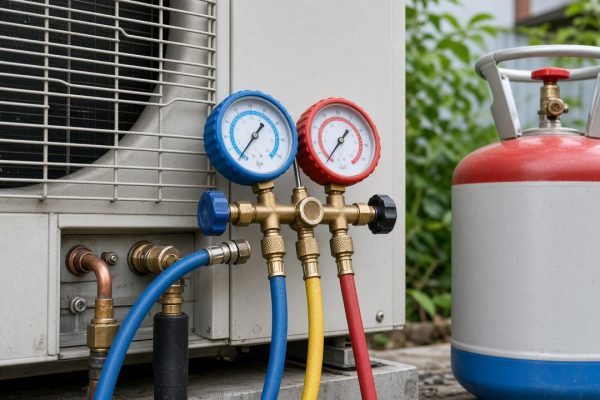
The outdoor nameplate decides the cylinder. It names the refrigerant and the factory charge in grammes. Everything else on a gas visit follows that plate: which manifold is safe, which oil is already in the compressor, which recovery cylinder is allowed to receive the old charge, and how the new charge is weighed back in. Age of the building is a hint, not a diagnosis. An older tower in Al Nahda can hold an R22 split on one floor and an R32 split on the floor above, replaced last year. Gauges go on after the plate is read, not before.
Refrigerant work is done by Burj Al Qasimiah AC units fix cont. under the marketing name Air-Con.ae, from the workshop opposite the cricket stadium in Industrial Area 6. Gas work stays in Sharjah. We carry R410A and R32 because those are the charges on current wall splits, and we still meet R22 on older machines around the industrial streets and in flats that have not been changed. The three are not mixed to save a trip back to the workshop.
What the plate is telling you
R22 on the older machines
R22 sits at a lower working pressure than the newer gases. The oil in those compressors is mineral oil, or sometimes alkylbenzene, not the synthetic oil used with R410A and R32. The service port is usually the smaller quarter-inch fitting. A manifold and hoses built for that era are often the wrong tools once the plate says anything else. R22 is used only where the machine was built for it. It is not a top-up for a modern inverter, and a modern gas is not tipped into an R22 compressor because the bottle was already on the roof.
R410A as a blend
R410A is a blended refrigerant. It has to be charged as liquid so the mixture that enters the pipes stays in the proportion the compressor and the expansion device expect. Charging it as vapour from a cylinder that is nearly empty changes that proportion. The pressures then refuse to match a standard chart, and the next technician cannot tell a leak from a bad blend. The factory charge on the plate is the starting number. Extra liquid and suction pipe, beyond the length the unit was precharged for, adds the grammes the manufacturer prints per metre. A roof run on a Muwaileh villa is often longer than a balcony run in Al Majaz. The two houses are not the same weight of gas.
R32 as a single gas
R32 is one substance, not a blend, so it does not separate in the cylinder the way a neglected R410A charge can. It still has its own oil, its own charge weight, and its own handling. It is mildly flammable. Recovery and charging stay outdoors at the condenser, with equipment rated for that gas, not in a closed store room. Many of these splits use a 5/16 inch service port rather than the quarter-inch port of an R22 unit. Forcing the wrong hose damages the valve core. An adapter is chosen before the connection is made. R32 is not a clever top-up for an R410A system, even though R32 is one ingredient of that blend. The plate says one or the other.
Oil, recovery, and why mixing wrecks the compressor
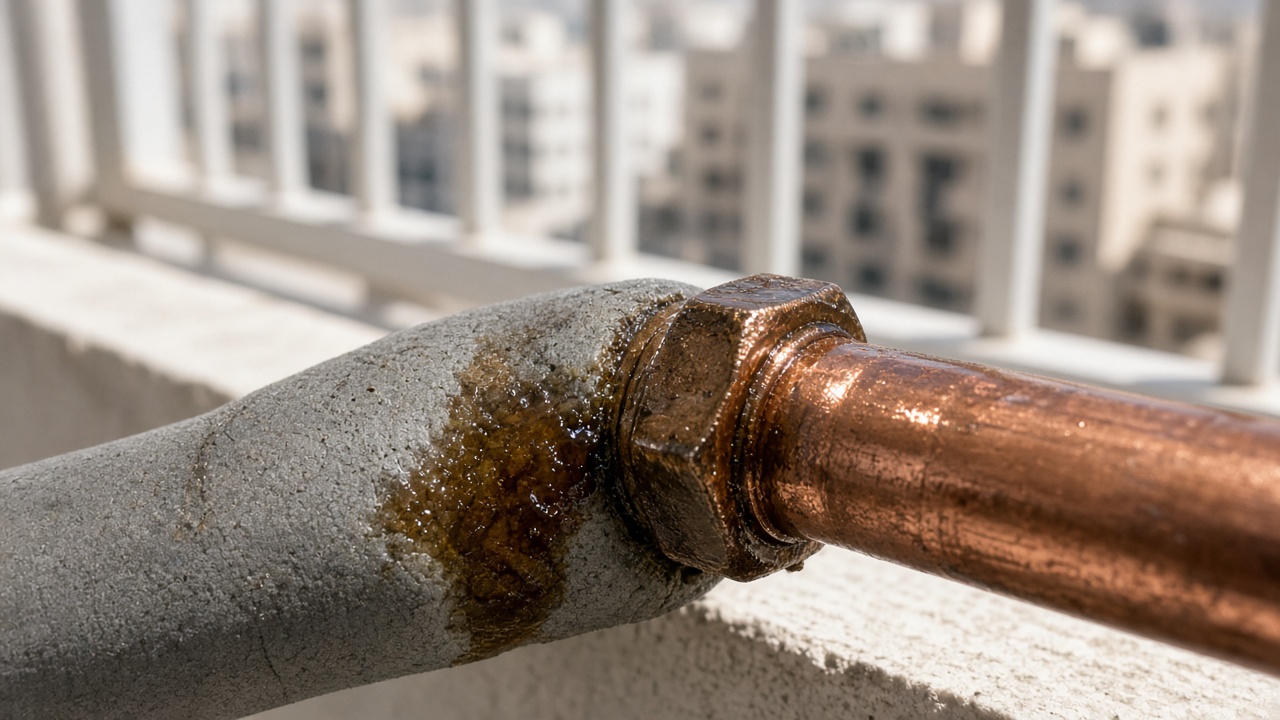
Mineral oil and the synthetic oil used with R410A and R32 do not behave as one lubricant. Mineral oil does not travel properly with the newer refrigerants. It drops out and sits in the evaporator and the lines, while the compressor bearings run short. The motor may still turn for a while. The failure shows up later as a mechanical noise or a compressor that will not pump. Mixing the gases themselves makes a third fluid that is on nobody’s pressure chart. Suction and head readings then cannot be turned into a saturation temperature, so every later visit is a guess. Moisture makes this worse in the synthetic oil, which absorbs water from the air as soon as the system is left open. That water becomes acid and attacks the windings.
Before a system is opened it is recovered into a cylinder labelled for that refrigerant, with room left by weight. R32 does not go into the R410A cylinder. R22 does not go into either. Venting the charge off a balcony in Al Nahda is not a recovery method. If a previous visit has already mixed unknown gas, we stop. Adding a third product to “balance” the pressures is how the compressor is finished. The honest repair is a new compressor and a flushed or replaced circuit, then a vacuum and the gas on the plate. That price is written on site before any of it is fitted. We do not discover the mixture, add more, and leave.
- Read the outdoor plate, or the indoor plate if the sun has destroyed the outdoor sticker.
- Match the manifold and the port adapter to that gas.
- Recover into a cylinder for that gas only.
- Leave the system open for as short a time as possible where the oil absorbs moisture.
- Weigh the new charge. Do not mix a second refrigerant to chase a cold pipe.
Charging without guessing
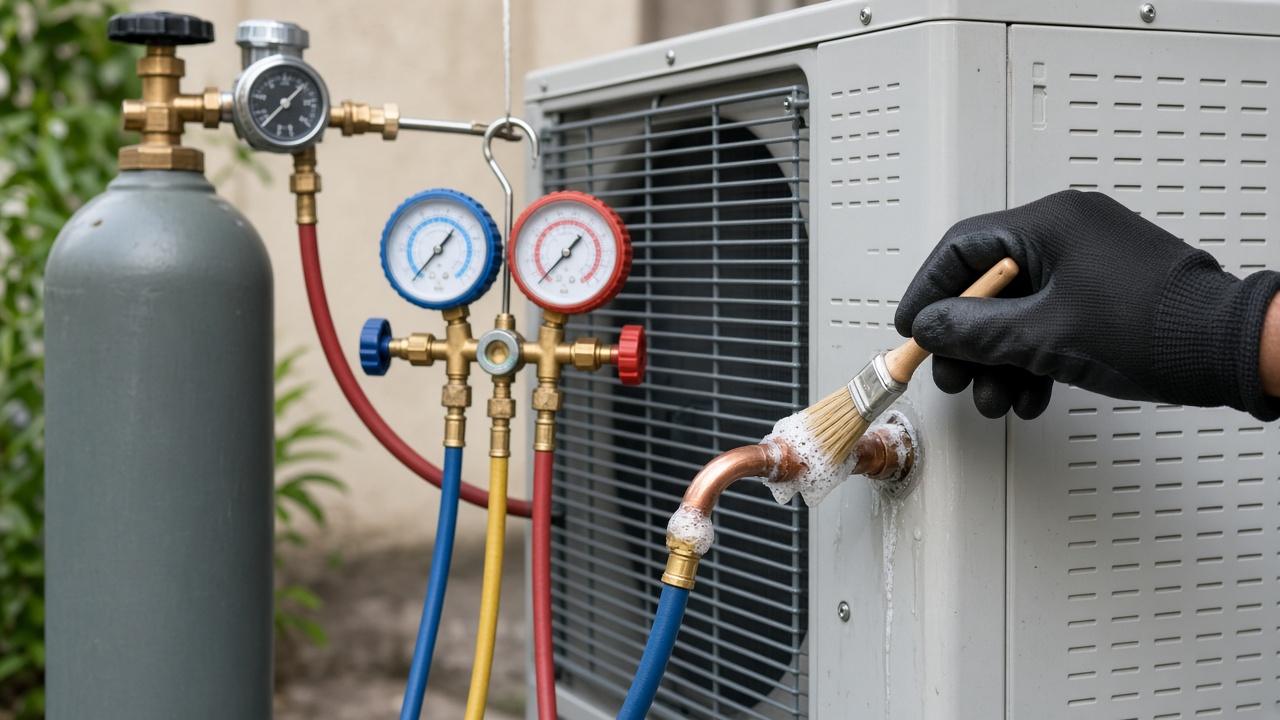
After the leak is repaired the lines are vacuumed with a micron gauge and the vacuum has to hold with the pump isolated. The charge is then weighed. R410A goes in as liquid, metered so the compressor is not slugged. R32 is weighed to the plate with the same care, because a single component can still be overfilled. R22 on a capillary machine can be checked by superheat once the weight is in, and the weight still comes first when the plate can be read. Overcharge is not extra cooling. On a Sharjah afternoon the head pressure is already high because the outdoor air is hot. Extra gas trips the unit or cooks the compressor. Undercharge brings the warm air back and, if there is a leak, the oil leaves with it.
Hoses, ports, and how full a recovery cylinder gets
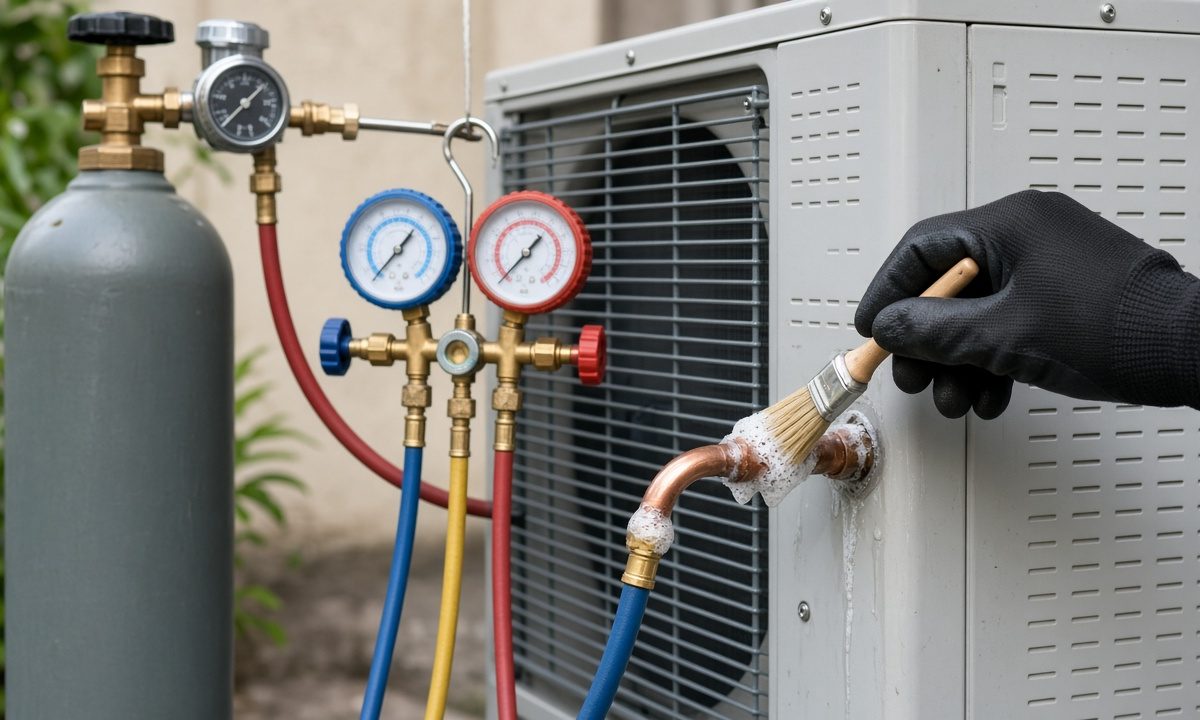
A manifold kept from the R22 years can be the wrong instrument once the plate says R410A or R32 and the outdoor air is above forty degrees. Head pressure on those gases rises with condensing temperature, and a gauge or a hose built for the older refrigerant can be past what it was made to hold on a Sharjah roof in the afternoon. The manifold and the hoses have to be rated for the gas on the plate. The port is identified before the hose is forced on. Quarter-inch fittings are the habit on R22 machines. A 5/16 inch port is common on R410A and R32 mini-splits. The adapter goes on the hose first. A chewed core from a forced connection becomes a leak we then have to find with soap.
Recovery cylinders are filled by weight, not by how heavy they feel in the hand. An overfilled cylinder left in the sun beside a roof condenser, or in the yard at the workshop, climbs in pressure on its own. We stop at a safe fill. R32 cylinders stay separate from R410A and R22 cylinders in the van, and a bottle with no label is not used even if a previous visit called it the usual gas. The synthetic oil in R410A and R32 compressors takes on moisture from the air as soon as the pipes are open. The system is not left open while a fitting is fetched from Industrial Area 6. The ends are capped, and the vacuum starts as soon as the joint is remade.
What we need before the visit
A photo of the nameplate saves the wrong cylinder. If the sticker is bleached, a photo of the model number on the indoor unit is the next best record. Say whether the outdoor unit is on a roof, a ledge, or a balcony, and whether anyone has added gas from an unlabelled bottle. Call +971 50 257 5128. The job, once the gas is known and the leak is found, is set out on the AC gas refill in Sharjah page. Sharjah only. If the compressor is burnt and the oil is black and acidic, that is a repair quote, not a top-up, and nothing is fitted until the figure is written down.
What we write down before the hose is opened
The nameplate gas, the oil family if it is printed, and the pipe length are on the job sheet before a cylinder comes off the van. If the plate is missing we do not guess from the age of the flat. A 2010 building in Al Nahda can hold an R22 unit that was never changed, or a replacement R410A chassis fitted last year. The service valve thread and the compressor label are the next places we look.