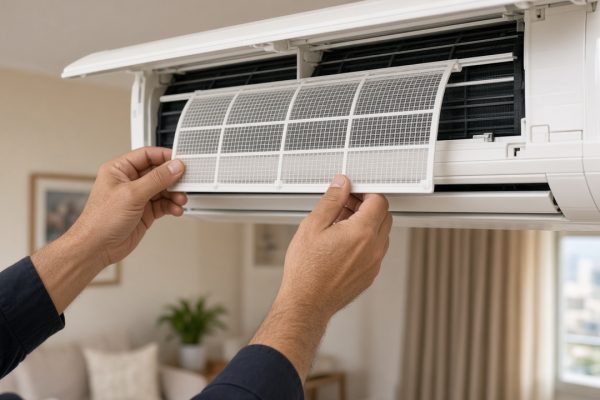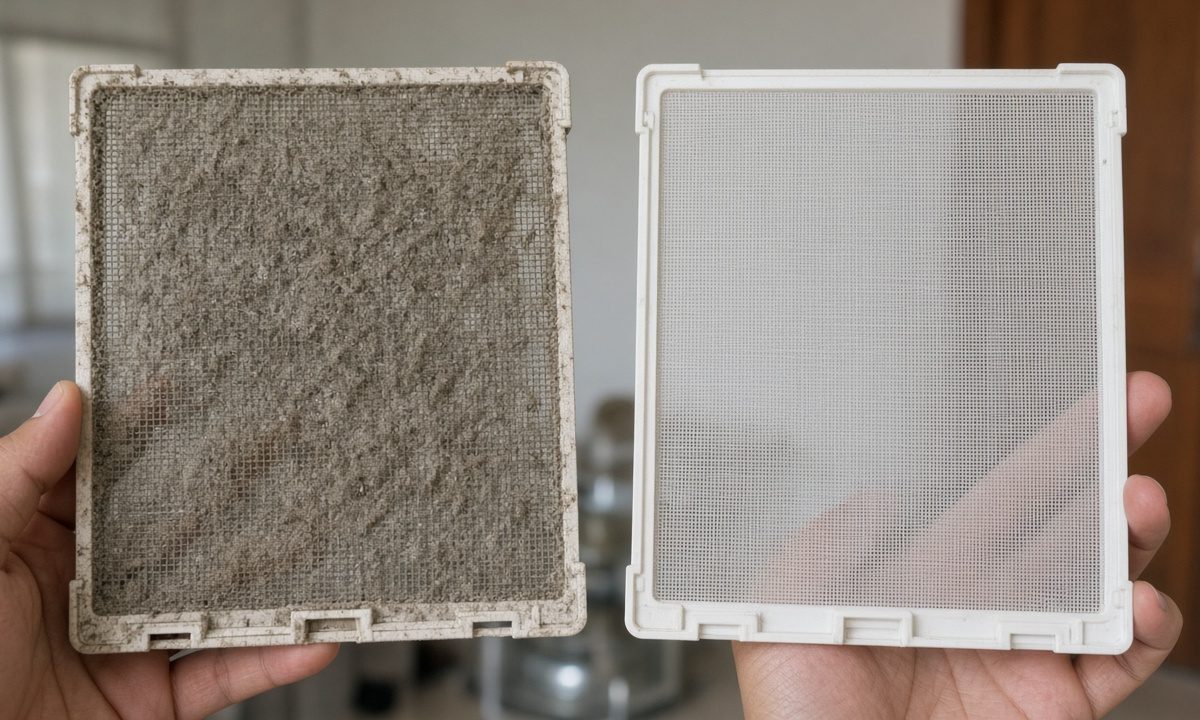
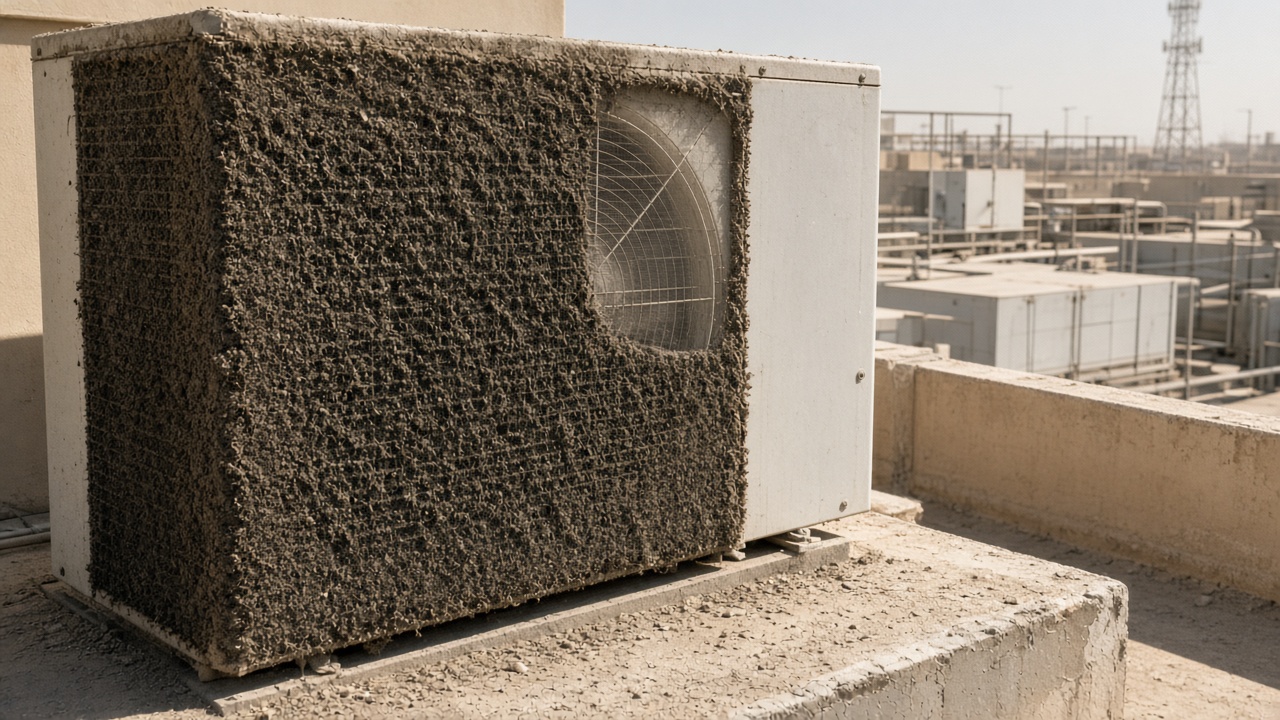
By June a condenser in Industrial Area 6 is often a black mat. The fan is still spinning. The compressor is still trying. The room or the shop is warm, and the unit may start and stop on its own every few minutes. That is head pressure climbing because the outdoor coil can no longer throw heat away, not because the machine has suddenly become empty of gas. Air-Con.ae, the marketing name of Burj Al Qasimiah AC units fix cont., washes that coil from the inside out and reads the pressures afterwards. Gas is not the first step. Any part is priced on site before it is fitted.
What the dust actually does
Head pressure is the high-side pressure the compressor is pushing against. The outdoor coil is supposed to dump that heat into the air crossing the fins. Fine dust from the industrial streets packs those fins until air barely gets through. The same heat then stays in the refrigerant, the pressure rises, and the compressor works harder for less cooling indoors. On a mild day in March the same dirty coil can still cope, because the air outside is cooler and the pressure has somewhere to go. By June the outside air is already hot. The margin is gone. The unit that “was fine last month” is the unit whose coil has been filling since winter.
The dust here is not only dry sand. Near workshops it carries oil and fine grit that sticks instead of blowing off. A hose waved at the face of the coil from the outside drives that mix deeper into the fin pack. The face looks streaked and cleaner. The middle of the coil is still blocked. That is why a unit can be “washed” in May and be back on high head in June. The dirt never left.
Short cycling with the fans still turning
High head trips a pressure switch or forces the compressor off on temperature. The outdoor fan often keeps running, or it restarts with the next try, so a glance from the yard says the unit is on. Indoors the air goes cool for a few minutes, then warm, then cool again. People read that as a gas problem or a thermostat problem. It is the high side hitting a limit, resetting, and hitting it again. Count the compressor starts, not the fan. A fan that never stops does not mean the compressor never stopped.
Al Nahda and Al Majaz ledges see ordinary house dust. Industrial Area yards, Rolla back streets with open shutters, and workshop roofs see this darker mat, and they see it earlier. A Muwaileh villa coil can be dirty. It is rarely this black unless a nearby site is grinding or the roof collects a sand trap. We say which coil we are looking at. A black industrial condenser is not maintained on a house schedule of one wash a year.
Why the amps follow the pressure
As head pressure rises, compressor current rises. The nameplate current is the comparison. A clamp meter during a short run, before the switch cuts the compressor, shows the climb. If the current is already over the plate while the fins are blind, cleaning comes before any talk of a weak compressor. A capacitor that has drifted low will push current up as well, and we measure it, but we do not use a new capacitor to excuse a coil that still will not pass light. Both can be true. The coil is the one you can see.
Why gas is the wrong first step
Low refrigerant does not produce a high head on a hot, blocked condenser. Low charge shows as low suction, weak cooling, and often a cold or icy suction line if any liquid is still moving. High head with a dirty coil mimics overcharge, which is the opposite mistake. Adding gas to that coil raises the head further, trips the unit sooner, and leaves the next person a system that is both dirty and overfilled. The pressures only mean something after air can cross the fins.
There is a second trap. A very blocked condenser can also damage the compressor if it is left cutting in and out on the pressure switch all day. The cure for that damage is still not a top-up. It is to stop the unit, clean the coil, and then see what current and temperature remain. If a flare is oily and the suction is low after the coil is clean, then it is a leak, and the leak is repaired before gas is weighed in. That order is the whole repair. Reversing it is how Industrial Area units collect a folder of gas invoices and a coil that has never seen daylight through the fins.
Washing the coil from the inside out
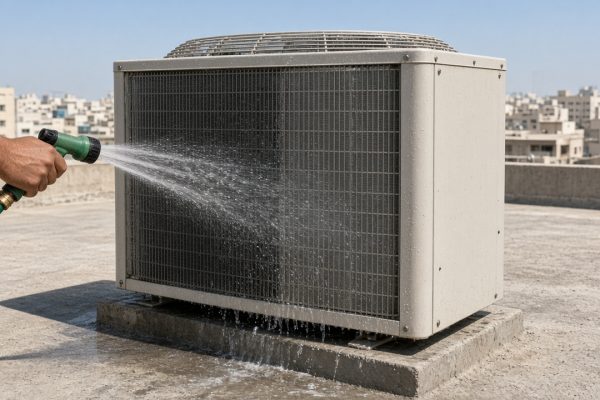
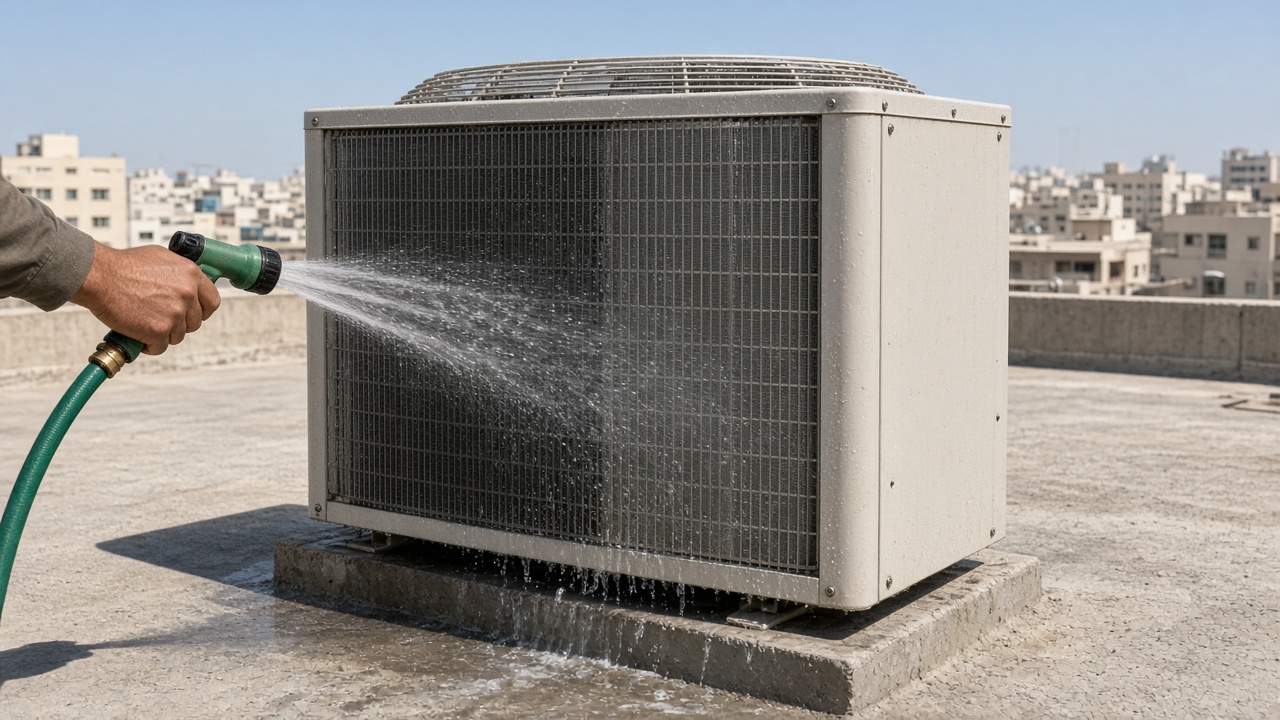
The isolator is off and locked out before any water is near the electrical panel. The fan grille or the top panel comes off so the spray can be aimed from the fan side, outward through the fins, which is the direction that pushes dust out the way it came in. Pressure is enough to move the dirt and not enough to fold the fins flat. A folded fin is closed forever unless it is combed back. We work across the whole face, including the bottom rows where wet dust settles and sets hard. The panel and the contactor stay dry. Water in the capacitor and the terminals becomes next month’s trip.
Oily fins need a coil cleaner that is rinsed off, not left to bake. The rinse is the same inside-out path. Then the unit is left to drain before power is restored. We do not start a compressor into a coil that is still a tray of chemical. When it does start, head and amps are read again, and the supply air indoors is measured. The before-and-after is the proof the wash did something. A coil that is clean and still trips is a fan, a capacitor, a charge, or a compressor problem, and those are quoted separately. A coil that is clean and now holds the shop is a maintenance job that finished.
- Judge the fins by whether light and air pass, not by a rinsed streak on the face.
- Spray from the fan side outward so the dust leaves.
- Keep water out of the isolator, the capacitor, and the contactor.
- Read amps and temperatures after the wash, not before, if you want them to mean the gas charge.
- Do not add refrigerant to a coil that is still blind.
Fins that are already flattened by a previous hard jet are combed where they will open, and the rest are reported. Some coils in these yards are past washing because the fin pack has collapsed. A new condenser coil, or a new unit, is a written price, not a harder spray. University City and Aljada machines rarely look like this unless a fit-out has filled them with gypsum. The method is the same. The Industrial Area version is simply due earlier and more often, because the air outside the gate puts the dirt back.
A sensible pattern is a wash before the heat settles and another when the summer dust has had its months, with a look in between if the shutter is open all day. The AC maintenance in Sharjah visit is that wash, plus the drain and the electrical readings, not a gas bottle standing by. Call +971 50 257 5128 and say the unit is in Industrial Area, whether it short-cycles, and whether the fan is the only thing you can hear running. The workshop is opposite the cricket stadium in Industrial Area 6, so a roof unit on these streets is not a long story to reach. The work stays in Sharjah. If the coil is black and the air is warm, start with the fins.
A coil or blower that is only dirty is AC cleaning in Sharjah.
If a part has actually failed, that visit is AC repair in Sharjah.