The first blast from a wall split often smells like a cupboard that has been shut since spring. That air was sitting still on the indoor coil, in the drain pan, and inside the long blower wheel. The fan throws it into the room before fresh condensate has had time to rinse the pan. People are told the gas has finished. Refrigerant leaving a joint does not smell like damp cloth. A low charge makes the supply air warm, or it puts ice on the larger copper line. The musty note is water that never left the machine, and dust that stayed wet.
Burj Al Qasimiah AC units fix cont. is the firm that does the work, with Air-Con.ae as the marketing name. The Industrial Area 6 workshop sits opposite the cricket stadium, and the call-outs stay in Sharjah. We see this startup smell in Al Nahda blocks, in Al Majaz flats that pick up more humidity off the corniche, and in bedrooms that stay shut while the rest of the home is lived in. On a packed wheel the room feels weak as well as stale. On a wet pan the airflow can still feel normal and the only complaint is that first minute. Those are different jobs.
Three places the smell actually sits
The drain pan under the coil
The pan is the tray under the evaporator. Water the coil pulls from the room is supposed to leave through a small outlet and a hose. In a ground-floor flat in Al Nahda the hose often runs almost flat along a balcony, or it ties into a shared stack that is already slow. The pan then holds water all day. Dust from the coil settles into it and turns into a brown gel around the outlet. That gel is the smell. When the unit cycles off, the water stays. The next start blows across it. A torch into the pan, with the filter lifted, shows whether the outlet is underwater. Wiping the visible plastic and leaving the gel in the corners keeps the smell for the next afternoon.
The cross-flow blower wheel
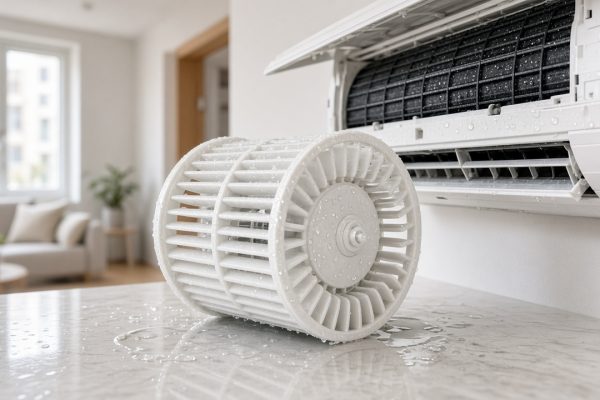
The blower on a wall split is a cross-flow wheel, a long barrel of small blades. Room air passes the coil and then goes through this barrel before it leaves the louvre. Fine dust that got past the mesh sticks because the air there is damp. Over a summer the blades fill until you cannot see daylight through the barrel. The wheel goes heavy on one side. It rumbles, or it ticks as a clump passes the coil end plate. The motor runs warmer because it is pushing less air through a tighter wheel. A vacuum hose at the grille never reaches the roots of those blades. A wheel that is only filmed can be brushed where it sits. A wheel that has become a felt drum has to come out.
The hose after the pan
The drain is the hose and the fall beyond the pan outlet. A pan can look empty when we arrive if the water overflowed onto the wall an hour earlier. The hose is still blocked. We look at the outdoor end while the unit is cooling. No drip, on a machine that has been on long enough to make condensate, means the water is trapped indoors. Slime forms a plug at a tight bend, or where the hose was pinched behind a wardrobe. Flats that were closed for months grow this plug faster because the water sat still in the heat. Pouring a jug into the pan and watching it fail to appear outside is the test. A pan wipe without that test is why the smell is back on the second day.
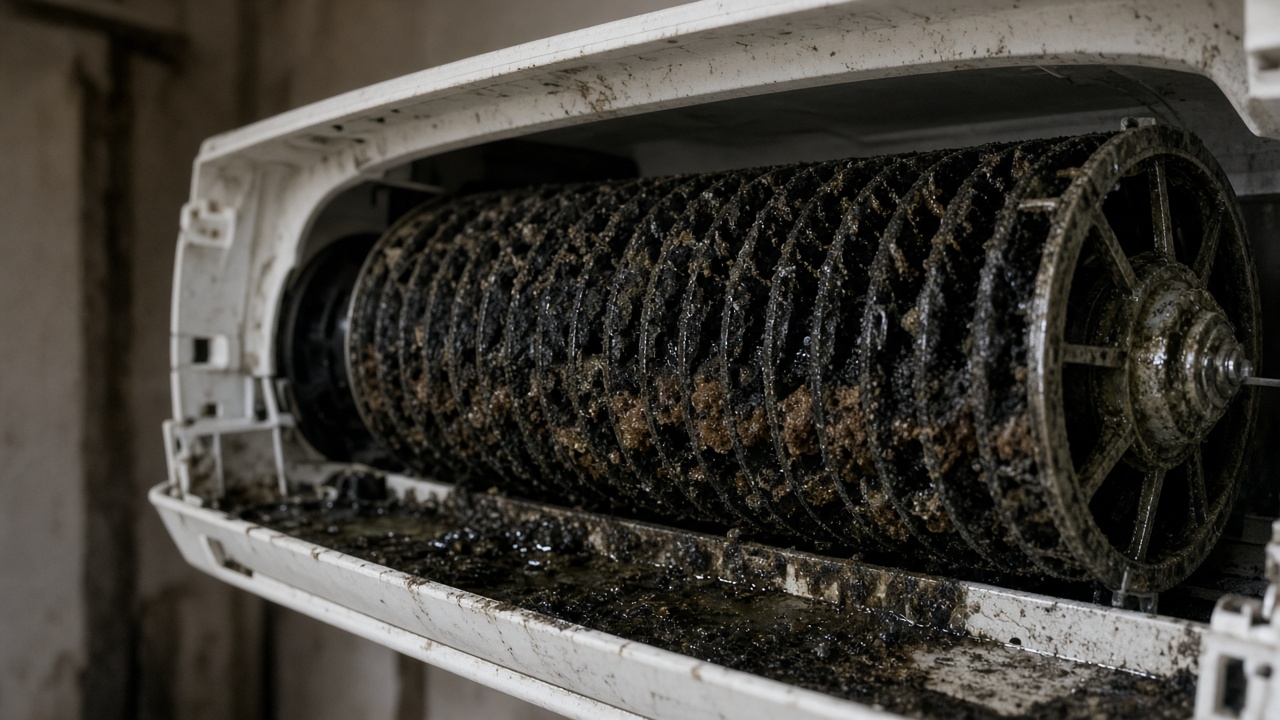
How we tell pan, wheel, and drain apart
Cleaner is not mixed until the source is clear. Fan-only, with the compressor off, still smells when the pan or the wheel is the source. Cooling is not required to prove a damp, biological smell. Airflow at the louvre is checked with the filter removed. Weak air and bridged blades put the wheel first. Strong air and a pan full of water put the drain first. Strong air, an empty pan, and a smell that lives in one room still gets the wheel looked at, because the film can be a thin dark layer rather than a thick felt. The outdoor drip is watched for several minutes of real cooling.
- Smell on fan-only points to wet surfaces inside the indoor unit.
- A pan outlet sitting underwater points to fall or a blocked hose.
- Blades you cannot see through point to a wheel that has to come out.
- A dry outdoor discharge while the coil is sweating points to a plug in the hose.
- Ice on the copper, with a clean wheel and strong air, is a different fault and is not handled as a smell clean.
How the blower wheel is actually cleaned
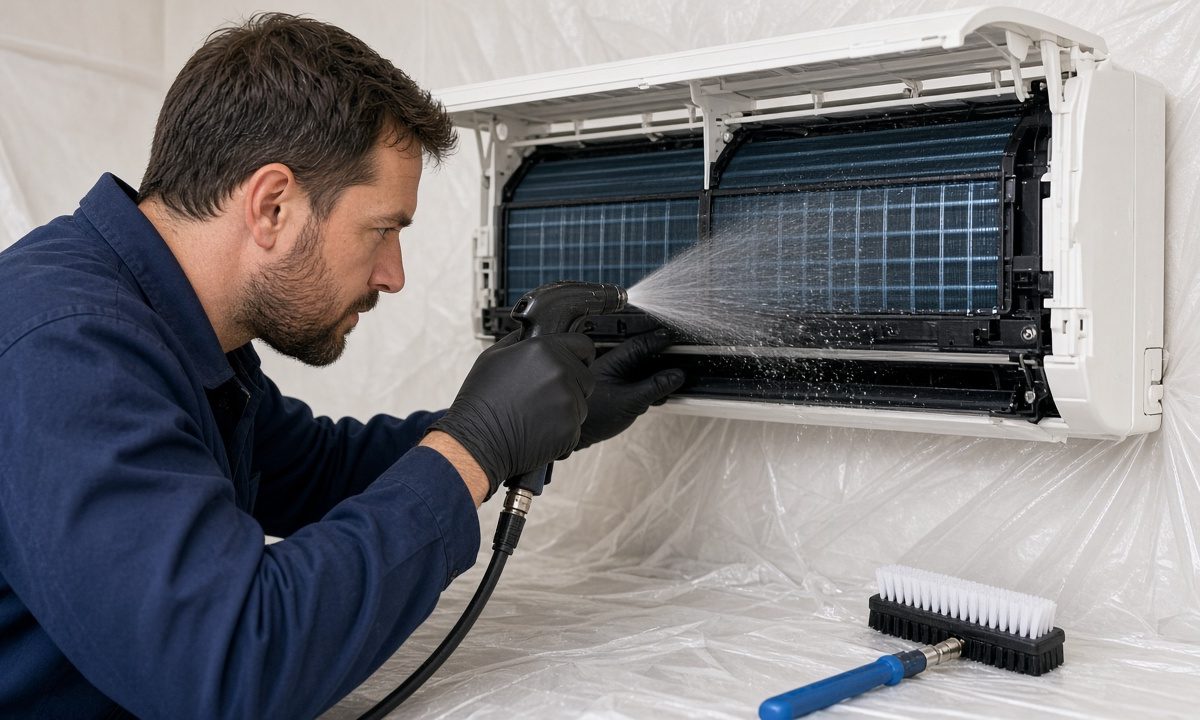
Power is off at the isolator, not only on the remote. The wall and the floor under the unit are covered. Filters, the front frame, and the horizontal louvre come off. On most splits in these flats the drain pan has to drop before the barrel will slide, and the pan still holds water, so it is emptied into a tray rather than onto the gypsum. The coil sensor is unclipped and left on its own wire. One end of the barrel sits in a rubber bearing screwed to the chassis. The other end meets the indoor fan motor. A set screw on the motor shaft, often reached through a hole in the casing, is loosened and the barrel slides free. We note which way the blades face, because a reversed barrel moves less air and whistles.
At the bench the barrel is washed with an evaporator cleaner and a soft brush worked along each channel of blades. Low-pressure water carries the loosened dirt out. A hard jet folds the plastic blades and throws the wheel out of balance, so the rinse stays gentle and the barrel is turned while it is rinsed. It is dried before it goes back. A wet wheel throws water at the coil and the same smell starts again. The set screw lands on the flat of the motor shaft. The barrel is spun by hand and must not rub the fins or the pan. A rub becomes a tick the same night. If the barrel is cracked or the bearing has seized, a replacement is priced in writing before it is fitted. We do not fit the part and announce the number afterwards.
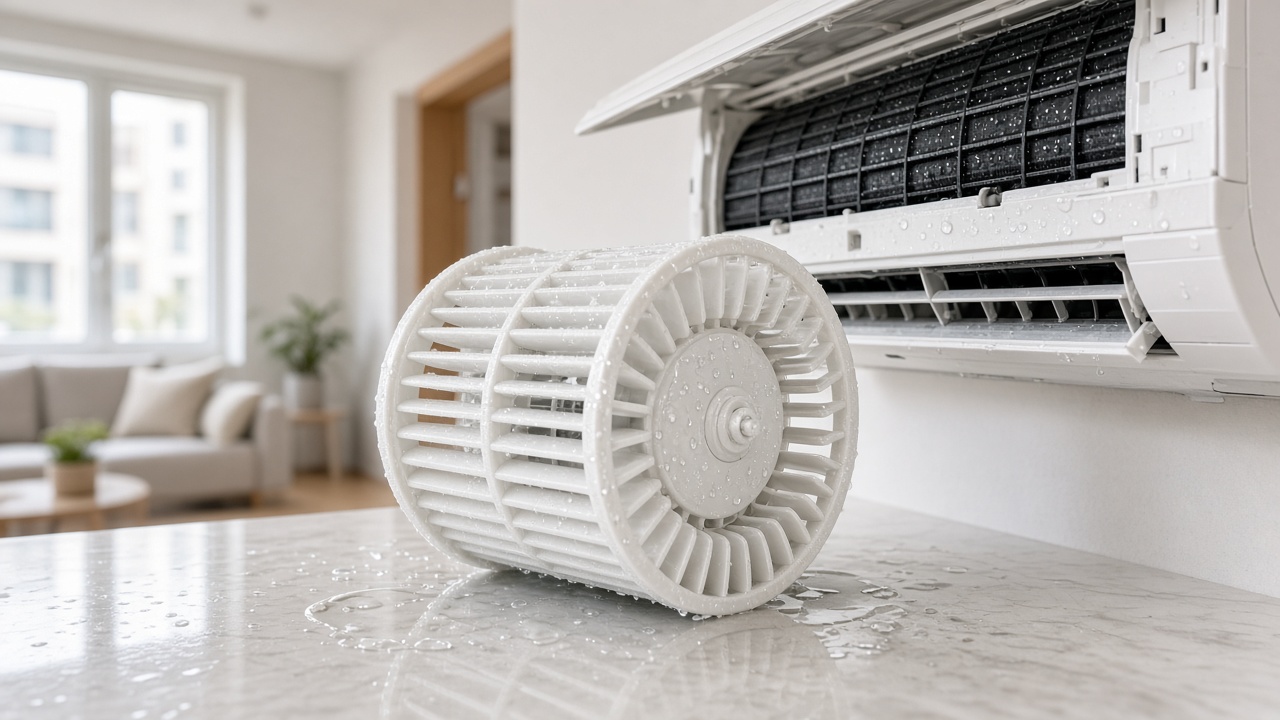
The pan and the hose on the same visit
The pan is cleaned into the corners and around the outlet, and the hose is cleared until water runs outside without backing up. A wet vacuum on the outdoor end pulls a slime plug that a jug poured at the pan will not move. The fall is checked by watching that water leave, not by assuming the original installer left a slope. A hose that rises to clear a balcony threshold holds a pool. If the run cannot be given a fall, a small condensate pump is the honest fix, and that pump is written up on site before it is fitted. The pan gasket is seated when the tray goes back. A pinched gasket leaks down the paint and looks like the old overflow.
Closed rooms and dusty districts
A flat in Al Majaz or Al Nahda that will sit empty needs an empty pan as well. After the clean we run the fan so the coil and the barrel dry, and we leave the drain dripping clear. A unit switched off on a full pan, windows shut through June and July, grows the same film again. Rooms near Industrial Area 6 pick up finer dust, so the barrel bridges sooner even when the drain is healthy. There the smell and the weak air arrive together. A bedroom split that smells, next to a majlis split that does not, is the bedroom machine. Each indoor unit has its own wheel and its own pan. Washing one filter and spraying the other louvre does not move either fault.
Call +971 50 257 5128 with the district in Sharjah, how many splits smell, and whether the air is weak or only stale at startup. The visit is a proper indoor clean, set out on the AC cleaning in Sharjah page. If the wheel is clear, the pan is dry, and the air is still warm, we stop treating it as a smell and test the electrical side and the charge instead of selling another wash.
Keeping the same fault from returning is AC maintenance in Sharjah.
If a part has actually failed, that visit is AC repair in Sharjah.