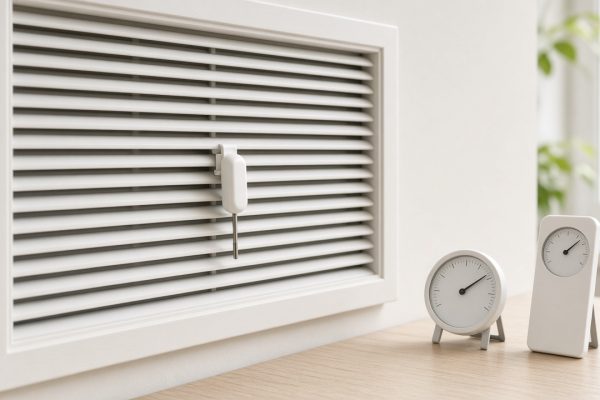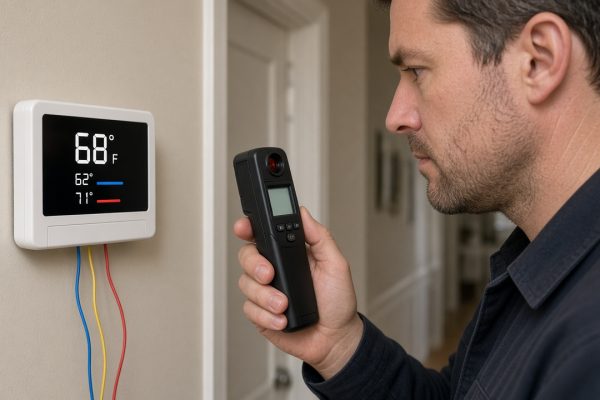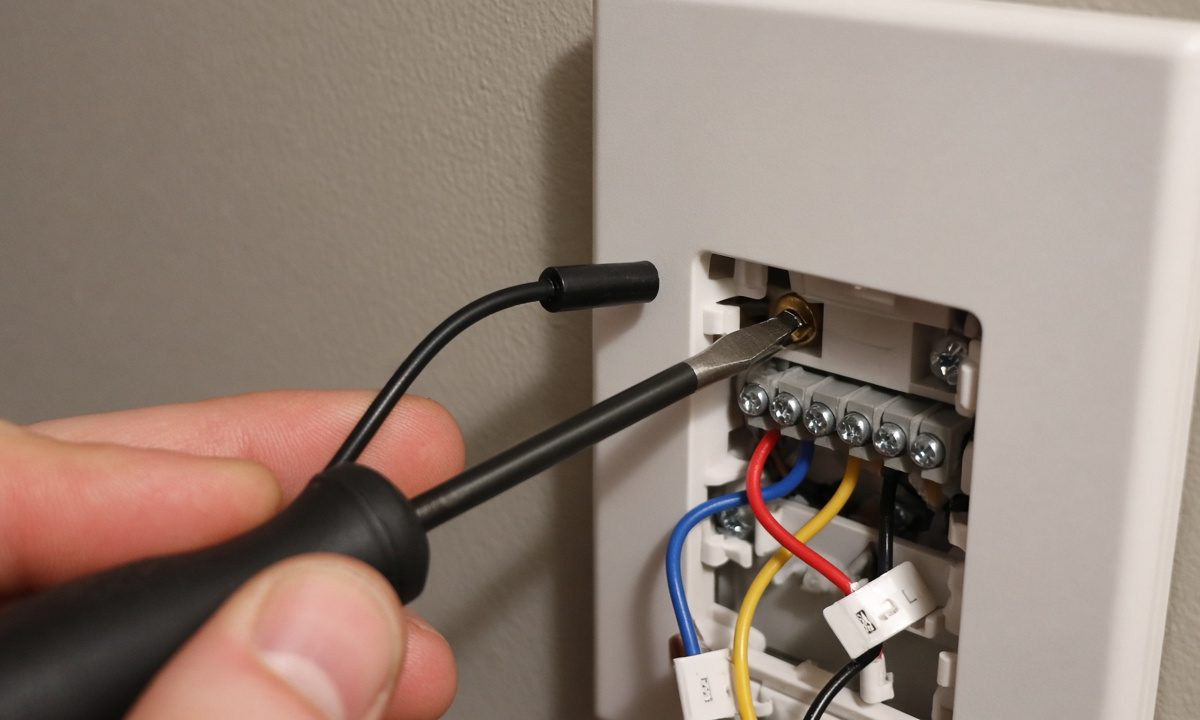
A ducted villa in Sharjah can have a perfectly capable air handler and still misbehave, because the sensor that is supposed to read the return is sitting in air the rooms never breathe. The ceiling void above a Muwaileh or Al Taawun roof is often far hotter than the living room. A sensor clipped to the handler casing, laid on the duct, or left in that void will run the system to the void’s temperature. The unit then either never stops, or it short-cycles when a leak of supply air cools the bulb for a few minutes and the void heat brings it back. Air-Con.ae, the marketing name of Burj Al Qasimiah AC units fix cont., finds that bulb and proves the error with two thermometers before any controller is sold.
The wall display can show a temperature and a setpoint and still hide which stream the bulb is in. The proof is a thermometer on the bulb and a thermometer in the room, watched through one full cycle.
Why a hot void produces two opposite complaints
In a Sharjah summer the space above a plasterboard ceiling, under a concrete roof, commonly sits well above the room. Handlers we open in Al Khan and Muwaileh are often surrounded by air in the high forties or above fifty degrees by early afternoon. A sensor bathed in that air tells the handler the “room” is still far above setpoint. The compressor stays on. Downstairs the sofas are already cool, or one room is cold while the stat still calls. People describe a unit that never rests, a high electricity use on the SEWA meter, and a machine that seems too small. The machine is tracking a void.
The same bad location can short-cycle, which is why the two complaints arrive as if they were different faults. Supply air leaks at a loose collar, a split flex, or a return box that is not sealed to the grille. When the fan starts, a tongue of cold air washes the bulb. The sensor drops through setpoint in a few minutes, the handler stops, the leak stops, and the void heat climbs back over the bulb. The unit starts again. From the room you hear a compressor that will not stay on. From the void you have a sensor swinging between roof heat and a stray jet. Both behaviours can come from one bulb in the wrong stream. Replacing the thermostat on the wall does not move the bulb.
What “return air” is supposed to mean
Return air is the air that has already been in the rooms and is on its way back to the coil. It should be close to the temperature people feel, lagged a little by the duct, and moving. It is not the still air in the void, not the supply leaving the coil, and not the air trapped in a joinery bulkhead above a hallway. A sensor in a dead pocket lags the room and then overshoots. A sensor in the supply satisfies early. A sensor in the void calls all afternoon. The label on the old drawing may say “return sensor” even when the bulb was never pushed into the return duct.
Where the sensor should sit
On a handler with a proper return duct, the bulb belongs in that duct, in moving air, downstream of the grille and upstream of the coil. It should be clear of a supply branch that could leak onto it, and clear of the handler motor, which heats its own corner of the void. The lead is clipped so it cannot fall out of the duct the next time the filter door is opened. If the return is only a grilled opening in the ceiling and there is no duct to sample, a wall sensor in the main room is the honest alternative. That wall should be an interior wall, about chest height, out of sun, out of the supply jet, and not above a television or a cooker.
We do not average a void reading and a room reading and call the midpoint the truth. The controller will follow the bulb, not the average we write in a notebook. If two floors have two handlers, each bulb has to sample its own return. A ground-floor stat left in a closed majlis while the family sits in a glazed family room will run the wrong space even when the bulb is technically indoors. That is a placement fault of the same family, and we say so before we talk about capacity.
How two thermometers prove it
Thermometer A is tied at the bulb, in the same air, not in a hand above it. Thermometer B is in the occupied room at sitting height, out of the supply. We start the handler from a known state and write both numbers at the start, at five minutes, and when the unit next stops or when twenty minutes have passed if it does not stop. The useful result is the gap, and whether the machine’s behaviour follows A.
- A stays high in the void, B falls in the room, and the handler never stops: the bulb is reading roof heat. Move it into the return stream.
- A drops fast as soon as the fan runs, the unit stops, then A climbs again: supply air is leaking onto the bulb. Seal the leak and place the bulb where that jet cannot reach it.
- A and B track together, and both stay high: the sensor is in the right stream. Look at airflow, the outdoor coil, and charge only after that agreement is written down.
A single infrared gun shot at a supply grille does not settle this. The grille is supposed to be cold. The question is whether the bulb is living in that cold, in the void, or in the room. Two contact or air thermometers, left in place through a cycle, answer it. We photograph the bulb’s location before we move it, so the note matches the building and not a memory of “somewhere above the hallway”.
The move, and what is replaced only if it has drifted
If A and B disagree and the element agrees with A, we relocate. The return duct is opened at a point we can reseal, the bulb is set in the airstream, and the penetration is closed so void air cannot leak in around the wire. Filter access is checked so the next service does not pull the bulb back out. Then we run the same two-thermometer test again. A and B should stay within about a degree once the room air has started to move, and the handler should complete a normal cycle instead of hunting or running flat out.
If A and the display disagree while they share the same air, the element has drifted and a move will not cure it. The replacement has to match the handler’s board. We quote that part from the model plate before it is fitted. A wall controller is changed only when the controller itself is the failed part, not because the void was hot. Gas is not added to satisfy a sensor that is reading the roof.
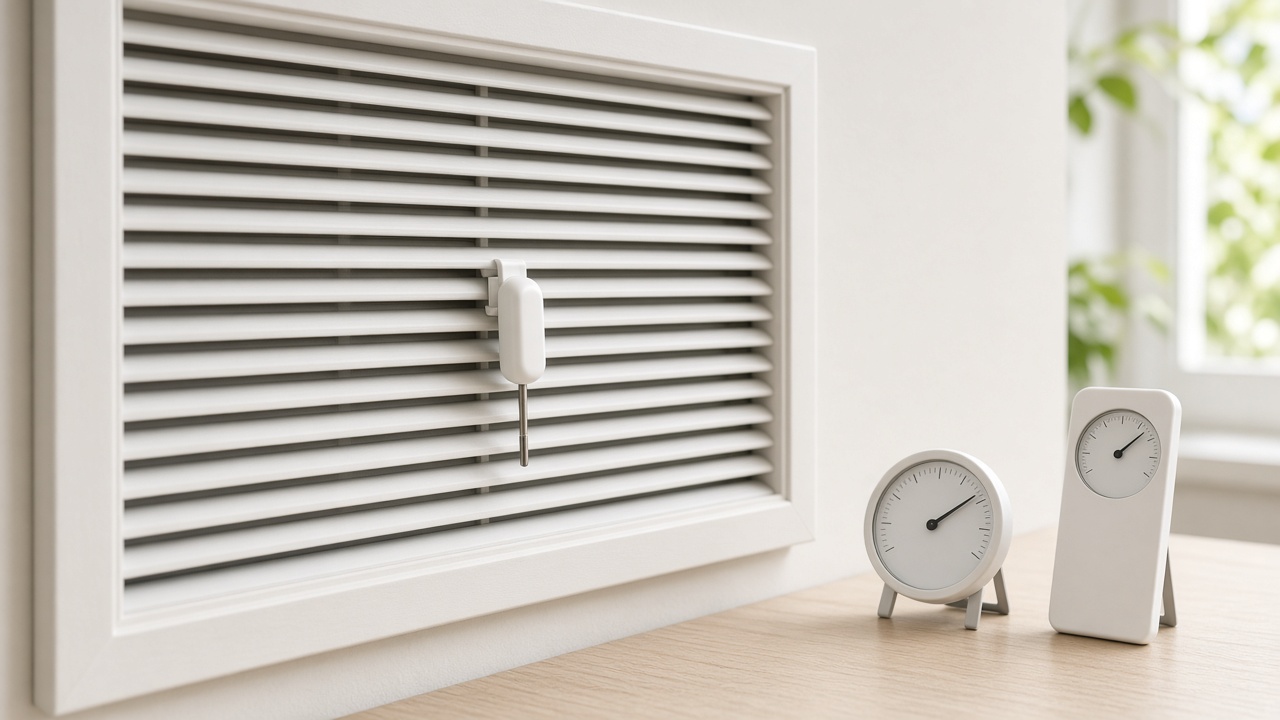
What the room should do afterwards
The occupied floor should change temperature in the direction the setpoint asks, and the outdoor unit should rest when that temperature is reached. A bedroom on a closed damper can still lag. That is a damper or a branch, and we note it separately rather than putting the bulb back in the void to “average” the problem away. If the upper floor of an Al Taawun villa cannot hold the setpoint at mid-afternoon because the glass load exceeds the machine, the honest sensor will show the truth. We will say the unit is at its limit. We will not hide that limit inside a roof space that reads 50 degrees.
Call +971 50 257 5128 with the district and which floor is wrong. The workshop is in Industrial Area 6, opposite the cricket stadium. The test is done at the villa with both thermometers. Diagnosis is typically AED 150 to AED 250, and a matching sensor is typically AED 150 to AED 400 including the part. Sensor work is on our AC thermostat repair in Sharjah page. The price is written before a ceiling is opened.
The handler and the ducted system are covered as central AC services in Sharjah.
If a part has actually failed, that visit is AC repair in Sharjah.