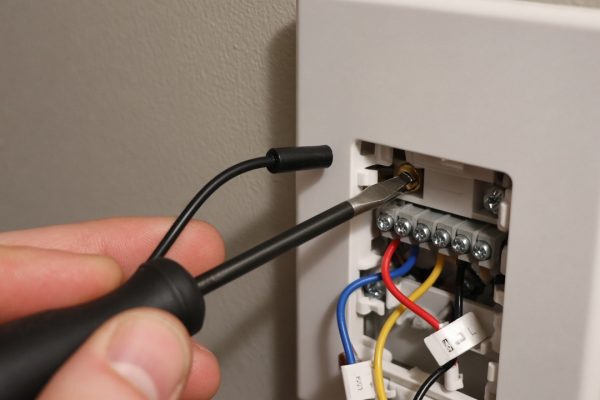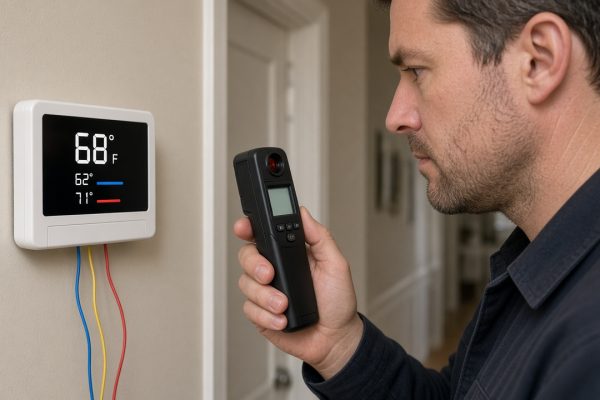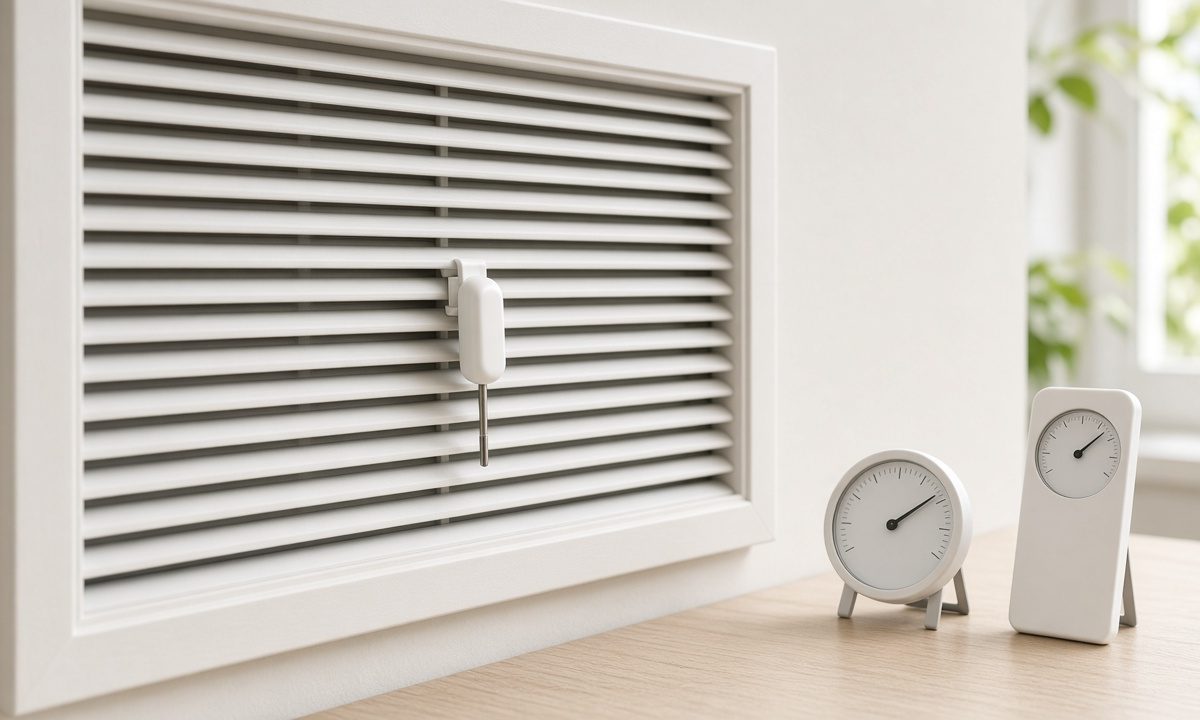
A wall split in a Sharjah apartment is controlled by an infrared remote and by sensors on its own indoor board. It is not a furnace with a 24-volt terminal strip waiting for a learning thermostat. When a 24-volt smart stat is wired into that board anyway, the usual results are dull and expensive: the unit locks on a fault, or the fan runs and the compressor does not, or the machine obeys the stat for a day and then ignores the room. Air-Con.ae, the marketing name of Burj Al Qasimiah AC units fix cont., takes that stat off when the split was never built for it, and leaves a wall stat in place only when the air handler actually has the terminals for one.
The box on the wall can look finished. The app can show 24 degrees. The indoor unit can still be lost, because the app is not speaking the language the outdoor inverter expects. The repair starts at the wiring, not at a replacement compressor.
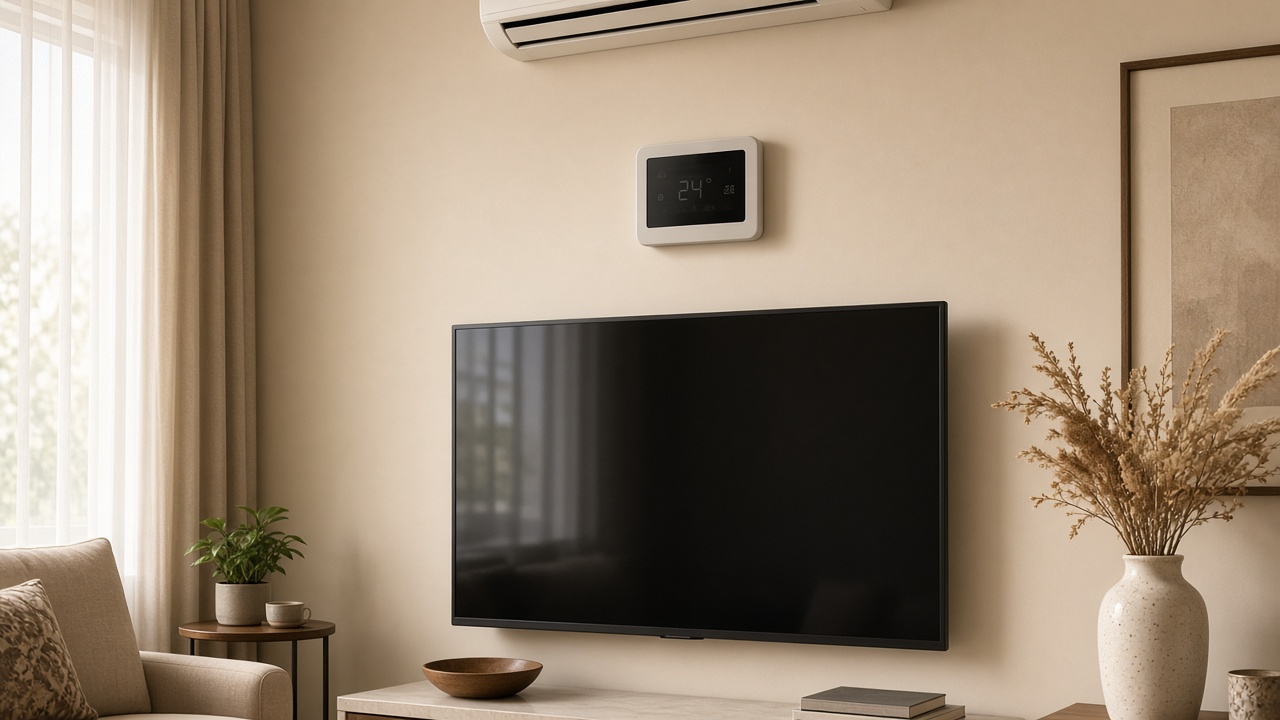
What a wall split actually listens to
The indoor board reads a room thermistor in the intake, pipe sensors on the coil, and commands from the remote receiver. It then talks to the outdoor unit on a communication pair that is not a thermostat circuit. Setpoint, mode, and fan come from the handset or from the brand’s own wired controller, if that model has one. There is no standard R, C, Y, and G waiting behind the plastic. A smart thermostat assumes those terminals, plus a common wire to power itself. Forcing the assumption onto a split means someone has found a fan tap, a test point, or a key-card contact and treated it as a cooling call.
A key-card or hotel contact, on the boards that have one, only enables the unit. It does not choose the temperature. A thermostat parked across that contact can let the split run at the last remote setting, or hold it off, depending on how the contact was jumped. People then say the smart stat “sort of works”. It is not controlling the room. It is permitting whatever the onboard sensor already decided.
Lockout, or a fan that is the only thing moving
Two failures cover most of the apartments we open in Al Nahda and Al Qasimia. In the first, the room thermistor plug was lifted so the new stat could be the sensor, and the board sees an open or a shorted sensor. The unit locks, the remote beeps, and an error lamp or a code sits on the indoor display. The compressor never starts. In the second, a relay from the smart stat was landed on a fan output or on a line that only runs the blower. The fan answers the app. The communication wire to the outdoor unit never receives a cooling demand the board understands. The room stays warm, the app says the house is cooling, and the outdoor fan may never move.
A third pattern is a fight. The smart stat calls for cooling, the onboard sensor in a cold intake decides the coil area is already cold, and the two commands alternate. The unit short-cycles or drops into a protection stop. Resetting power clears it until the afternoon. None of these is a gas fault. Gauges come out only after the original control path is restored and the outdoor unit still will not run.
When a wall thermostat is the right control
Some ducted handlers are built for a wall stat. The clue is a terminal strip marked for a conventional control: a 24-volt supply, a common, a cooling call, and a fan call, sometimes a heat-pump reversing connection. The cable in the wall is the multi-core that was pulled for that strip, not a figure-eight remote wire. The outdoor unit on those systems is started by a contactor, or by an interface the manufacturer published for a third-party stat. In a villa in Muwaileh or Al Taawun that was ducted this way, a smart thermostat can stay. We land it on that strip, confirm the common is really a common, and run a full cycle at the new setpoint.
A communicating ducted system is a different machine even though it also lives in a ceiling. The wall controller and the outdoor board share a data line. A generic smart stat on that line can take every indoor unit offline, not only the one room you meant to automate. If the manufacturer offers an adapter that turns a normal cooling call into their protocol, we fit the adapter they specify and we price it before the old controller comes off. If they do not, the original controller stays. Wanting an app is not a wiring diagram.
- Wall split, infrared receiver, thermistor plug, no 24-volt strip: the smart stat comes off and the remote path is put back.
- Ducted handler with a labelled 24-volt strip and a contactor outdoors: a wall stat can stay, wired to that strip.
- Communicating inverter with a data bus: keep the brand controller unless a stated adapter exists, and quote that adapter on its own.
Taking the wrong stat off without losing the unit
We photograph the extra wires before they are lifted, then we return the indoor board to the arrangement on its diagram. The room thermistor goes back into its plug and its pocket in the intake. Any conductor that was used as a homemade common is removed, because a stray tap on a split board is how a fuse or a small transformer gets burnt next. The remote is tested from the doorway. The unit is run until the outdoor machine starts, the supply air falls, and the onboard sensor is clearly the device in charge.
If the smart stat was covering a failed remote receiver, we still remove the stat, then we quote the receiver or the indoor board as its own line. Hiding a dead receiver behind an app is how the lockout comes back the next time the Wi-Fi drops. The quote is written before that board is ordered. Model and serial come from the indoor plate, not from the logo on the discarded thermostat.
Settings that still matter after the wires are right
A stat that is allowed to stay needs a setpoint the villa can hold, a fan mode that does not fight the handler, and a schedule that does not shut the floor off at the hottest hour by accident. We write the schedule we left. On a split that has gone back to the remote, we clear timers and swing settings that were masking the earlier fault. A remote locked to fan mode will look like the smart stat “broke the compressor” when the compressor was never asked to run.
What we will not pretend a split can do
Room-by-room apps, occupancy tricks, and a thermostat that learns a furnace do not map onto a high-wall inverter. If you want a proper wall control, the honest routes are the brand’s wired controller where the model supports it, or a ducted handler that already has a 24-volt strip. We will price those. We will not land a smart stat on a fan motor and call the apartment automated. Apartments in Al Majaz, Al Qasimia, and Abu Shagara are almost always the infrared kind. A photograph of the indoor wiring, taken with the power isolated, tells us which case you have before anyone buys another box.
Call +971 50 257 5128 and say a smart thermostat was added to a split, and whether the symptom is a lockout, fan only, or a unit that will not hold a setpoint. The workshop is in Industrial Area 6, opposite the cricket stadium. The diagnosis is done at the indoor board. Control diagnosis is typically AED 150 to AED 250, and any receiver, sensor, or adapter is written on site before it is fitted. The work sits under AC thermostat repair in Sharjah. If the outdoor breaker trips as soon as the compressor is asked to start, say that too. A shorted compressor is not cured by removing a thermostat, and we test for it before the visit is closed as a control fault.
The wall unit and the outdoor ledge unit are covered as split AC services in Sharjah.
If a part has actually failed, that visit is AC repair in Sharjah.