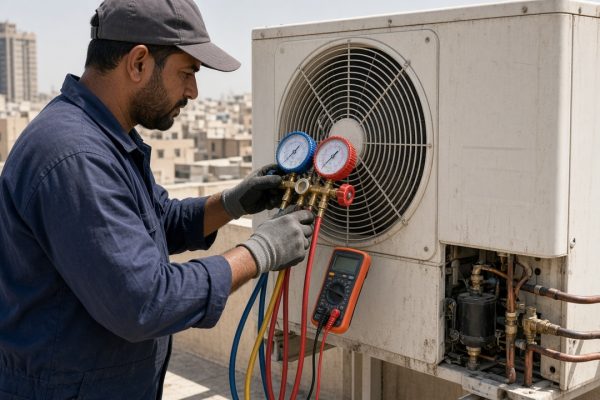
A roof unit that runs, cools, and then kills the breaker after about twenty minutes is not “a sensitive breaker”. It is a machine drawing more current as it heats, or a motor whose insulation fails once it is hot. The delay is the clue. A dead short trips at once. A thermal trip waits until the current, or the temperature, has had time to accumulate. Air-Con.ae, the marketing name of Burj Al Qasimiah AC units fix cont., measures that current against the nameplate before anyone condemns the compressor. The price of a capacitor, a fan motor, or a larger repair is written on site before parts are fitted.
Why twenty minutes, not instantly
The breaker has a magnetic trip for a short circuit and a thermal trip for overload. The magnetic trip is sudden. The thermal trip is a strip that bends as it heats, so a current that is somewhat above the breaker rating can run for many minutes before the strip has had enough. Twenty minutes of cooling, then silence, fits that second path. It also fits the compressor’s own overload, which people confuse with the breaker. We note which device opened. A compressor overload that resets and a breaker that is off are different repairs, even when the room feels the same.
Holding the breaker handle in the on position, or wedging it, does not cool the room safely. The handle is forced against a mechanism that wants to open. The contacts arc. The terminal heats, discolours, and eventually burns. We see that burned terminal on Muwaileh roofs and on Rolla shop roofs where someone needed the unit for one more afternoon. The breaker then becomes part of the fault, and the cable lug with it. Leave the handle alone. A unit that will not stay on is already telling you the current is wrong.
What pushes the current up
A weak capacitor
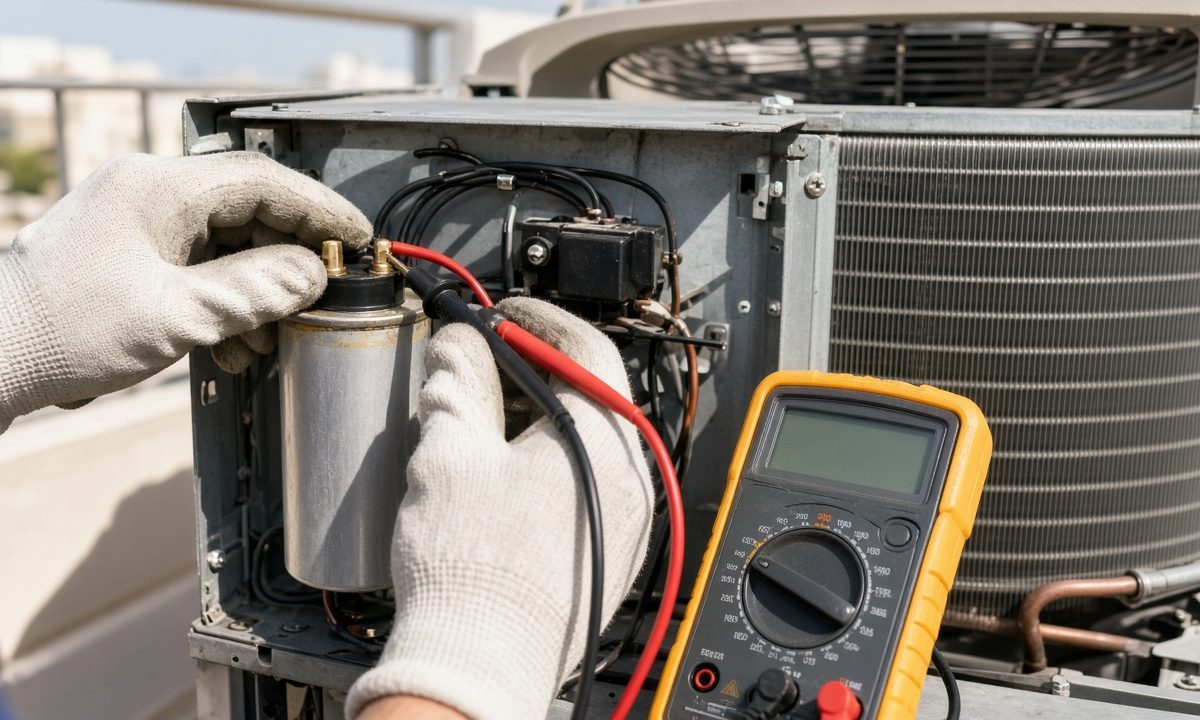
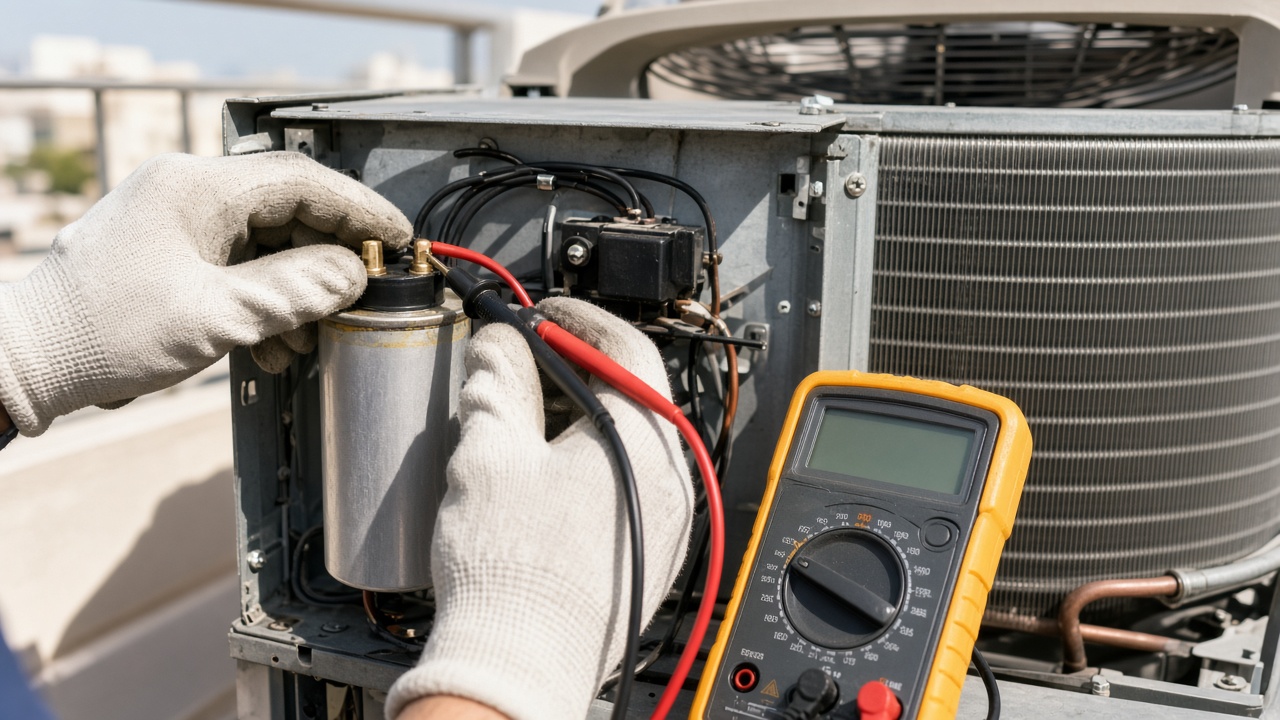
On a fixed-speed O General or Gree compressor the run capacitor is in the motor circuit the whole time the compressor runs. When the microfarad reading has fallen, the compressor still turns, but it draws more current to do it. The shell gets hotter. The amps creep up. Somewhere around the twenty-minute mark the breaker or the internal overload opens. In the cool of the morning the same capacitor may start and hold, which is why the call is always in the afternoon. We measure the capacitor against the rating on its case, discharged and isolated. A bulged case is replaced even if the meter is borderline. A new capacitor of the same rating is the first part we discuss, not a new compressor.
Hot air at the condenser
Head pressure and compressor amps rise together. A black outdoor coil, a fan spinning the wrong way, or a unit boxed so that it breathes its own discharge air will all push the head up once the roof is hot. Al Nahda plant areas and Industrial Area roofs do this by June. The unit starts fine. Twenty minutes later the pressures and the amps have climbed and the breaker opens. The fan may still have been spinning the whole time, so it looked healthy. Spinning is not the same as moving cool air through clean fins. We measure the air temperature into the coil and out of it, and we read the amps while it is still running, before the trip.
A fan motor that grounds when it is hot
A condenser fan can run, then leak current to earth as the windings warm. The breaker, or the residual-current device if one is fitted, opens after the motor has been hot for a while. It will often reset and run again once everything cools, which imitates a weak breaker. An insulation test with the motor disconnected shows whether the winding is leaking to the frame. A motor that fails that test is replaced. It is not “dried out” and sent back for another month, and it is not cured by fitting a larger breaker so the leakage has more room. Larger protection does not restore insulation.
The supply on the roof
A long cable, a loose isolator, and a voltage that sags when the compressor is running will also raise current. We read voltage at the unit while it is under load, not at the indoor socket with the machine off. Aljada and University City roofs with a long feed from the flat are where this shows. If the voltage is low only at the isolator, the repair is the connection, and the compressor is innocent. A burned isolator terminal is photographed and priced before it is replaced. Tightening a blackened lug and walking away leaves the heat in the joint.
Current against the nameplate
The number that matters is on the outdoor plate: the rated running current, sometimes printed as RLA. We clamp the compressor lead while the unit is cooling, in the shade of the panel, and we write the reading next to that number. A small difference on a very hot roof can be normal. A reading that climbs well past the plate, with the coil dirty or the capacitor low, is the cause of the trip. A reading that is already far over the plate with a clean coil, a correct capacitor, and a sensible supply is a compressor that is no longer earning its keep.
- Note whether the breaker or the compressor overload opened.
- Do not hold or wedge the breaker handle.
- Measure capacitor microfarads against the case, power isolated.
- Clamp running amps and compare them with the nameplate.
- Check condenser air and fan insulation before condemning the compressor.
When the compressor is actually finished
A compressor is finished when the windings say so, or when the amps stay wrong after the cheap causes are gone. Windings that are open, or shorted to the frame on an insulation test, are not a capacitor problem. A compressor that tries to start and trips in a second or two, with huge current, is locked or shorted. That fast trip is a different visit from the twenty-minute trip. Do not mix them up and buy a compressor for a dirty coil.
The twenty-minute case becomes a compressor replacement only after this list is done: capacitor in range, condenser clean and not rebreathing, fan insulation sound, voltage at the unit acceptable, charge not so high that the head is forcing the amps up, and the running current still well above the nameplate while the shell is too hot. Then we say the compressor is finished. On many roof splits the honest comparison is a new unit against a compressor change, because the rest of the machine is the same age. That comparison is written down. It is not a surprise added after the old compressor is already off.
A Daikin or LG inverter that stops after twenty minutes may be a high-pressure or high-temperature code rather than a breaker at all. We read the code before we treat it as a fixed-speed overload. The breaker is still inspected, because a code and a weak supply can share a roof. Either way the handle is not held in.
Parts wait for the written price. A capacitor and a fan motor are common. A compressor is not treated as common, and it is not fitted on the strength of one tripped breaker. The AC repair in Sharjah visit on a Sharjah roof is the clamp meter, the capacitor reading, and the condenser air, taken before the unit trips if we can get there while it is still running. Call +971 50 257 5128 and say how long it runs before the breaker opens, and whether anyone has been holding the handle. The workshop is in Industrial Area 6, opposite the cricket stadium, and the work is in Sharjah only.
A coil or blower that is only dirty is AC cleaning in Sharjah.
A leak that is confirmed and then repaired is AC gas refill in Sharjah.