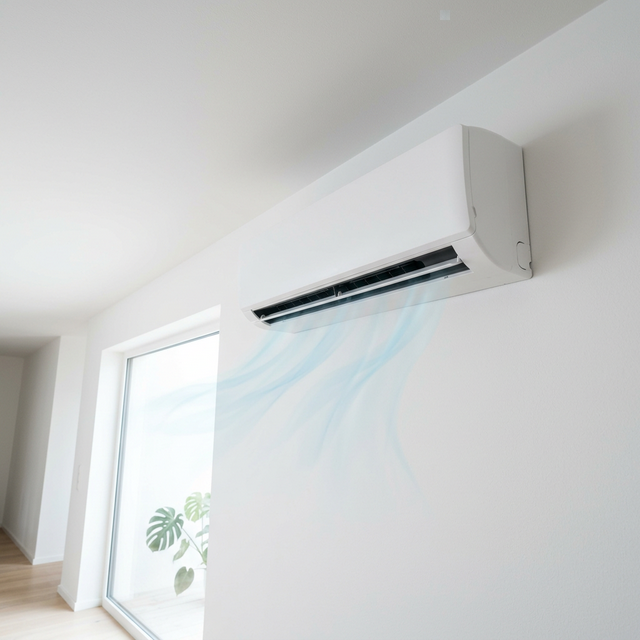
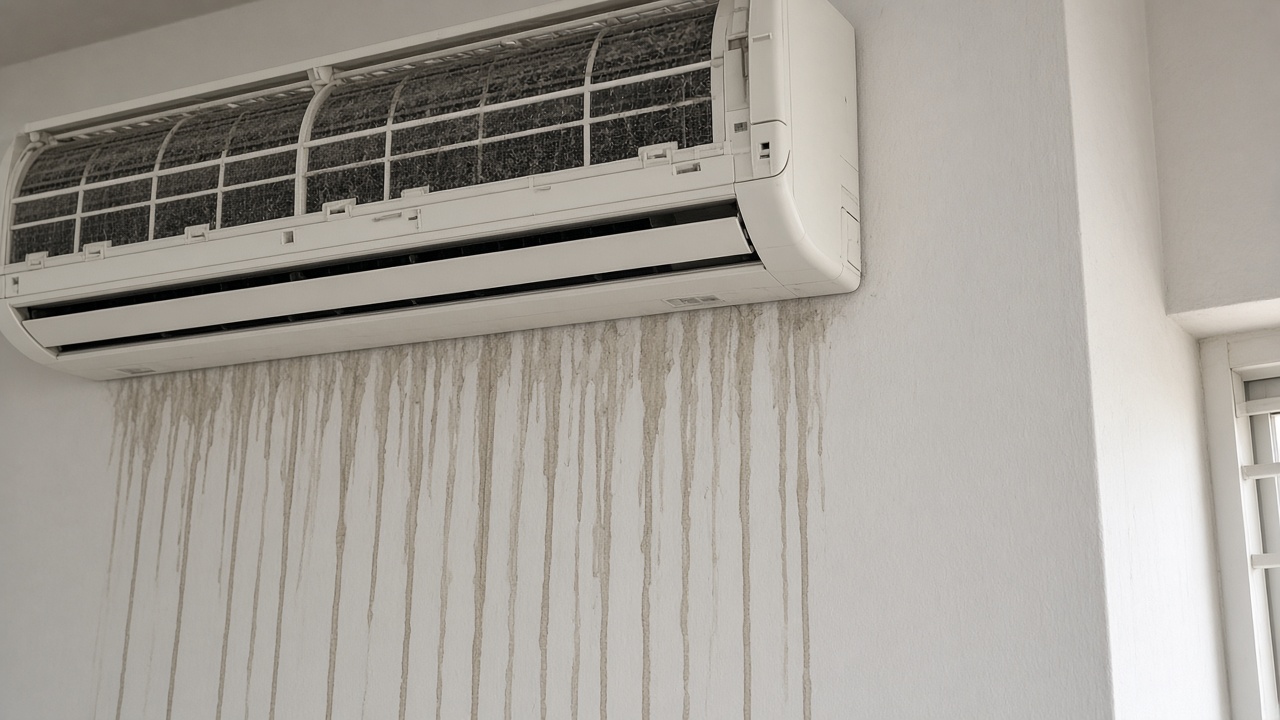
A brown or wet line on the plaster under a split in Al Nahda is usually the drain, and it is usually not a mystery leak inside the coil. The ledge outside is narrow, the hose run is short and badly treated, and the indoor pan overflows back into the room. Algae, a kink behind the casing, a hose with no fall, or a float switch that has been defeated will all do it. Ice melting off the coil does it too, and that is a different fault. Air-Con.ae, the marketing name of Burj Al Qasimiah AC units fix cont., separates those before any part is fitted. The price is written on site first.
What the stain is telling you
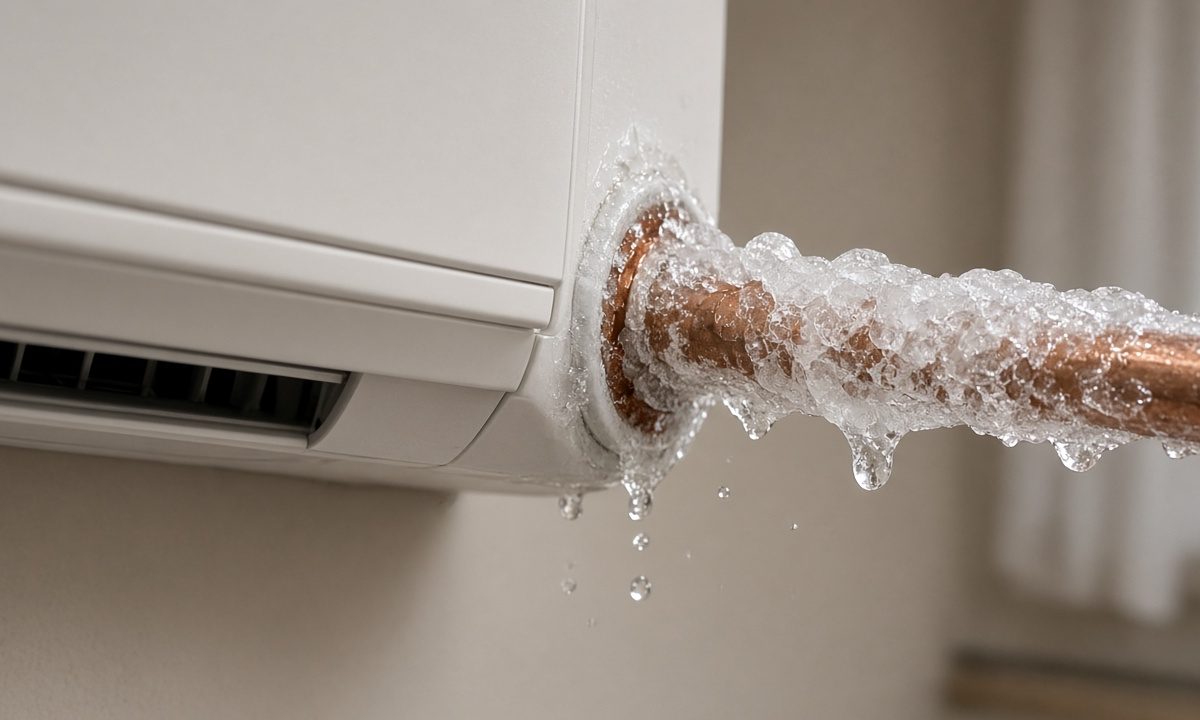
Condensate should leave the pan through the spigot, fall all the way to the ledge, and drip clear of the wall. When it cannot, the pan fills and the water takes the next path, which is out of the front of the indoor unit and down the paint. The stain starts at the bottom edge of the casing, not at a random patch of ceiling. If the mark is beside a bare copper pipe instead, that is sweat from missing insulation. Both are wet walls. Only one of them is the drain.
Al Nahda blocks put the outdoor unit on a ledge reached through a small door. The drain hose is the soft item in that gap, so it is the item that gets folded when the unit is pushed back after a filter clean. Al Majaz and Al Qasimia ledges do the same. The room can cool normally for weeks because a little water still gets past a partial kink. A humid week fills the pan faster than the kink allows, and the wall loses.
The drain faults, in the order we find them
No fall, or a belly in the hose
Gravity is the whole pump on an ordinary split. A hose that runs uphill to clear a bracket, or that sags between two clips, holds a pool. Dust and slime settle in the pool. The first metre, just behind the indoor casing, is where we find it, not at the outdoor spout that someone has already poked with a stick. A spout that looks clear does not mean the pan can empty. We look at the hose with the casing forward, in the position the unit actually sits.
Algae in the pan and the first metre
The pan is dark, wet, and never fully dry through a Sharjah summer. That is enough for a film of algae, and the film breaks off and plugs the spigot. University City flats that run all night grow it as readily as an Al Nahda bedroom. Pouring bleach into a closed casing and hoping is how the blower and the coil get sprayed. The pan is opened, the slime is removed, and the hose is flushed through until what comes out is no longer green. Then the fall is checked, because a clean hose with a belly fills with slime again.
A kink behind the unit
The casing was pushed to the wall to look tidy, and the hose folded flat against the plaster. You cannot see it from the room. You see the result. The hose has to be disconnected at the spigot and at the outlet and looked at in daylight. A flattened section is cut out and replaced with hose that can hold a fall, clipped so the next person who pushes the unit back does not recreate the dam. Rolla shops with the indoor unit hard against a bulkhead do this with even less room to see the fold.
A float switch that was bypassed
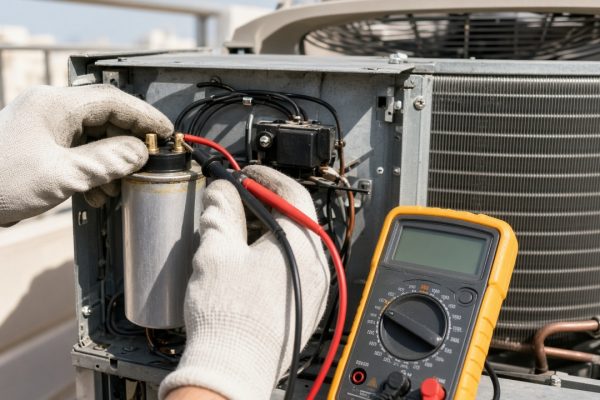
Many indoor units have a float that opens the control circuit when the pan rises, so the compressor stops before the water reaches the wall. If the switch works, the symptom is a unit that stops, not a stain. If the switch is stuck closed, or someone has tied it up because the unit “kept cutting out”, the pan is allowed to overflow. The cutting out was the drain telling the truth. We repair the drain and put the float back in circuit. A float that is stuck open, so the unit never runs, is the other failure, and it is an electrical check, not a reason to leave the switch jumpered for the summer.
Ice melt is not a blocked drain
A coil that has frozen will dump a lot of water when the ice lets go. The drain may be perfectly open and still lose that race for a few minutes, and it may also be marginal, so the melt and the blockage happen together. The clues that ice was involved are on the machine, not in the stain. The suction line is frozen or has been frozen. The blower wheel is packed, or the filter is a mat, or the charge is low and the coil is starving. The supply air was weak before the water appeared. If we only clear the hose, the coil freezes again and the wall gets wet again.
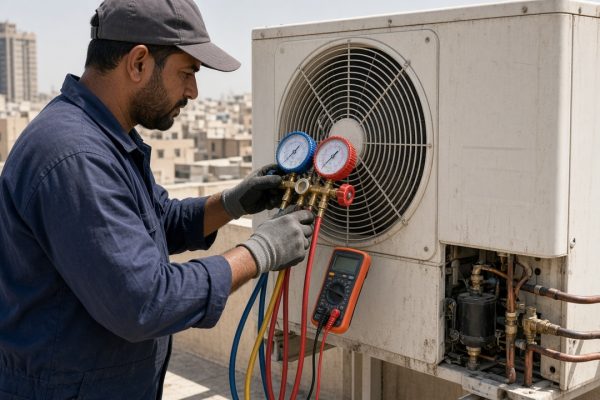
So the order is deliberate. We look for ice or the marks of ice, and we look at airflow, before we call the job a drain. A dirty wheel in Industrial Area dust will freeze a coil that has a normal charge. A flare leaking on a Muwaileh roof will freeze a coil that has a clean wheel. Either one can end as water on an Al Nahda wall if that is where the indoor unit is. The drain is still cleared, because a slow drain makes the melt worse, but the invoice names the freeze as the cause.
How the line is cleared and proved
The wall and the floor under the unit are covered. The casing comes forward enough to see the pan, the spigot, and the first part of the hose. Slime is lifted out, not pushed further down the pipe. The hose is disconnected and flushed from the indoor end toward the ledge, so the dirt leaves outside. A kink is cut out. The hose is refitted with a continuous fall, clipped, and kept off the sharp edge of the ledge. Where the drain joins a shared waste, a real trap is checked. A knot in the soft hose is not that trap, and it is removed.
- See the hose from the pan to the spout, with the unit in its finished position.
- Remove slime at the pan. Do not ram it toward the ledge.
- Cut out a flat section of hose. Air alone will not round it out.
- Put a defeated float switch back in circuit after the drain flows.
- Prove the result with a measured pour, then check for ice if the pour was already fine.
The proof is a measured pour. A known volume, enough to matter and small enough to catch if it misbehaves, goes into the pan. The pan level must not climb, and the same water must arrive at the ledge spout without dripping at the casing. We pour again once the hose is wet. A single splash that “came out somewhere” is not a test. If the water never arrives, the hose is still dammed and we open it again. If it arrives and the coil was frozen, we go back to airflow or to the leak, because the pour has only proved the drain.
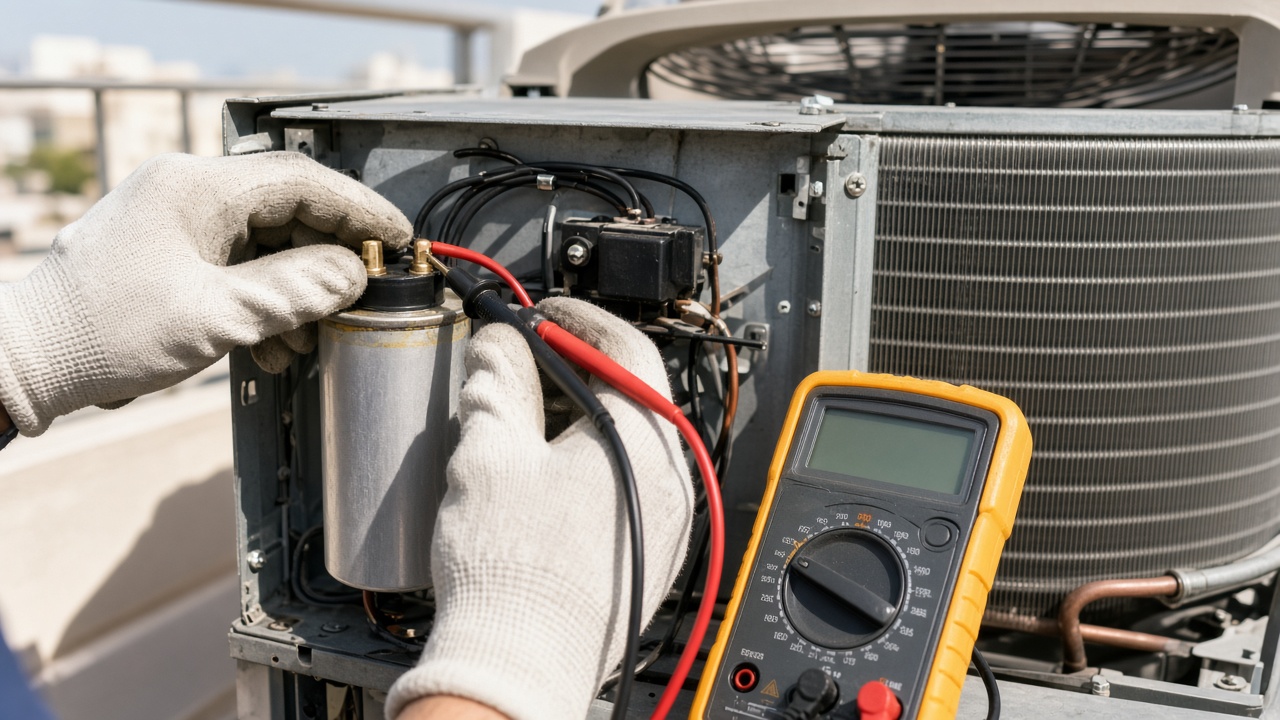
A Gree or O General pan and a Daikin or LG pan use the same gravity. The float, if fitted, is tested by lifting it, with the unit safe to run, to see that the compressor actually stops. That takes a minute and it saves the bypassed wire we otherwise find next summer. Parts, if a new hose, a float, or a section of insulation is required, are priced before they go on. The AC repair in Sharjah visit is this: the line seen, the pour measured, and the freeze separated from the blockage.
Before we arrive
A photo of the stain and a photo of the ledge help us bring hose and clips rather than a gas cylinder. Say whether the unit had ice on the thin pipe, or whether it simply drips while cooling normally. Say if someone has already jumpered a float because the machine kept stopping. Call +971 50 257 5128. The workshop is in Industrial Area 6, opposite the cricket stadium, and the work is in Sharjah only. Aljada and University City follow the same pour test when the stain is the same. The ledge in Al Nahda is just where we see it most, because the door, the gap, and the hose are all fighting for the same few centimetres.
A coil or blower that is only dirty is AC cleaning in Sharjah.
A leak that is confirmed and then repaired is AC gas refill in Sharjah.