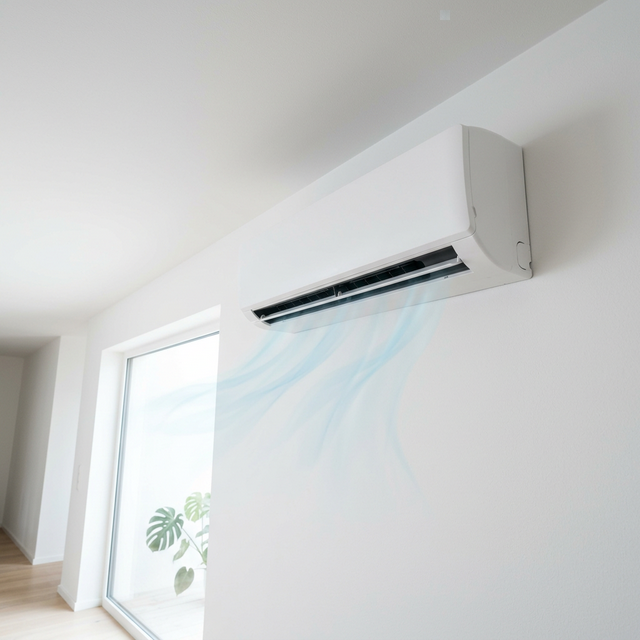
The indoor fan is moving air and the air is warm. From the sofa that is one fault. On the machine it is three different faults, and they are not tested in the order a gas bottle suggests. Either the compressor is not running, or it is running against a coil that cannot move heat, or the refrigerant has actually left. Air-Con.ae, the marketing name of Burj Al Qasimiah AC units fix cont., starts with the compressor and the coils. A cylinder is opened only after those two have been ruled out, and any part is priced on site before it is fitted.
The fan proves less than it seems
On a wall split the indoor blower and the outdoor compressor are not the same motor. The blower can be perfectly healthy while the compressor is stopped. The room still hears a fan, so the call is “the AC is on but warm”. In Al Majaz and Al Nahda that is the most common afternoon complaint, and it is often a run capacitor on a fixed-speed outdoor unit, not an empty system. A capacitor that has drifted low lets the compressor hum, or lets it start and then drop out, while the indoor fan never notices.
An inverter is a different circuit. A Daikin or LG unit may not have a simple run capacitor in the way an O General or Gree fixed-speed unit does. The outdoor fan can run, the compressor can refuse, and the indoor display may show a code that a capacitor swap will not clear. We read the code and the model plate before anyone talks about a board or about gas. Treating every brand as a capacitor job wastes the visit. Ignoring the capacitor on a fixed-speed machine and selling gas wastes it the other way.
Compressor stopped, coil packed, or charge gone
The compressor is not starting
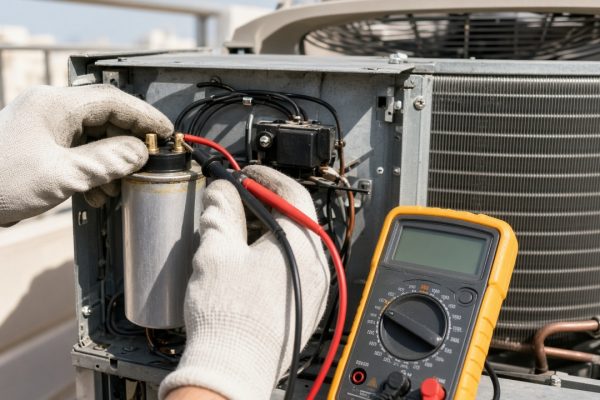
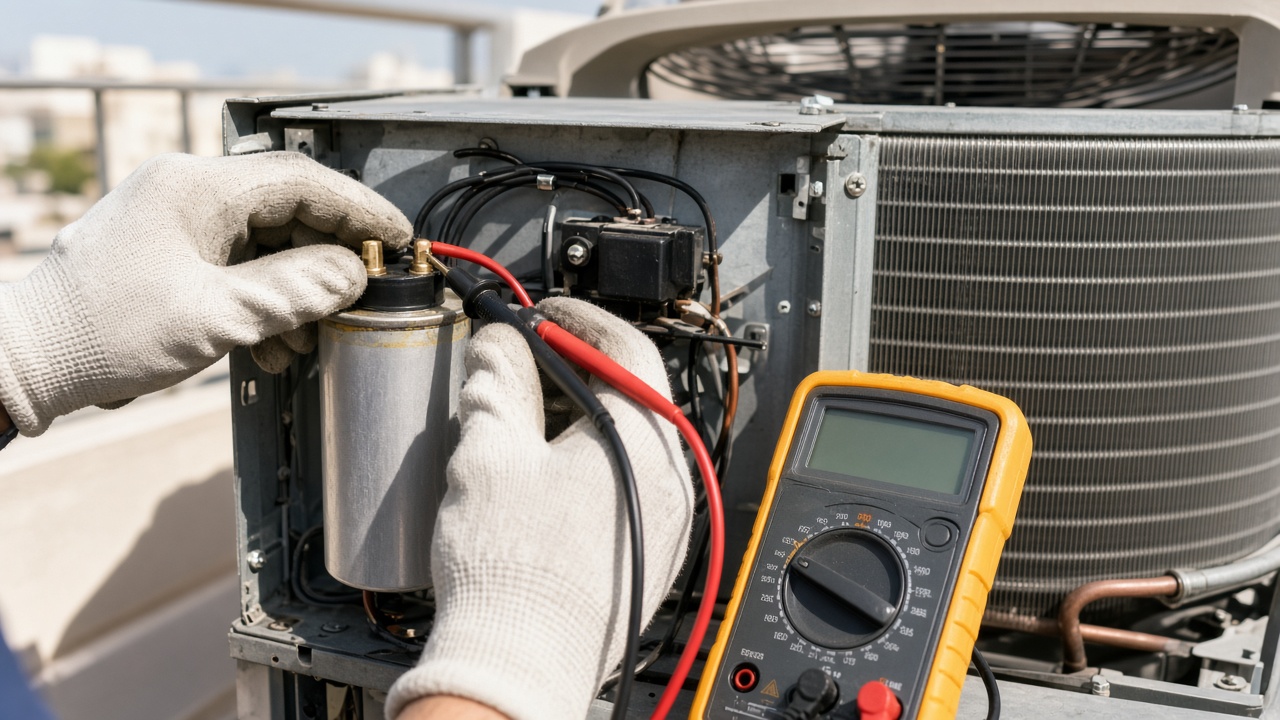
Feel and listen at the outdoor unit, do not guess from the remote. A contactor that is pulled in, a compressor that is hot and silent, and a fan that may or may not be turning: that is electrical until proved otherwise. The capacitor is measured in microfarads against the number printed on its case, with the power isolated and the capacitor discharged. A bulged or split case is finished even if the meter is still close. A reading well below the rating is replaced with the same value, not with a larger one “to make it stronger”. A larger capacitor is not more cooling. It is the wrong part.
If the capacitor is in range, the contactor, the overload, and the supply at the isolator are next. A loose isolator on a Muwaileh roof or a Rolla shop roof drops voltage once the compressor tries to start, and the start fails only when the unit is hot. That is still not a gas fault. Amps that never rise because the compressor never starts are written down so the next step is a winding check, not a top-up.
The compressor runs and the coil cannot reject heat
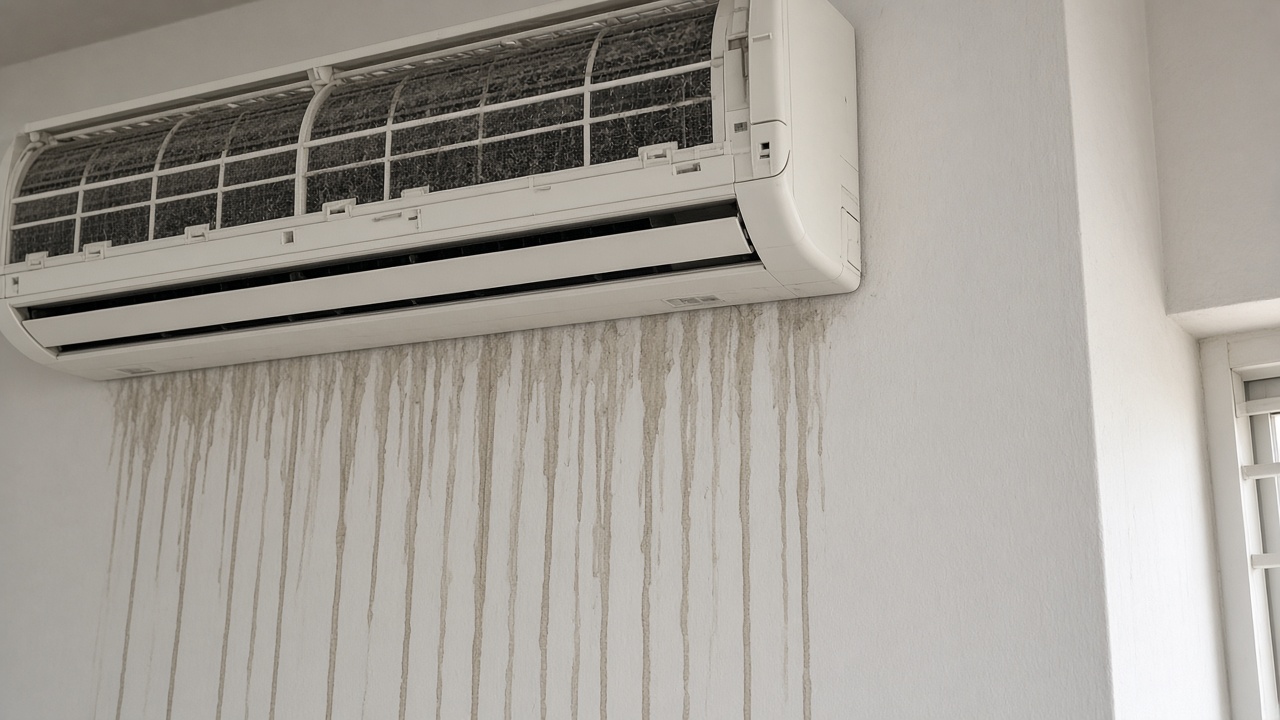
Both fans turning, compressor running, supply air only a degree or two below the room: look at the coils before the gauges. An indoor coil packed with dust, and a blower wheel so loaded that the blades have disappeared, moves too little air. The coil gets cold, sometimes icy, and the air that does come out is weak and not cold enough to hold the room. Industrial Area dust and a summer of closed windows in University City do this without a single gram of refrigerant leaving. An outdoor coil black with fine dust does the matching harm on the high side. Head pressure climbs, capacity falls, and the air goes warm while every motor is still spinning.
Washing the filter and leaving the wheel and the fins is how this call comes back. The wheel has to be seen. The outdoor fins have to pass light. Until they do, the pressures are not evidence of a leak. They are evidence of a dirty heat exchanger.
A real leak, after the other two
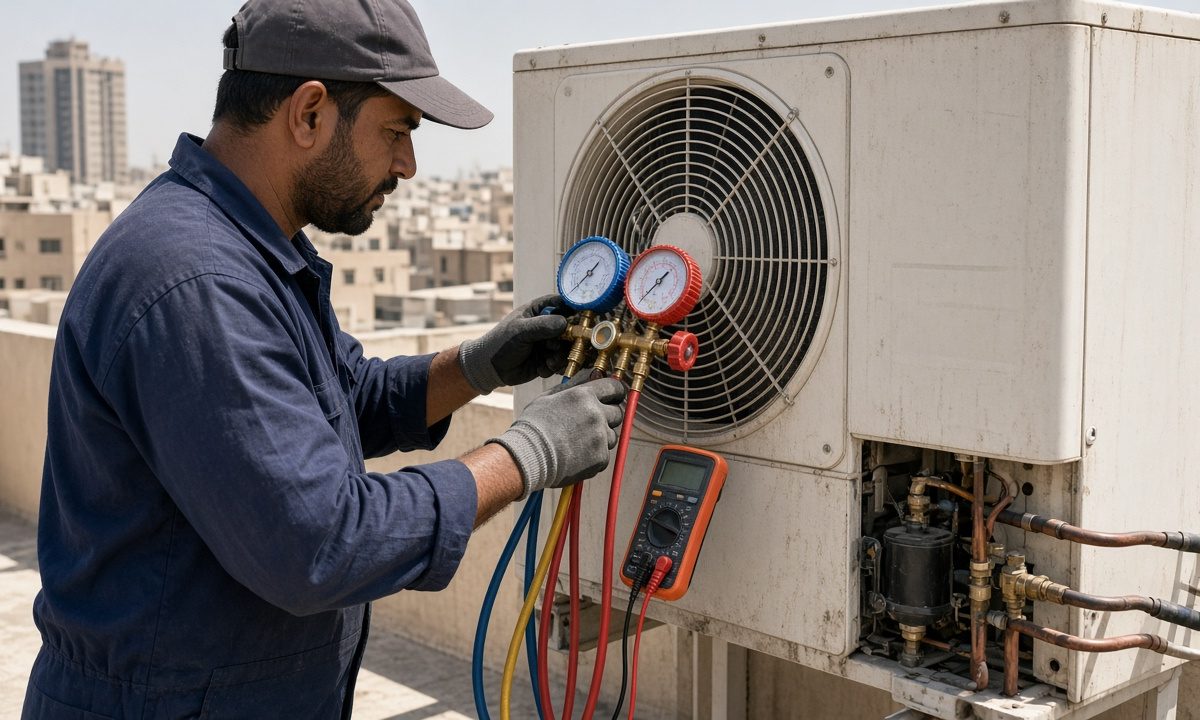
If the compressor is running, the wheel is clean, and both coils are open, then low charge is a fair question. The signs are specific. Suction pressure is low, superheat is high, the thin copper may sweat or ice while the filter is clean, and there is often oil at a flare. Al Nahda indoor flares and Muwaileh roof flares are the joints we soap first. A system that is simply a bit tired does not describe this. A system that lost its charge does. Gas goes in after the joint is repaired and the line is vacuumed, not instead of that repair.
The order we actually use
- Is the compressor running, or only the indoor fan?
- On a fixed-speed unit, measure the capacitor against its printed rating.
- On an inverter, read the fault code before changing parts.
- If the compressor runs, inspect the blower wheel and both coils.
- Only then connect gauges, and only soap-test a leak before adding refrigerant.
Amp draw is taken while the compressor is running and compared with the nameplate, not with a memory of a similar Gree or O General. High amps with a weak capacitor point back to that capacitor. High amps with a good capacitor and a black outdoor coil point to the coil. Low amps, low suction, and a clean coil point to charge. The three readings are how the same warm room becomes three different invoices. Mixing them up is how a clean new capacitor is fitted to a choked wheel, or how gas is added to a system that was only dirty.
What the repair looks like once the fault is known
A capacitor job is short if the value is a common one and the isolator is safe to work at. Power is isolated, the old part is discharged and removed, the new part matches the rating, and the compressor is run until the supply air drops and the amps sit near the nameplate. We do not leave a bulged capacitor in place because it “still starts in the morning”. Morning starts and afternoon failures are the same part, tested at the hot part of the day when we can.
A coil job is a wash, not a chemical poured through a dry filter. The wheel is cleaned so the blades are blades again. The outdoor coil is washed so the dirt leaves the fins rather than being driven deeper. After that, supply air and amps are read again. If they are now normal, the gas was never the subject. If they are still wrong, the gauges come out and the leak search starts. That sequence is the whole point. Cleaning first is not a way to sell a second visit. It is how we avoid charging a system that was only blinded by dust.
A leak repair is the flare or the joint, then a vacuum, then a weighed charge. The price of the capacitor, the clean, or the gas is written before the part or the cylinder is used. Al Qasimia and Aljada flats follow the same order as a villa. The building does not change which test comes first. The AC repair in Sharjah visit is this sequence, finished with a supply temperature, not a bottle opened because the air felt warm.
What to say when you call
Say whether the outdoor unit is silent, humming, or running with the fan. Say whether the air is weak or strong, because weak air is the coil and the wheel more often than the gas. A photo of the outdoor nameplate tells us if we are bringing a capacitor value or an inverter manual. Call +971 50 257 5128. The workshop is in Industrial Area 6, opposite the cricket stadium, and the work is in Sharjah only. If a previous visit added gas and the air is warm again within days, say that too. We start again at the compressor and the coils, not at a second top-up.
A coil or blower that is only dirty is AC cleaning in Sharjah.
A leak that is confirmed and then repaired is AC gas refill in Sharjah.