Choosing commercial AC services in Sharjah is not only about finding a contractor who can make a unit blow cold air. The system must suit the building, control humidity, support daily operations, and remain serviceable when temperatures are high. A poor equipment choice or rushed installation can lead to uneven cooling, rising SEWA bills, water leaks, and avoidable downtime.
This guide explains how to compare system types, what professional installation should include, what an annual maintenance contract should cover, and how to review contractor quotes. It is written for offices, shops, restaurants, warehouses, clinics, and other businesses that need dependable cooling in Sharjah.
What commercial AC service does your Sharjah business need?
Start with the problem, not the equipment brand. A small office with several rooms may need a different solution from a restaurant with cooking heat, a warehouse with large doors, or a retail shop that needs quiet and even cooling throughout the day. The number of occupants, ceiling height, sun exposure, operating hours, equipment heat, and fresh-air needs all affect the right design.
Commercial AC work usually falls into several service categories:
- New installation: Selecting and fitting equipment, pipework, controls, ducts, drains, electrical connections, and outdoor units.
- Replacement: Removing outdated or unreliable equipment and checking whether existing ducts, wiring, and drainage can be reused safely.
- Preventive maintenance: Scheduled inspections and cleaning that help identify faults before they stop business operations.
- Emergency repair: Diagnosing cooling failure, water leaks, electrical faults, unusual noises, sensor faults, or refrigerant problems.
- Cleaning and duct work: Cleaning filters, coils, drain trays, grilles, and accessible duct sections where dust or poor airflow is affecting performance.
- Gas refill: Testing for the cause of low refrigerant before adding refrigerant. A refill alone is not a permanent repair if a leak remains.
Commercial buildings need more planning than most residential jobs. A contractor should ask about floor area, room use, opening hours, existing drawings, power supply, access to roof or plant areas, and the consequences of a shutdown. For local support across these requirements, see Air-Con.ae’s commercial AC services in Sharjah.
Which AC system fits your building?
There is no single best system for every Sharjah business. The right choice depends on cooling zones, available plant space, control requirements, budget, and how much disruption the installation can cause. Ask the contractor to explain the design in plain language and show how the proposed capacity was calculated.
Centralized and package units
Centralized systems can suit larger buildings or sites that need cooling from a shared plant. Package units are commonly considered for larger open areas, warehouses, workshops, and commercial spaces where a packaged outdoor unit can deliver conditioned air through ductwork. These options can provide strong cooling capacity, but they need careful planning for duct routes, access, controls, drainage, and future servicing.
Ask where the outdoor equipment will sit, how technicians will reach filters and coils, and how the design will handle heat around the condenser. A system that fits the cooling load but cannot be safely serviced is not a good long-term choice.
Ducted split systems
Ducted split systems can work well for offices, shops, restaurants, and mid-sized commercial spaces with several rooms or a concealed ceiling. The indoor unit supplies conditioned air through ducts and grilles, helping keep the equipment out of sight. They are often practical when the building has enough ceiling space and the rooms have similar operating schedules.
The design still needs attention. Poorly sized ducts, blocked return air paths, weak insulation, or badly positioned grilles can create hot and cold spots. Ask for access panels at service points and make sure drain lines have suitable falls, cleanouts, and protection against water damage.
VRF and VRV systems
VRF, or variable refrigerant flow, systems use one or more outdoor units to serve multiple indoor units. VRV is a manufacturer-specific term for a similar type of variable refrigerant system. These systems are useful for offices, hotels, mixed-use buildings, and businesses that need separate control across many zones.
Each area can have different cooling needs. A meeting room may be empty for part of the day, while a server or equipment room may need continuous cooling. Zonal control can help match operation to demand, but the installation is more complex. Pipe sizing, branch connections, refrigerant limits, controls, commissioning, and future troubleshooting must be handled by trained technicians.
In Sharjah, ask whether the proposed equipment is suitable for local outdoor temperatures and dusty conditions. Brands such as Carrier, York, SKM, O General, Mitsubishi Electric, Daikin, and Samsung may be considered depending on the project, but the brand name alone does not confirm that a system is right. Compatibility, local support, parts availability, warranty terms, and correct installation matter just as much.
What should professional commercial AC installation include?
A professional installation starts with a site survey. The contractor should inspect the building, measure or verify the cooling requirement, review electrical capacity, identify drainage routes, and confirm where indoor and outdoor units can be installed. For a replacement project, the team should check whether existing pipework and ducts are suitable rather than assuming they can be reused.
Ask for a written scope that covers:
- Equipment model numbers, cooling capacity, quantity, and control method.
- Indoor and outdoor unit locations, mounting details, and service access.
- Refrigerant pipe sizes, insulation, supports, joints, and maximum permitted lengths.
- Duct design, insulation, grilles, diffusers, return air paths, and access panels.
- Condensate drainage, traps where required, pump arrangements, and leak protection.
- Electrical isolators, control wiring, protection, earthing, and connection responsibilities.
- Testing, vacuuming, pressure checks, refrigerant charging, airflow checks, and commissioning.
- Removal of old equipment, disposal responsibilities, making good, and cleaning after the work.
Humidity deserves specific attention. AC does not only remove sensible heat, which is the heat that raises the measured temperature. It also needs to remove latent heat, which is moisture in the air. The Sensible Heat Ratio, or SHR, describes the balance between those two cooling duties. A system chosen only from a basic temperature estimate may cool the room while leaving it damp or uncomfortable.
Ask the contractor how the design addresses humidity, fresh air, occupancy, and door opening. Equipment selected for local conditions may also need a tropicalized design, meaning it is built or rated to operate reliably in high outdoor temperatures. The contractor should verify the manufacturer’s operating limits rather than make a general claim.
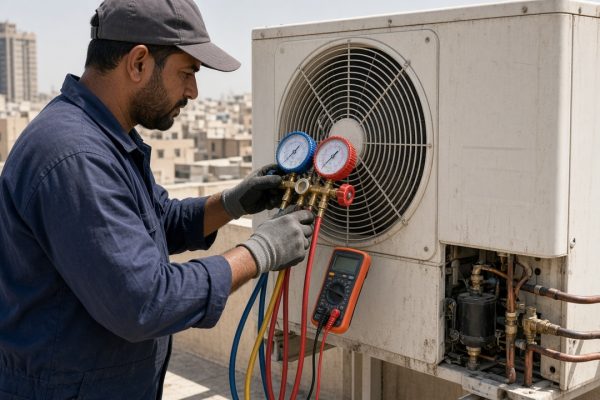
Commissioning should not be treated as a quick start-up. Request test readings and handover information, including operating pressures where appropriate, temperature readings, airflow checks, control settings, and confirmation that drains are flowing correctly. Keep equipment manuals, warranty documents, model numbers, and commissioning records in one place for future repairs.
What belongs in a commercial AC maintenance contract?
A commercial AC maintenance contract, often called an AMC, should describe the work and response process clearly. “Regular servicing” is too vague. The agreement should state how often each system will be inspected, which parts are included, what counts as an emergency, whether consumables and replacement parts are extra, and how reports will be delivered.
A useful maintenance visit may include:
- Cleaning or checking filters, coils, grilles, diffusers, and accessible duct sections.
- Inspecting condensate trays, drain lines, pumps, insulation, and signs of water damage.
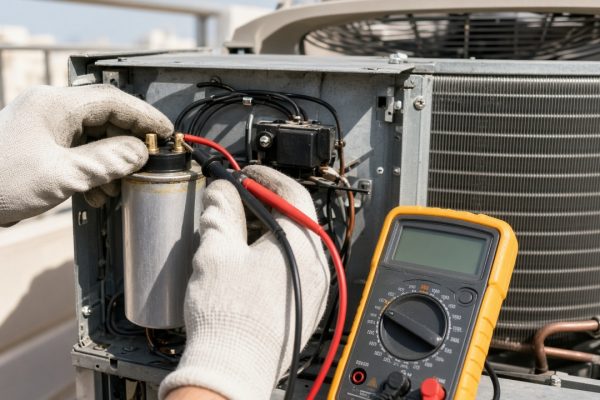
- Checking electrical terminals, contactors, capacitors, isolators, controls, and visible wiring.
- Reviewing refrigerant condition and looking for signs of leaks before recommending a refill.
- Checking fans, belts where fitted, bearings, vibration, airflow, and abnormal noise.
- Testing thermostats, sensors, timers, zone controls, and building management connections where applicable.
- Recording faults, parts that may fail soon, test readings, cleaning completed, and next actions.
Maintenance frequency depends on the building. A clean office with moderate occupancy may not need the same schedule as a restaurant, workshop, retail outlet, or dusty warehouse. Heavy use and poor indoor air quality can increase the need for filter and coil cleaning. Ask the contractor to base the schedule on operating conditions rather than offering the same visit pattern to every customer.
Good records help facility managers make better decisions. If a unit repeatedly loses gas, trips a breaker, or develops a blocked drain, the report should show the pattern. Repeated temporary fixes can cost more than finding the underlying fault. A maintenance contract should help you plan repairs, not only respond after a failure.
Repair warning signs and downtime planning
Call for an inspection when cooling becomes uneven, electricity use rises without a clear reason, a unit runs constantly, or indoor humidity feels higher than usual. Water near a ceiling cassette, drain pipe, or indoor unit should also be investigated quickly. Other warning signs include burning smells, repeated breaker trips, refrigerant oil marks, loud vibration, ice on pipework, and controls that do not respond.
Some faults are unsafe to ignore. Switch off equipment and seek qualified help if there is smoke, a burning smell, exposed wiring, repeated electrical tripping, or water reaching electrical components. Do not open electrical panels or handle refrigerant without the right training and equipment. Refrigerant work, electrical repairs, and roof or plant-room access should be assigned to qualified professionals.
Businesses should also plan for downtime before an emergency happens. Keep a list of critical rooms, opening hours, equipment locations, isolator points, and contacts for building management. Identify areas that cannot lose cooling, such as server rooms, food storage areas, medical spaces, or production zones. Ask your contractor how urgent calls are prioritized and what information they need to send a technician quickly.
Air-Con.ae states that it provides 24/7 availability, a 30-minute response time, transparent pricing, licensed technicians, and a 90-day service warranty. Confirm which of these terms apply to your specific commercial job, including the service area, warranty exclusions, parts coverage, and response definition. Air-Con.ae also says it has served Sharjah since 2005 and supports areas across Sharjah and nearby Northern Emirates.
How to compare commercial AC quotes in Sharjah
The cheapest quote may not be the lowest-cost option after installation. A low price can leave out controls, access panels, proper insulation, drain protection, commissioning, or safe electrical work. Compare quotes line by line so you can see what is included and what may become a variation later.
Use this checklist when reviewing a commercial HVAC contractor in Sharjah:
- Scope: Does the quote describe survey work, equipment, installation, testing, cleaning, removal, and handover?
- Capacity: Are the proposed capacities and quantities supported by a site assessment?
- Equipment: Are full model numbers, operating limits, warranty terms, and expected lead times shown?
- Installation quality: Are pipe insulation, supports, duct access, drains, electrical work, and controls included?
- Commissioning: Will you receive test readings, operating instructions, and maintenance recommendations?
- Maintenance: Does an AMC list visit frequency, included tasks, response terms, exclusions, and reporting?
- Price: Are VAT, access equipment, night work, civil repairs, parts, and disposal included or excluded?
- Warranty: Is the warranty for labour, parts, equipment, or only selected repairs?
Before appointing a contractor, ask for proof of relevant experience, technician qualifications, insurance where applicable, and the process for handling refrigerant and electrical work. You can also ask how the company documents completed visits and escalates repeated faults. A clear answer is more useful than a broad promise.
For a local assessment, compare the scope offered for commercial AC installation and maintenance in Sharjah against your building’s actual needs. Give the contractor floor plans if available, photos of existing units, recent fault details, operating hours, and any known access restrictions. Better information usually leads to a more accurate quote.
Safety, indoor air quality, and practical next steps
Indoor air quality, or IAQ, covers conditions such as dust, moisture, ventilation, odours, and airborne contaminants. AC cleaning can help when dirty filters, coils, drain trays, or grilles are affecting the space, but cleaning is not a substitute for correct ventilation or a building-wide IAQ assessment. If staff or visitors report persistent odours, dampness, irritation, or visible mould, arrange a proper inspection.
Do not assume that an online service description confirms a legal or municipal requirement. Sharjah businesses should verify current requirements with the relevant official authority, building management, and a qualified contractor. The same caution applies to electrical changes, refrigerant handling, fire safety, roof access, and work permits. Requirements can depend on the building and type of business.
A sensible buying process is straightforward:
- List the rooms, operating hours, occupancy, equipment heat, and areas that need separate control.
- Record current problems, including leaks, noise, poor airflow, high SEWA bills, and repeated breakdowns.
- Arrange a site survey instead of accepting a capacity estimate based only on floor area.
- Compare at least the full scope, equipment, commissioning, warranty, response terms, and AMC details.
- Keep all model numbers, readings, manuals, warranties, and service reports after the work is complete.
The right commercial AC decision is not simply the system with the lowest quote. It is the system that fits the building, controls heat and humidity, can be serviced safely, and has a clear plan for keeping your business running.